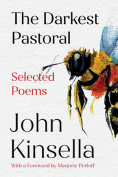

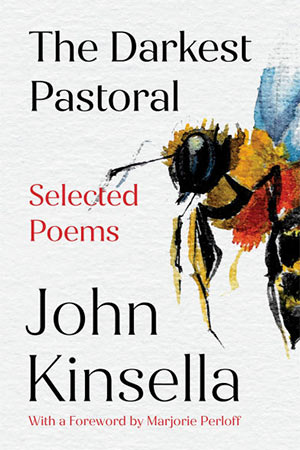
W. W. Norton. 2025. 272 pages.
The Darkest Pastoral, John Kinsella’s most recent book of poetry, is a generous selection of poems dating from his earliest published book in 1983 to the present. In it we find the best of Kinsella: his lyricism, his intelligence, his erudition, his tragic sense, his humor, his imagistic resonance. I mean poems like “Night Parrots,” “Sacred Kingfisher and Trough,” and “Kangaroos in Torchlight,” poems in which Kinsella creates what Bly would call “deep images” and then speaks through them, achieving profound poetic resonance. We also find a few poems that might best have been culled from the final lineup, such as “Bushfire Sun” and “Travelling Eye,” which are basically just typological games that fail to reach any version of the poetic that this reader can appreciate. These, however, are few.
Much has been made of Kinsella’s environmental concerns, and indeed he has them, with a touch of misanthropy, which comes out as pointed asides (e.g., “You see, where people settle, imbalance follows”). To call his work “environmentalist” is a reductive assessment of the concerns of his poems, one that is easy to repeat and safe to assert in our times, but his work is also focused on interpersonal relationships, existential problems, language play, humor, and linguistic experimentation. Furthermore, poems that might at first glance seem “environmental” because of natural landscape imagery are often using that imagery as objective correlative for abstract philosophical inquiry. In other words, these are various poems.
When Kinsella is relying on the resonance of his imagery, he is at his best; however, he also has a tendency to use abstract and conceptual language, often in his later poems, at the expense of the imagery, which vitiates the poem’s power, making it more of a cerebral experience than a full-bodied poetic one. Some examples will illustrate this. Take, for example, the previously mentioned poem, “Night Parrots,” which I will quote in its entirety since it is short: “If at all, then fringe dwellers of the center. / Ghosts of sapphire, navigators / of the star-clustered tussocks. / Of salty marsh, limestone niches, and acrid airs. // If at all, then flitting obscurely / the rims of water tanks, the outlands / of spotlights and filaments of powerlines . . . / in brief nocturnal flight, with long / drawn out mournful whistle. // If at all, then moths in a paper lantern.” Here we have a sequence of concrete imagery that in aggregate creates an atmospheric “spirit of place,” as Lawrence would say. The reader enters the field of language and enters a specific setting, a vision, one that speaks of elusiveness, mystery, and solitude without mentioning these things. The vision does not reduce or summarize through conceptual language, which is almost always summary language (i.e., after experience).
Compare the language of “Night Parrots” to the following passage, which is picked almost randomly from the later poems: “In the stench of body decay, the stench / of explosives, the stench of testosterone mirroring megalomania, / the human condition mutates. Even on feast days, someone / is out of kilter, someone is on a different timetable. / Bomb first, party later. And so held is all dominion.” This language, if not rant, is at least the mostly imageless, conceptual, abstract language of expository prose, not “what every language hopes to become,” as Brodsky once defined poetry. It is the language of direct assertion and commentary, mostly arhythmic but for the rhythm of grammar. It seems to have palpable designs upon the reader in its lapel-grabbing certainty of opinion.
To complain about an artist’s style, especially toward the end of his career when the style is determined by a lifetime of development into the authentically individuated phenomenon that it is, is probably pointless. Still, one is allowed to have one’s preferences, even within the oeuvre of the same poet, and one is permitted to wish that the poet restore some of his best qualities, qualities that place him as one of the leading, living English-language poets.
Fred Dings
University of South Carolina