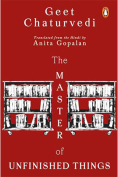

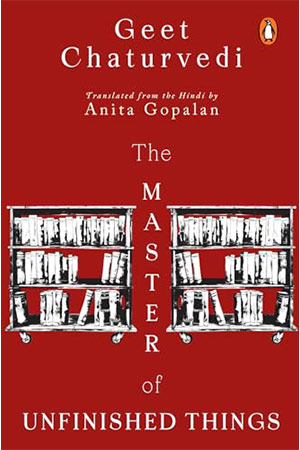
Penguin Books. 2025. 208 pages.
“The concept of apurnata (incompleteness) cannot be understood without recognizing the significance of ‘a.’ . . . In Hindi (as also in many other languages), ‘a’ is used as a prefix to give a word the opposite meaning. For example, purna (complete) becomes a+purna (not complete).” Occurring in the eponymous essay, the concluding piece in renowned Hindi writer Geet Chaturvedi’s riveting collection of lalit nibandhs (lyrical essays), reviews, reflections, and aphorisms, The Master of Unfinished Things—translated wonderfully by Anita Gopalan—this quote captures the spirit of the writer’s attempt to capture the ephemeral and the fleeting. Chaturvedi’s collection reminds me of a resonant passage from the anthropologist Kathleen Stewart’s book Ordinary Affects (2007). Ordinary life, Stewart writes, “draws its charge from rhythms of flow and arrest.” It is composed of “fragments of experience that pull at awareness but rarely come into full frame.” The play of “a” between and betwixt purna and apurna is a comparable effort to represent the rhythms of flow and arrest, those fragments of experience that pull at awareness but rarely come into full frame.
Notice the reverberations between purna and apurna, flow and arrest, the pulling at awareness and the half-light of the fleeting moment in the memorable closure to the series of vignettes about memory titled “Some Sorrows Bring a Gentle Smile to the Face”:
We have a habit of turning off the lights when we leave a room. In that moment, it feels as if the room holds nothing but darkness. Yet, within that space, a glove, a sock, a broken pen or a snippet of music each holds its own light—a light that has the power to illuminate the room anew.
I once came across an old proverb: Though our pupils are dark, every time we search, we seek out the light.
Chaturvedi’s impressionistic reviews of films, of books, and musings on the influence of his literary predecessors are an attempt to seek out the light, to arrest a flash that illuminates the room anew. Thus, the Vietnamese filmmaker Tran Anh Hung’s Cyclo, a film Chaturvedi has seen many times, is like a desolate place: “You can’t visit them once and leave; you find yourself returning again and again. You won’t build a home there, but then you don’t always stay at home either. There is a space beyond your home that you visit as often as your own.”
Sometimes this shuttle between purna and apurna, flow and arrest, poignantly reveals such “grim truths” as Chaturvedi’s reading of Iranian working-class poet Sabeer Haka’s “Mulberries”: “A fruit like mulberry falling from a tree is too trivial an incident and the death of a worker plummeting from a building is just as trivial to some—this realization alone confronts us with a grim truth.” Beyond grim truths, though, attention to trivial forms, like the nondescript karvi flower in the lalit nibandh with the same name shows that close attention to fragments of experience are rife with potentiality—they can both be and not be.
To attend to their unfolding, just like Chaturvedi does with the karvi, which seems otherwise story-less and history-less, necessitates immersion, attention, and attunement to how they pull at our awareness. By itself, a single karvi doesn’t attract attention, but every seven years they bloom together, draping the Sahayadri Mountains in Maharashtra in “a blue veil.” Tracing the karvi’s ephemeral existence, its life cycle, and its absence in the long floral tradition of Indic poetics, Chaturvedi’s lalit nibandh blooms in a flowery crescendo: “It won’t blossom for seven years, but when it does, for many square miles, it’s nothing but karvi. All other plants hide in embarrassment, their colours overshadowed by the karvi’s blues and deep purples.”
Chaturvedi takes us through the karvi’s process of slow becoming, its relative invisibility and apurnata for seven years, culminating in the slow shedding of the “a” as the flowers become purna in an ecstatic efflorescence. That efflorescence is the function of such lyrical writing, memorably signposted in one of the epigraphs to the book by the Urdu poet Mirza Ghalib: “For me, / Expressing through language / Is opening a vast door to victory— / The door of the holy Kaaba. / The scraping of my pen on paper / Is the sound of the panel opening.” The Master of Unfinished Things opens many such panels and portals to that which appears fleetingly without coming into full frame.
Amit R. Baishya
University of Oklahoma