
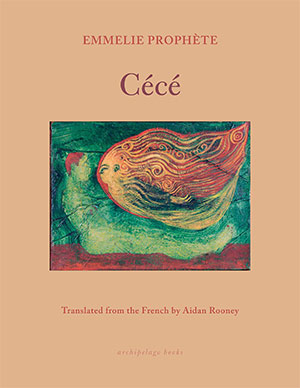
Archipelago. 2025. 224 pages.
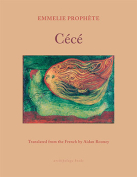
In Emmelie Prophète’s newly translated novel, Cécé, the residents of the Cité of Divine Power neighborhood in Port-au-Prince are all trying to escape. For some, this means emigration to the United States, “that wonderful country.” For Cécé’s uncle Fredo, “an emaciated body wrecked by drink,” this means alcohol. Others forget the slum by losing themselves in doomed passions, drugs, or religion.
Cécé’s escape of choice is social media. In her real life, she is Célia, twenty years old, by her own description “five foot one and not very pretty,” an occasional prostitute whose mother, a drug addict, died when she was two and whose grandmother has recently died. Online, though, she is Cécé la Flamme, whose constantly updated photos on Facebook get her thousands of friends, likes, and followers. “I mostly posted pictures of my feet,” Cécé remarks in the book’s first chapter, “food I bought at Morel’s, the gullies in the Cité, dead bodies I came across on the street.”
Cécé’s large audience attracts the attention of people outside her neighborhood—journalists, marketers, and leaders of the various gangs who control the slum—and leads to profitable or frightening encounters. Her progress to influencer status is the central story of the book, but Cécé’s plot is loose and episodic. The novel is mainly a tour through a Port-au-Prince slum and a poetic portrait of its residents. We meet Livio, for example, whose “head was forever mussed from all the heavy containers of water he carried,” and Patience, the beautiful girlfriend of a gang leader who reads all of Cécé’s Facebook posts to make sure she says only good things about the boss. And we get a picture of life in the Cité, where “bony dogs” often have infected wounds because “everyone let the stray dogs have it, for pleasure, out of habit, for something to do; throwing stones at them was a reflex shared by children and adults alike.”
Some of these descriptions are vivid and memorable, and between the novel’s dramatic setting and its underdog narrator, Cécé can’t help but be an engaging book. It is also a frustrating one, since Prophète declines opportunities to make her novel more compelling. Cécé, observant, cool-headed, and precociously tough, is a promising character, but she never develops. Her tone remains equally flat and disaffected throughout the book, and we never get a glimpse of the vivid personality that got her all those followers and likes. Prophète doesn’t do much with the novel’s strong premise: Cécé’s ventures outside her corner of the slum don’t change her life meaningfully or, really, amount to a plot. Instead, the novel is a series of vignettes, all of which circle back to the basic hopelessness of life in the slum.
In one of the most moving episodes of the book, Cécé recalls how Fredo, a talented athlete when he was young, went to the United States to compete in the Olympics and took the opportunity to stay there and work. When he finally returns, deported, twelve years later, he is almost unrecognizable, a “shadow.” His bittersweet reunion with his mother is affecting.
The shadow stayed for several minutes and said nothing. She finally caved in and looked up. The shadow was a very thin man in crumpled clothes, with a large afro, a full beard that was too long, worn out shoes, and a battered fuchsia suitcase, who was looking at her tenderly. Grand Ma let out cries that sounded like yelps.
Unfortunately, Prophète rarely allows this much tension into her stories, instead depicting her characters in a condition of stasis. This limits the effectiveness of what has the makings of a powerful book. The Cité’s gang leaders, with names like Fanfan le Sauvage, Dread Bob, and Cannibal 2.0, are eccentric and sinister figures (and sad and ridiculous ones as well, as described by the perpetually unimpressed Cécé). Prophète writes well when she lets Cécé observe the ordinary details of her life. Of her first client, Cécé observes:
He floated a little in his white briefs that had seen their share of washings. He must have had a mother or wife obsessed with scrubbing clothes, especially whites, like my grandmother was. She was capable of soaking old undershirts and socks for several days in a basin of bleach-water and still not being satisfied with the result.
Too often, though, her heroine lapses into morose philosophizing: “It rained, and we were bogged down in our lives. There was mud on our feet, our clothes, our hands. Maybe our souls too.” Despite its flaws, however, Cécé is worth reading, both for its moments of excitement and its compassionate portrayal of a setting otherwise largely ignored by contemporary literature and off-limits to outsiders, except in the form of lurid news stories.
Aaron Labaree
Brooklyn