
Printim. 2025. 127 pages.
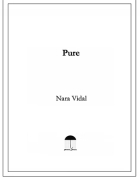
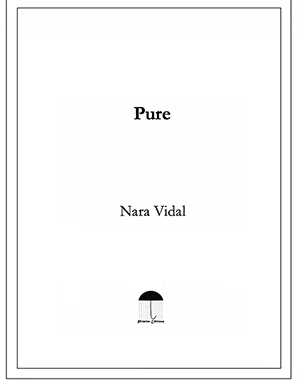
Nara Vidal’s third novel and first English translation, Pure, is a grim read. Set in the 1930s in the invented Brazilian city of Santa Graça, it opens in a prelude with excerpts from the Dum Diversas and the nation’s 1934 Constitution, texts with nearly half a millennium of history between them, yet both declaring a eugenics commission to go forth and conquer those of other (impliedly lesser) races, subjugating them to papal (impliedly righteous) authority. This dictate is central for the cast of Pure, who continually contend with their race and the idea of purity.
Pure is a novel written like a three-act play. Act 1, “Ícaro Crosses the Ocean,” sets up Santa Graça’s class and racial disparities—those who are white are served by or asked for charity from those who are Black or mixed. Two white boys and neighbors, Lázaro and Ícaro, live parallel lives. Lázaro, an orphan who mutilates creatures and boasts of his ethnic superiority, fully embodies the bigotry taught to him. Conversely, Ícaro, a disabled teenager whose father is a eugenics pamphlet distributor and whose mother and grandmother promulgate such ideology, experiences mistreatment due to his health conditions: an outcast despite his race.
Connecting these families is Iris, a maid and the central Black character—her internal thoughts are the most interesting and complex of the cast. Lázaro taunts her for her race and station while Ícaro seeks out her protection and affection. Iris’s positionality as a Black woman in a town at the forefront of the eugenics movement, as a bereaved mother serving as a maternal figure, and as a sincerely religious person confessing to an immoral pastor, all the while enduring derogation by the very same people who employ her and attend her church, make Iris’s portions deeply compelling.
A mystery that persists throughout the story is the disappearance of a band of Black boys who are often found on the streets of Santa Graça. Growing concern over their vanishing is the catalyst for the discovery of more than just the answer to their whereabouts. Acts 2, “Delfina Bittencourt,” and 3, “Gregório without Skin,” contain revelations about characters’ histories and relationships, and as their agendas are unraveled, the ghosts in their literal and figurative attics are revealed. The past haunts relentlessly.
Brazil in Pure is in a state of political upheaval; the eugenics movement codified in the constitution during the tenure of a highly controversial leader after an era of café com leite (coffee with milk) politics makes for a nation necessarily ripe with strife. This novel does not tread lightly in discussing opposing attitudes on the matter of race. Spoken and unspoken hateful tirades, motives of genuine malice, and acts of brutal violence are depicted in full color. In this way, the novel is playlike not only in its form but in its identification of characters and their thoughts and actions. It tells instead of shows, demonstrating constant odds between the interior feelings and exterior behaviors of its ensemble. Love on display, hatred stored within.
Each character is a sepulcher, masking a decaying corpse with an artificially pure-white painted tomb. They conceal their impure thoughts with performances of purity. Spotlessness is conflated with holiness. The reader can see the truth without filter—under the façades of holy pastor, good doctor, and benevolent caretaker are the darkest sins of the spirt and the flesh.
With religion as a central aspect of social and cultural life in Santa Graça, this discord between the internal and the external calls into question characters’ actual convictions. When transgressions come to the surface, there’s a choice to repent or to cover, but the conspiring characters of Pure aren’t prepared to give up the fruits of their labor. Vidal presents their insincerity plainly, providing ample evidence of lives led by a fearful and hateful obsession with eradicating the entirety of the Black and sick in Brazil. Characters with any real claim to goodness are those who sense that something is wrong with the way things are and are becoming—they want out. And out they get. Whether this is a mercy or a damnation is a question for the reader to consider.
What is true purity? Is it in the color of the heart, the intentions that drive actions, or is it measured by the disparity between what’s presented and what lies underneath? Vidal cautions readers to take care not to paint over one’s roots with white, because like blackness cannot be washed out of one’s skin, darkness doesn’t easily wash out of the soul.
Pure incites an imperative and timely discussion and examination into the covert and overt ways that labels and division cut humanity out of humans, and forces readers to sit in the devastating aftermath of persecution that prevails, long after its last word.
Eva Hu
Boston