
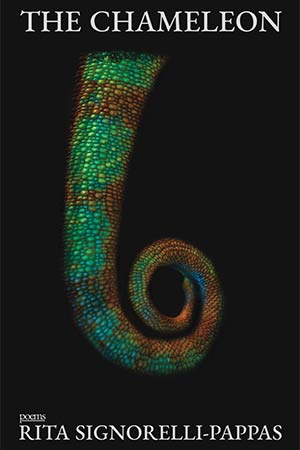
Serving House Books. 2025. 72 pages.
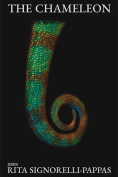
To read The Chameleon, by Rita Signorelli-Pappas, is to flip through a book of postcards from around the world and throughout time. It is a yearbook of characters where each poem is a portrait of someone new, or perhaps like opening a new window to an advent calendar each day. Though each poem, on the surface, seems to leap from character to character, there are thematic notes that ring throughout the collection and tie everything together: images of sunflowers, ghosts, insects, mirrors. Themes of transformation, identity, and madness, especially in the portraits of women.
The collection is bookended in examples of profound change, from the title poem, “The Chameleon,” to the final, anthemic “Self-portrait.” Throughout the book, we see creatures of transformation, like the chameleon and cicadas, that go through obvious bodily transitions. From the cast of female characters, I see several who are transformative themselves but also those who are deeply changed (for better or worse) through their proximity to and engagement with men: Philippa Chaucer, Ophelia, Eve, Lot’s wife. In “Asylum Journal: The Internment of Camille Claudel,” we are taken into a behind-the-scenes look at the unravelling of a brilliant artist. In the final stanza, the speaker, Camille Claudel, says directly to her former teacher and lover, Rodin, “This is the nightmare: my vision / caged and abandoned / like a mad dove / that wept and sang once / in the wilderness of your hands.”
I am haunted by several of the poems in The Chameleon. They linger in the folds of my mind, and the repeated themes and images create that haunting in the same way that a pantoum or villanelle would in the space of a single poem. In “The House Ghosts Speak,” the speaker asks, “What do the invisible know?” Many of the female characters in this poetic journey can be thought of as invisible in some way—always second fiddle to the leading man. “How to live inside the pause / between breathing in / and breathing out,” the speaker continues, “How to live / in an utterly white world . . . They are humble / as they go roaming through / the lightning and the thunder. Transformed, they do not look back.”
Sarah Rebecca Warren
Denver