
Little, Brown and Company. 2025. 192 pages.
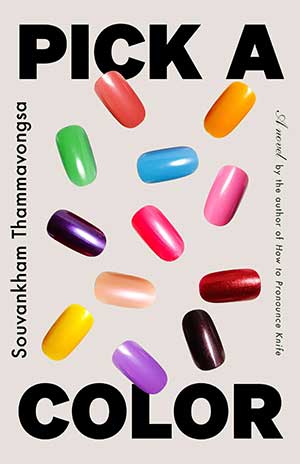
Souvankham Thammavongsa published her first book of poetry in Canada more than twenty years ago and has been winning literary awards ever since, which has included a few more poetry collections and her first book of short stories, How to Pronounce Knife (2020). She writes about Laotian immigrants, invisibility, and belonging. Now her debut novel, Pick a Color, continues with this theme of invisibility in the everyday setting of a nail salon.
Ning is the forty-two-year-old owner of a nail salon and happy to be her own boss. In her younger days, she was a boxer and a tough one at that. But boxers don’t have great longevity, and after she was no longer agile, she tried her hand at several odd jobs before her coach introduced her to a nail salon owner. Ning worked in this salon for a dozen years before starting her own. As she narrates in the beginning of the story, “I live in a world of Susans. I got name tags for everyone who works at this nail salon, and on every one is printed the name ‘Susan.’ So many girls come and go. I don’t want to bother getting new name tags each time. Besides, you know, it’s never difficult to pronounce a name like Susan.”
Several instances of invisibility float through the story, starting with these name tags. It’s one thing for Ning to purchase all the same name tags so she doesn’t have to spend extra money when a new employee starts at the salon, but Ning is all too aware of something else: the clients who frequent the salon never pay enough attention to see that all the employees have the same name, at least according to their name tags.
Ning and the other Susans—Noi, Nok, Mai, and Annie—are used to listening to their clients’ innermost concerns and secrets, often confidential information these clients wouldn’t dare to share even with their best friends. And although these clients feel comfortable revealing these intimacies, they never bother to get to know the women who make them pretty, including something as basic as their names.
There’s also the issue of language, which ties into the title of the book. When clients arrive at the salon, one of the first questions they’re asked is to pick a color of nail polish. “Pick a color” is easy to understand, yet without even trying the clients decide they cannot understand this simple statement and ask their Susan to repeat it. This inability of the clients to understand someone with an accent becomes a running joke among the Susans, but it’s another form of invisibility.
For Ning, the part of her that remains most invisible is a missing finger on one of her hands. As she works on her clients’ hands—sitting face-to-face with them—she wonders why no one has ever asked her about this missing finger. Here she is massaging and scraping and polishing her clients’ fingers with her own hands, but not even one has bothered to see that she is missing a finger. It’s an irony that baffles her, and it’s this recognition that Ning hopes and waits for day after day.
Thammavongsa’s writing is concise and befitting a complex character like Ning, and it wouldn’t surprise readers to learn that her background is in poetry. And even though Pick a Color is short, it’s replete with memorable characters that bring visibility to nail salons and their mainly female staff.
Susan Blumberg-Kason
Hinsdale, Illinois