
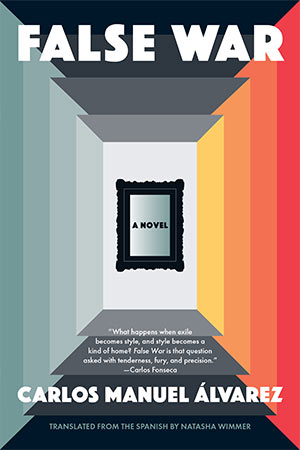
Graywolf Press. 2025. 272 pages.
This is not so much a review of Falsa guerra by Cuban author Carlos Manuel Álvarez as it is of False War, the English translation created by Natasha Wimmer, one of the most visible translators of Latin American fiction working today. Reviewing a translation is not the same as reviewing the original; it means evaluating a distinct work that occupies the uneasy space between fidelity and invention. Wimmer’s False War exemplifies the risks of that space: fluent, precise, and readable, yet stripped of much of the texture, rhythm, and linguistic tension that animate Álvarez’s Spanish.
Widely considered the preeminent interpreter of Latin American prose in English, Wimmer is celebrated for her translations of Roberto Bolaño, which have come to define a globalized idiom of contemporary Spanish fiction. That export-ready idiom has its place, but it should not be a one-size-fits-all template. In a 2008 Village Voice interview, Wimmer acknowledged that “the translator’s inclination is to smooth things over and make passages read seamlessly, so it’s a counterintuitive process.” False War reveals the danger of that instinct: in striving for seamlessness, the translation loses the friction that gives Álvarez’s prose its force.
Álvarez’s Falsa guerra is a hybrid of chronicle and travelogue, written in the clipped, propulsive prose of the Latin American crónica. His sentences accumulate like camera cuts: declarative, at times paratactic, unadorned, rhythmic. They register disillusionment through tempo. In Spanish, the novel feels oral, restless, reported. In English, it feels written. The difference is subtle but crucial.
Consider the opening sentence: “El ruido de los aviones . . . del Distrito Federal. No podía seguir en la ciudad,” which Wimmer renders as “The sound of airplanes . . . over Mexico City. I couldn’t hang around.” In the Spanish, “Distrito Federal” is historically precise. “Distrito Federal” isn’t merely a place; it’s a political category. Translating it as “Mexico City” flattens that resonance. The reader no longer hears the residue of a political term; they hear a travel guide. And “hang around” replaces the gravity of seguir—to remain, endure—with a line fit for small talk. It’s the first sign of a broader tendency: to make Álvarez’s world comfortable for English ears.
One of the recurring figures in the novel’s cast, el Fanático, undergoes the same smoothing. In Spanish, fanático evokes zeal—religious, ideological, or other. The definite article and capitalization create an archetype who personifies the zeal and exhaustion of a generation that can’t quite stop worshiping what it knows is dead. Wimmer renders him “Fanboy.” The alignment of fanático with “fanboy” is tenuous at best; the registers and connotations diverge. Álvarez, who imports English when wanted, could easily have used “fanboy” (or fanboi). Fanático designates a believer; “fanboy” narrows it to pop-culture fandom.
Nowhere does this semantic displacement feel more gratuitous than in the line “Teikitisi, Fanboy, I said to myself.” In Spanish, teikitisi—a phonetic rendering of “take it easy”—is a small masterpiece of bilingual play: a Cuban phrase made of English, a sound of hybridity that carries humor and class. Left unchanged in English, it becomes gibberish; paired with “Fanboy,” it collapses into self-parody. Wimmer does the same with madafakas and foquin: in Spanish they enact the same bilingual sleight of hand; carried over verbatim into English, however, they read as stagey affect, not lived code-switching. Anyone who has read my work knows I’m a fan—you might even say a fanboy—of foreignization, but this isn’t that. The original shows a speaker navigating two linguistic worlds; the translation shows a narrator pretending to speak foreign.
The pattern is consistent. Wimmer leaves traces of Spanish—mierda, loco, nada, and hybrid phrases like dame un breik—but the texture of Cuban Spanish, its rhythm and politics, disappears. The result is a bilingual mirage. The translation looks multicultural but reads monolingual, as if English were stretching to impersonate another culture without inhabiting it.
I’ve met Carlos (if I may take the liberty), first in Havana and again in Dallas, where we bumped into each other at the Hay Forum. In person, he speaks in quick bursts, ironic and alert, his syntax agile with pauses that mimic the rhythms of his prose. Falsa guerra carries that same voice, its fatigue, its defiance. In False War, that rhythm disappears. The English sentences are poised and balanced, their disorder tamed. Wimmer’s touch, so effective with Bolaño’s long, drifting syntax, misfires here: Álvarez’s jaggedness is smoothed out.
To be fair, False War is not without its strengths. Wimmer’s syntax is supple, her dialogue crisp, her pacing controlled. The book never feels clumsy, except when code-switching is reduced to caricature. But it also never feels risky. Translation, at its best, should unsettle the reader, forcing English to stretch toward another logic. Here, English remains perfectly at ease.
This is not simply a question of fidelity. Every translation interprets. But False War interprets too narrowly, treating the text as story rather than as speech. Where Álvarez writes to capture a way of speaking born from historical contradiction, Wimmer renders a way of writing polished for the page.
Ironically, False War ends up enacting the condition its title names. The war between languages here is false, already decided in favor of English, a language in which two of Álvarez’s works already exist—The Fallen and The Tribe—in Frank Wynne’s translations. Different translators notwithstanding, Álvarez remains the achievement: a fierce, unsparing chronicler who deserves to be read. In any language.
George Henson
Middlebury Institute of International Studies