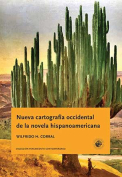

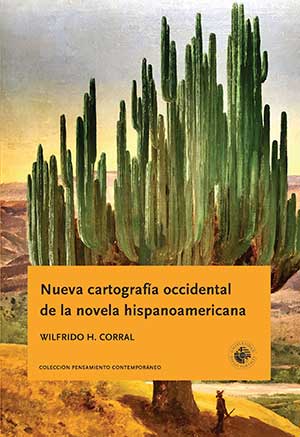
Ediciones Universidad Diego Portales. 2025. 336 pages.
For over twenty years, Ediciones Universidad Diego Portales has been publishing not only the finest works of Chilean literature—particularly through its collection that recovers the complete works of such poets as Gabriela Mistral, Nicanor Parra, and Enrique Lihn—but also essays that surpass national borders, showcasing some of the most significant intellectual contributions from across Latin America and beyond. Its Contemporary Thought series has included works by Jacques Derrida, Humberto Giannini, Aïcha Liviana Messina, and Carla Cordua.
Just published in that series is Nueva cartografía occidental de la novela hispanoamericana, by Wilfrido H. Corral, an Ecuadorian critic established in the United States. This title joins other significant works of his—published in Spain—that must be considered to gain a comprehensive view of his project. In 2023 he released Peajes de la crítica latinoamericana, and in 2019, the over six-hundred-page volume Discípulos y maestros 2.0: Novela hispanoamericana hoy. The titles alone might suggest the obvious: Corral is concerned with the internationalization of Latin American literature. One must also consider his other books published in English, such as The Contemporary Spanish-American Novel: Bolaño and After (2013), co-authored with Nicholas Birns and Juan E. De Castro, and the influential Theory’s Empire (2005), a critical examination of contemporary Western literary theory, edited with Daphne Patai.
His sustained and rigorous work makes him one of the most internationally prominent Latin American critics, and this new title reaffirms the strength of his comparatist approach. In an academic landscape often constrained by overly cautious methodological boundaries and narrow specialization, scholars tend to forget that the true depth of literary expertise lies in expanding the field and bringing diverse perspectives and methodologies into dialogue. Corral complicates and dismantles an already complex terrain: contemporary Latin American literary prose. He does so by critically examining the approaches taken by a wide array of actors—from national literary critics to Latin American scholars working abroad, European theorists, and, notably, the so-called global perspectives imposed by anglophone academia. At its core, this is the work of a comparatist capable of engaging with major Latin American critics such as Antônio Cândido, Ángel Rama, Ana María Barrenechea, Beatriz Sarlo, and Christopher Domínguez Michael (with whom he shares deep affinities) as well as internationally oriented contemporaries like Franco Moretti, Guido Mazzoni, Jean Bessière, Thomas Pavel, and his admired Rita Felski.
This complex network, which Corral navigates with admirable currency, does not dismiss but rather values—and breathes new life into—the most remote traditions of the novel and its criticism. His work produces a distinctive intellectual tension, demanding that readers stay alert to a dense interplay of varied registers. Thanks to this exhaustive perspective, he can put in their proper place the claims of ultracontemporaneity, which, in the end, often offer nothing new or become blind to what appears marginal—namely, what the most compelling novels actually propose: a resistance to the ideological, nationalist, or activist instrumentalization advanced by some strands of academic criticism. In this spirit, Corral polemically challenges what he sees as narrow, regionalist perspectives—e.g., those of a US Mexicanist and a Spaniard writing from Spain, among others—exposing the limitations of these positions.
Nueva cartografía occidental de la novela hispanoamericana is structured around six central axes. Corral begins by positioning Rama as a foundational critical figure through his essay “Ten Problems for the Latin American Novelist.” He then examines in parallel the unheralded Ecuadorian avant-garde writers Pablo Palacio and Humberto Salvador, followed by a comparative reading of Julio Cortázar and Mario Vargas Llosa as public intellectuals. He devotes a sharply critical chapter to Carlos Fuentes’s theoretical pretentions, continues with an in-depth reflection on “rudderless” novels—misleadingly labeled as total novels—and concludes with a final axis: “(Fake) Critical News from Novel Theory.” Each chapter sheds light on key issues, emphasizing that the Latin American novel cannot be separated from the Western tradition—not because it submits to it, but because it critically engages with and reinterprets it, from A (Aira) to Z (Zambra).
Corral finds this stance more vividly present in the novelists themselves than in their critics—or rather, not only in their novels, but in the novelists’ own reflections on the form. To support this, he draws on insights that range from early twentieth-century figures like Virginia Woolf to later thinkers such as Doris Lessing, Iris Murdoch, and A. S. Byatt, and up to the present day, with his equally admired Ariana Harwicz and Aira. In this way, Corral turns his critique toward criticism itself—particularly the kind that fails to broaden the horizon, as if its goal were not to explore the richness of novels but to assess how well they conform to the critic’s own “subject position.”
The strength of Corral’s exhaustive comparatist methodology is that, without claiming to offer a theory of the genre (which he distrusts), he illuminates the intellectual challenges the novel can pose. Resistant to reductionism, he repositions the novel as an artistic form rich with cognitive possibilities in a world that seemingly sidelines or domesticates it. The reality, however, is that the novel continues to raise diverse challenges—historical, psychological, philosophical, linguistic—even if its most visible role today appears limited to entertainment or sales figures. Fortunately, there are critics who can discern the trivial from the profound and understand that this vast expressive range speaks to the novel’s vitality and importance, even if its depictions are not strict portraits of reality. They argue that novels deserve to be read differently—with greater rigor and beyond the expectations imposed upon them.
Leonardo Valencia
Universidad Andina Simón Bolívar