
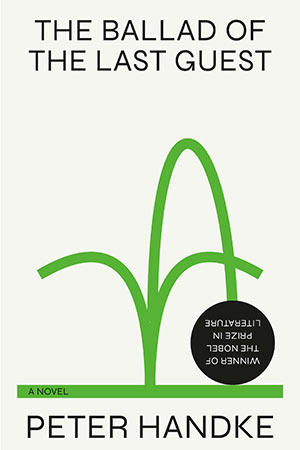
Farrar, Straus & Giroux. 2025. 176 pages.
The Ballad of the Last Guest is the most recent English-language translation of Nobel laureate Peter Handke. It sees an at-first unnamed man returning to his hometown on his so-called annual leave. As we progress through the novel and as he walks about the paths and lanes, both familiar and new, he gains a name, at first simply Gregor, and then eventually Gregor Werfer, a protagonist that will be familiar to Handke fans from his previous works. This slow acquaintance with the main character draws the reader slowly deeper into the story, as if circling in ever decreasing circles before unearthing the heart of the matter. The feeling of being at home but not quite, both physically and mentally, is the theme that runs through this novel.
Gregor has landed in his home country having just received news of his brother’s untimely death. His remaining family members are unaware of Hans’s passing, but instead of hurrying home to tell them and share their grief, Gregor departs on a series of his “one-man expeditions”: first dawdling home from the center of town to the dinner to celebrate his return, and then leaving his parents’ house again the next morning without having mentioned his brother and not returning until his nephew’s christening, a week later and on the day of his departure. Carrying his grief for his brother but also for the homeland he has lost, Gregor traces the ancient cattle tracks to his family’s old and abandoned orchard, finding it where it had always been yet changed by the passage of time.
This motif is continued throughout as he wanders, seemingly aimlessly around the villages of his childhood, which have now become an urban agglomeration, which Gregor both recognizes but also finds to be different and somewhat disorientating. He notes that houses are being abandoned, one by one, and even the forest has changed. However, people from his past continue to recognize and greet him. In turn, these changes make him feel engaged and disengaged at the same time and are reflected in the unusual narrative style of swapping between the third and first person.
The distance created in the majority of the novel gives way, increasingly toward the end, to the intimacy of being privy to Gregor’s innermost thoughts by the sudden use of “I.” Yet there is also another speaker, an interrogator, frequently asking him why and how. Is that us as readers or Gregor, who sees himself as a chronicler, trying to answer his audience’s questions, before they even ask him?
The Ballad of the Last Guest feels like a love song to a world and society that is slowly vanishing. The gentle prose with so many meandering thoughts is reflected in the indirect countryside paths, journeys to the end of the line on the streetcars, and evening walks through the woods, while his homage to the final outpost of this fading way of life takes the form of protagonists who appear in the tale—for instance, the retired priest who returns to his divine service one last time to baptize Gregor’s baby nephew, and Gregor himself, who deliberately sets out to be the last guest at night in the town’s taverns and restaurants.
The final section appears as a chronicle of Gregor’s week spent in his homeland. The fragmented poetic reflection reinforces the idea and images of the novel: “And how the news of our brother’s death, as we were sitting on the windowsill, caused her acne, which had disappeared long ago, to break out on both cheeks, and how I saw constellations in the outbreak, which made her even more beautiful.” And we as readers glide out of the book, knowing that Gregor has delivered his sad message and questioning whether he will ever return to his homeland.
Krishna Winston’s translation beautifully re-creates the gentle rhythm of Gregor’s steps as he pounds the streets searching and leaves the reader marveling at her ability to deconstruct the complex German and re-form it into a flowing prose that mesmerizes the reader, drawing them further into Handke’s creation.
Catherine Venner
Durham, UK