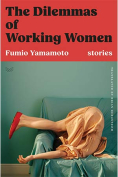


HarperVia. 2025. 288 pages.
Fumio Yamamoto’s understated stories are a reminder that the English-speaking world is only just beginning to encounter the diverse range of feminist literary worlds long existing in Japan. Yamamoto is from a generation of writers appearing slightly earlier than international literary superstars Sayaka Murata and Mieko Kawakami, and until now her work has never been translated into English. The Dilemmas of Working Women, translated by Brian Bergstrom, is a welcome gift for readers eager to explore perspectives on gender from Japanese literature.
Published in Japanese in 2000, The Dilemmas of Working Women is composed of five short stories: “Naked” is about the aimless lifestyle of a divorced woman in her midthirties; “Planarian” portrays a young woman who loses her right breast to cancer before her twenty-fourth birthday; “Here, Which Is Nowhere” illustrates in minute detail the lifestyle of a housewife in her early forties; “The Dilemmas of Working Women” depicts a twenty-five-year-old career woman at an impasse with her graduate student boyfriend; and “A Tomorrow Full of Love” is narrated by a male bar owner in an ambiguous relationship with a woman living with him.
While the final story has a male narrator, Yamamoto’s collection spans the lives of many women struggling with disparate circumstances. In particular, the English title—the original title in Japanese is Planarian—is clever and ironic given that several narrators resist working. Two years after her divorce, Ryōko (“Naked”) occupies herself with crafting and spending countless hours at manga cafés, utterly detached from her previous life as a workaholic. Sumie (“A Tomorrow Full of Love”) refuses to work properly at the narrator’s bar, instead doing fortune-telling for customers in exchange for drinks and food. To avoid “rejoining society,” Haruka (“Planarian”) hangs out with her college-age boyfriend every day while plagued by expectations from him and her family concerning how she needs to “get over” having had cancer. She imagines life as a planarian, a type of flatworm: “I could spend my days swimming beneath a rock in a clean mountain stream. . . . I could live my whole life without thinking about anything at all! And since I would regenerate if I got cut up, I could live free from the fear of death. I wouldn’t have to worry about sex either.”
Dreaming of life as a planarian requires the willingness to be viewed with frustration and even disdain by others; these female protagonists are impractical but brave. Written during the anxieties of an earlier time of recession in Japan, this fantasy describes an escape from productivity as well as heterosexual pressures from male partners. Yamamoto never depicts men as villains, but they tend to be insecure, oblivious, or self-absorbed, offering little wisdom or genuine understanding for the women in their lives. On the other hand, all these stories subtly portray complex ways that women exist together through tenuous, sometimes painful intimacies: a daughter bursting into tears seeing her easygoing mother overwork herself, a young woman strangely drawn to a gorgeous woman she encounters at the hospital, a woman weeping while tightly embracing the small daughter of her childhood friend. With their varied voices translated adeptly by Bergstrom, women are alternately disappointed, betrayed, loved, and rescued by women and girls around them.
In his excellent translator’s note, Bergstrom explains how Yamamoto’s story collection won the 2001 Naoki Prize for popular literature and became a bestseller in Japan. The Dilemmas of Working Women shows how a gap of over twenty years is not too long for these women’s voices to move readers today, too. (Editorial note: WLT’s September 2024 issue included a cover feature on “Japanese Women Writers in the 21st Century.”)
Grace Ting
University of Hong Kong