
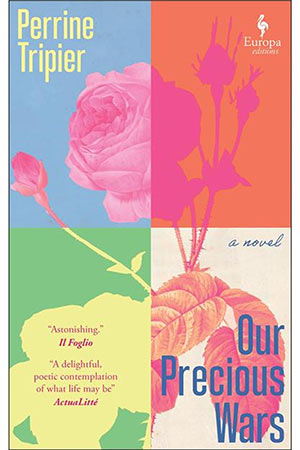
Europa Editions. 2025. 160 pages.
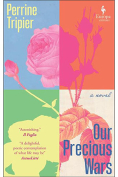
Despite being only twenty-four years old when her award-winning debut novel, Les guerres précieuses, was published in France, it is clear that Perrine Tripier understands deeply both time and grief. Newly available in English translation courtesy of Alison Anderson, Our Precious Wars is told from the perspective of Isadora Aberfletch, an elderly woman reminiscing about the life she lived and the countryside House that served as her most enduring companion. Though it is told in lyrical language saturated by color and fragrance—“russet forests,” “resin-scented wind,” “a vast sky dappled with wisps of marble”—what is most striking about this slim book is its pacing and manipulation of time.
After a brief introduction, which establishes that Isadora is newly relocated to a hospice, we dive into the summers of her early youth. Told in four parts that mirror the seasons of the year, we experience all of Isadora’s summers followed by all of her autumns, winters, and springs, replete with family rituals and traditions that root us in time: building woodland forts with her cousins each summer, visits with their worldly great-aunt Babel each fall, the wearing of heirloom sweaters that magically grew alongside them each winter, and the “Great House Cleaning” each spring. There is a sense, as in memory, that the childhood memories linger more and burn brighter and that the years which follow hasten so that Isadora’s early adulthood walks and her later adulthood passes by in a sprint. Tripier lovingly captures the sense that life moves faster the older you get.
The first-person narration is pronounced and wistful, capturing tenderly what it’s like to lose those you love—especially those you grew up with—either to death or to distance. Early on, Isadora reflects that “we can only say we truly know someone when we’ve grown up with them. Our individual development has been lightly colored by that of others, like water into which a drop of syrup has fallen, a single drop, enough to color the entire glass a pale mint.” And so, her account becomes a love letter to those she grew up with: older brother Klaus, older sister Louisa, and younger sister Harriett, but also the House that served as the scenery of their shared childhoods.
The House, which is notably always capitalized as if it is a character or perhaps even a god or muse, is a repository of memories. While her siblings seek distance from the House and express desires to move forward and away from grief, Isadora instead tethers herself to the House, becoming its eventual inheritor and serving as its caretaker until she is no longer able to care even for herself. She justifies the way she clings to the House as her way of coping with loss: “The past has always been easier for me than for them. They live too much in the sorrow of the present.” Houses often serve as ghostly, character-like figures in literature, as evidenced by the sprawling estates in works such as Daphne du Maurier’s Rebecca, Charles Dickens’s Great Expectations, Ian McEwan’s Atonement, and others. While the Aberfletch House embodies similar themes of the past and of decay, Tripier’s allusions to yellow wallpaper also suggest a sense of madness à la Charlotte Perkins Gilman’s “The Yellow Wallpaper,” in which a woman’s mental health deteriorates as a result of an unhelpful prescription for rest. Markedly, the ghastly yellow wallpaper in Isadora’s world is not in the House but rather in the hospice, a place where she is being slowly driven mad by her own memory and longing. There is grief in remembering. There is grief also in “the imperfection of memory itself.”
As Isadora reflects on her life, there is a reminder of seasonal cycles and the hope of renewal they suggest: “What I would like would be a rebirth, without pain, without bitterness, almost without a memory of what I was before.” Without the ability to return to her own summers, she clings instead to memory, hoping to reconstruct the place and the people that gave her purpose, with the understanding that even though memory is its own kind of fiction, it is also a way of sustaining life.
Our Precious Wars is a quiet story, the kind that offers glimpses into the entire lifetimes of multiple characters while also maintaining a sense that not much happened in those lifetimes, that those lives were remarkable only to the extent they are lovingly remembered. It’s the story of an old woman’s winter rendered heartrendingly, and incredibly, by a writer in her early spring.
Lauren Bo
St. Louis