
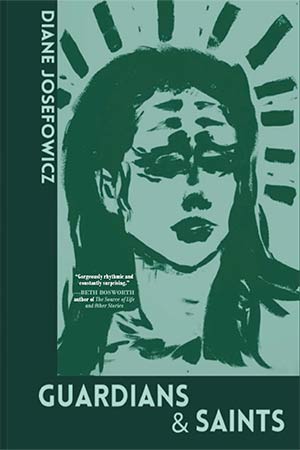
Cornerstone Press. 2025. 202 pages.
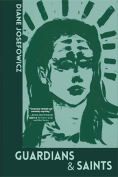
There are eleven short stories in Diane Josefowicz’s third book of fiction—with much to say about thematic interfaces, characters that seem to reappear, and places that are defamiliarized to the point where one finds oneself looking on a map. A richness of language and vision pervades the entire collection, stories that ask us to consider the role of a caretaker, all so intriguingly rendered by way of a pristine handling of language as to create a series of stories that often feel like puzzles to be assembled. And if the title invokes the idea of stewardship, of people taking care of one another, what it doesn’t suggest is how badly they do it, how brutally they fail, between their theory and practice.
“Kindness,” says a child in the first story, titled “The Dwindling,” which sets the tone for the entire book, “if it exists at all, is a blade—and it is serrated.” Used here not as a state of becoming diminished, but in fact the word references a child, a being in such a state—induced by guardians. Both the first and second stories are set in New Bedford, Massachusetts, a place readers of Melville know well for his evocation of a grim whaling city, associated with men who take to the seas and more often than not do not return, as in the case of this Dwindling’s father. Here the Dwindling speaks of her parents:
My mother, the artist Helen Dando of New Bedford, claimed to be a reincarnation of Helen of old, and most days she did seem capable of launching anything, from the boats that took my father and returned him to us shining with fish scales, his pockets jangling with bounty, coin and shell, to the flotilla of toy tugboats that nightly went wheeling round the tub drain. Even the tide came and went at her behest, or so it seemed to me, leaving pewter puddles in which I found sea treasures: ropes of kelp that slimed through my fingers, tiny cowries that I threaded into bracelets, and best of all, lumps of sea glass, edges blunted by sand and water, my mother’s elements.
You savor the morsels of Josefowicz’s offerings, which evoke objects rare and precious and fanciful. You inhabit the worlds for these words to live in, and these worlds speak to those who actually do live in them.
The second story, “The Radio,” also features a father and daughter. The father’s fascination for “radio physics” takes the pair upon an excursion to a shop where he hopes the proprietor might be able to fashion for him an instrument to capture “the sound of the trumpets at Jericho.” (My father, too, expressed a belief that there would someday be an instrument to capture the waves that are still present.) Meanwhile, the daughter here is peering into compartments and sees a telescope the size of her “thumb.” Additional sounds the father wishes to capture: “a train getting up speed, a chicken clucking, a blade on a whetstone, fanfares, hunting horns, the pop of a cork, gurgling of liquid decanted, a violin solo . . .”
“Alberto: A Case History” presents another locale with undesirable children. Also, a character reappears, namely Lunette, whom we now see as the daughter of a wise and compassionate man who has designed a very different home for a similar situation. When the village’s ritual “exorcism” meant to remove the possibility of caterpillars on their filbert orchards—an event gone horribly wrong—results in the drowning of “the magistrate’s child,” the village, “seized by a mania,” witnesses “all but the most docile” of children turn into demons. And so, we are introduced to Alberto, one of the “forsaken children of Bad Dürrenmatt.”
The following story, “Psoriasis Memoir,” offers a first-person rant that instantly calls to mind Thomas Bernhard in its addictive obsessiveness—but with punctuation and paragraphing. The narrator well describes the malady, along with her self-consciousness about “how shameful it is to let someone else see everything I throw away.” And yet, when a doctor pronounces the malady as “a symptom of confused thinking,” our narrator asks, “What about the necessity of a periodic molt”—and why not? Such ruminations put a smile on the reader’s face.
“Eleven, the Spelunker” is an epistolary narrative with another Thomas Bernhard–like insistence: a letter to a student by a mad professor residing in the same institution as the mother of said student.
Of the six stories that follow, three feature Zinnia, who appears in some of Josefowicz’s other books with her winning share of wit—and grit.
These are unusual characters—inimitable and compelling. All of it in the hands of a stylist, whose wordsmithing is wildly faceted, prismatic, and compressed, a muscling of information. We journey into the strangest domiciles, the academy, the institutions, with the intricacies of treasured objects, of art and architecture—such details that remain with the reader, along with a lingering desire to handle, and to reread.
Geri Lipschultz
Borough of Manhattan Community College