
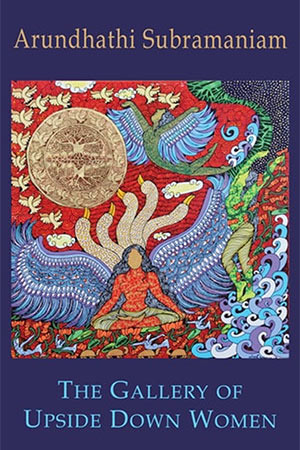
Bloodaxe Books. 2025. 107 pages.
In the West, the idea of Indian spiritual poetry is still linked to Rabindranath Tagore’s Gitanjali and its many translations (including Tagore’s own, which paved the way for his Nobel Prize in 1913). Yet India has produced scores of medieval and early modern mystics, many if not most of them women, whose spiritual travels, unconventional figures, and profound and provocative “utterances” became the stuff of legends, folktales, and literary lore. More recently, scholarly and poetic translations, mostly done by men, contributed to the creation of a new literary genre.
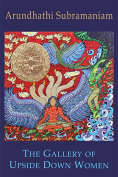
Starting in the 1990s, however, Indian women poets have taken the lead in producing new translations and poetic interpretations of what in the meantime has become known—and marketable—as “bhakti poetry.” Not surprisingly, their work has focused on female figures (mystics as well as devotees, seekers, or epic heroines) and on new and creative ways to explore women’s spirituality. This “new wave” in contemporary Indian poetry in English has one of its most dedicated and accomplished adepts in Arundhathi Subramaniam. Following the US edition of Women Who Wear Only Themselves (2025), a collection of essays on four “contemporary female spiritual travelers” and the anthology Wild Women: Seekers, Protagonists and Goddesses in Sacred Indian Poetry (2024), The Gallery of Upside Down Women represents a new installment in the poet’s “fascination with women on sacred journeys” and confirms her reputation as one of India’s foremost poets.
Such a fascination finds a more explicit and direct expression in the second of the three sections of the book, which engages with six women spanning nineteen centuries of spiritual quest. “The Girl from Karaikkal” is the husband’s account of a Tamil mystic’s progress from newlywed bride (“She wasn’t exactly the girl / you took home to mum”) to spiritual teacher (“No need to flee to the forest, seeker. / Stay right here in the madcap town. / Do exactly what you’ve always done. / Just do it upside down”); while “Questions for Akka Mahadevi” re-creates the master-disciple interview around which many philosophical texts are structured, from Persia to Japan.
The same creative engagement informs the other two sections of the book. The first (“Cycling Hands-Free on Air”) offers a critique of our problematic omnipresence from a perspective shaped by a long and intimate acquaintance with Indian women mystics and their intellectual legacy, while the third (“God’s Forgotten Nickname”) goes under the skin of the divine experience as an intellectual, spiritual, and emotional investment. Throughout the book, in poems such as “The World Takes a Breath,” “Staying Unnamed,” “The Breaking News Lullaby,” “What Stories Are Left?”, or “Nothing Is Singular” (to name only a few), irony and a sharp sense of humor (the philosopher’s gaze) address today’s specters and chimeras in subtly unpredictable ways. Humor then meets technical brilliance in “When Two Women Drink Chai Together,” where Subramaniam, in a most enjoyable example of enumerative exuberance, manages to rhyme “men / estrogen” and “AI / sky” in the first four lines of a stanza of six. This is only one of many examples in a book that crowns the poet’s achievement so far.
Drawing on spiritual research to cast a sharp glance at the present world, The Gallery of Upside Down Women shows throughout a masterful comfort in the use of poetic language and technique, which in turn allows Subramaniam to handle her subjects with critical elegance and style. (Editorial note: Visit worldlit.org to read Krätli’s November 2024 conversation with Subramaniam, “Making Love to an Ancient Poem.”)
Graziano Krätli
North Haven, Connecticut