
Prototype. 2025. 280 pages.
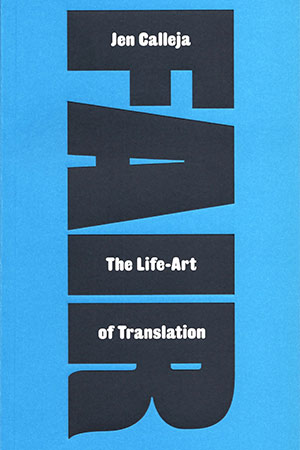
Over the past three years, English-language readers have enjoyed an increase in the number of single-authored publications by literary translators on translation. Examples include Daniel Hahn’s Catching Fire: A Translation Diary (2022), Damion Searls’s The Philosophy of Translation (2024), and Suzanne Jill Levine’s Unfaithful: A Translator’s Memoir (2025), the first in a series dedicated to prioritizing translators’ perspectives and their role in literary networks titled TRANSLATED BY. While not an exhaustive list, together these titles show promising activity in making more space for learning from translators and making translators more visible as creators. A recent addition to this list is Jen Calleja’s Fair: The Life-Art of Translation.
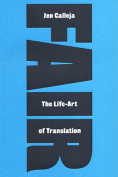
Fair, dressed in a bright blue cover with clean black-and-white letters and praise from five different translators, artists, and writers, stands out because of its genuine effort to be for anyone interested in learning more about a literary translator of the anglophone world. It also is remarkable for its thrilling level of creativity that weaves elements of Calleja’s life as a poet, writer, essayist, translator from the German, scholar, musician, daughter, colleague, and partner throughout this story of translation.
Readers can choose to read the book straight through or to follow one, some, or all five guided tours at Calleja’s imagined fair. Fair’s accessible structure of short sections, set up as fair attractions or stands, each with its own title and focus, keeps readers active, engaged, and filled with wonder. Readers at any point in their relationship with literature will all find something amusing at the fair from where and how Calleja works: language learning in school; language learning for monolingual English speakers later in life; moving to another country; working as a translator with publishers; establishing Praspar Press for Maltese literature in English translation; challenging established translation terms, and much more. Fair also succinctly engages with long-standing and contemporary translation topics such as collaboration, mentorship, activism, and rates, demonstrating Calleja’s deep and knowledgeable commitment to translation backed by experience.
Current conversations about translation are largely dedicated to artificial intelligence. Fair briefly addresses AI in section “C3 – Folly” with a clear message that it’s taking up too much space. “AI cannot read,” AI-produced “translations” can’t be edited, and “they’re an obstacle to a real translation built from the ground up.” The entire book, however, defends the value of human involvement in translation as well as the benefits for humans to translate. While general conversations about AI often focus on translation as a product, Fair takes readers on the ride of translation as a process and how humans learn from that process, which then shapes their world and their contributions to it. Fair shows how Calleja’s life, including her education, family, friends, class, music, experiences, and more are part of her translations and their making: “a translation is of its time, and of its translator—in any case, there is no neutral choice.”
The following section, “Spotlight!” is dedicated to the invisibility/visibility of translators. Especially notable in this section is the clarity on why translators need to be visible. Visibility helps readers know who is behind the work they’re reading, that “there are different approaches to [a] work,” how to find translators and get them more involved in projects, and to “highlight issues with pay and working conditions.” Visibility is also about drawing “attention to translation in general, and all literary translators.” To further promote translator visibility, throughout Fair Calleja underlines translators’ names and demonstrates awareness of what other translators say about translation. Fair includes a booklist of recommended reading of other literary translators on literary translation.
The book’s title alone announces Calleja’s illuminating and clever writing and the complexities of translation. A “fair” is an event, and that’s how Calleja chiefly uses the word until page 212 of 213, when it takes on its other meanings in English in “a manifesto for fair translation” (emphasis in the original). Readers of Fair who put on their translator lens might close this book wondering how to translate it into other languages. How will they translate the polysemous “fair”?
While lighting up the life of a translator, Fair can be read as Calleja’s confident response to the “serious people with their impenetrable mask of knowledge” and situations that exclude her and others from literature. Fair is the book that wasn’t available to her when she was a student and early professional. Instead of whining or being bitter about that past, Calleja’s Fair is energetic, fun, and inspired. Readers learn about a translator and learn to care about her. They, like many fairgoers, will not want the experience to end. They’ll want more.
Regina Galasso
University of Massachusetts, Amherst