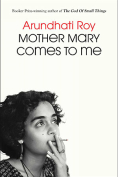

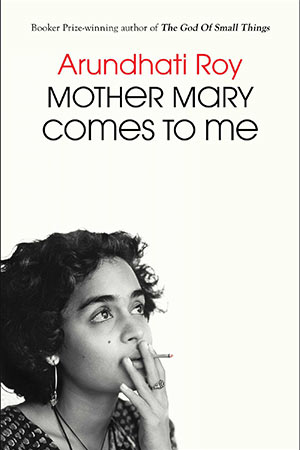
Scribner. 2025. 352 pages.
I don’t know if my conflicted feelings about my mother would have ever found language had I not discovered mother-daughter memoirs unflinchingly exploring the unspeakable pain that often lurks in this primal bond. A large part of my hunger to imbibe Mother Mary Comes to Me comes from growing up with a mercurial mother who clutched me too close. And the rest is the usual giddy omigoshness of a new one by our beloved Arundhati Roy.
But this memoir is not about picking at the knotted hairball of memory or contending with the shadows of the past. This is a reminiscence by a Booker-winning author who broke free from her past a lifetime ago. Its point is to memorialize the redoubtable Mary Roy while not omitting “what had happened to us as children.” Arundhati Roy gives us an often-humorous account of her life as a neglected daughter who ran away and groomed herself into an architect, an actress, a scriptwriter, an author, a prizewinner, a fearless thinker, and a human rights activist. Told with ready anecdote and great sense of humor, her life entwined with her mother’s becomes a guidebook of following one’s heart and taking phenomenal risks that yield extraordinary success. The deeply personal in her political shines all along.
But for these very reasons, the book remains distant from the intimacy of a memoir. The author hovers high above her past, offering us fragments of neglect and meanness, once cold moths gripping her heart, now edgy tattoos of them. The journey from the wound to the scar remains hidden. The new self with its lifelong refusal to stop loving the mother, no matter what, takes the stage. The old pain, never grappled with on-page, is but a lightly woven thread in the luminous tapestry of an eventful life. Darkness, if any, has been left so far behind that its dissection is beside the point.
Arundhati calls Mary Roy an “upstreaming swimming fish,” a mother who considers her children a “millstone around her neck.” The impatience with the constraints of motherhood comes across as the necessary flip side of Mary Roy’s ability to make and take up space for herself. This forcefulness steers her destiny as a famous educator and the winner of legendary legal battles. Mary Roy’s life models the art of escape for her daughter. Her biggest gifts to Arundhati are a voracious appetite for risk-taking coupled with an equally honed instinct for (emotional) self-preservation. The mother might be a tyrant, but a tyrant too busy to keep the daughter entrapped. She gives the daughter the impetus to escape. Only after years of separation and “un-daughtering herself,” Arundhati discovers her immense love for the incredible woman her mother is.
As an adult, their mutual pride and affection is shot with some unease, but shorn of the power to hurt, the mother’s outbursts are easily tolerated as foibles. Spectacular success brings psychic distance and makes past trauma shed its oppressive weight. Arundhati explains her detachment: “when you surgically excise an incident from its circumstances and look at it dispassionately, shorn of context, as though she is someone else’s mother and as though it were not I but someone else who was the object of her wrath.”
Arundhati who had once escaped the mother “comes undone” at her funeral. Would she still have felt “heart-smashed” at her mother’s passing away had she stayed on in Kottayam? Interestingly, her brother, who stayed close all along, does not even try to pretend being sad at Mary Roy’s funeral and is seen jovially welcoming the guests streaming in to pay their respects.
Arundhati Roy admits her soft filters. “I have always thought of my life as a footnote to the things that really matter. Never tragic, often hilarious . . . perhaps what I am about to write is a betrayal of my younger self by the person I have become. If so, it’s no small sin. But I am in no position to be a judge of that.” Embracing the subjunctive allows her to shrug off the charges of romanticizing what could not have been so hilarious and entertaining while it was happening. Having surgically excised the abuse long ago, Arundhati celebrates her mother’s lasting legacy in form of the Pallikoodam school Mary founded with pride and affection.
Once the curiosity about the great author is sated, what else can readers take from this memoir that would help them in their own personal and creative struggles? It’s this: no one, not even your mother, has your best interests in mind. Only radical loyalty to stuff that feeds your soul will enable you to unapologetically smash the cocoons of safety and respectability time and again. If, like Roy, you imbibe this truth early in life, you will become an expert of the clean break and build a life conducive to Art because Art cannot be made as a footnote to all else.
Arundhati Roy’s whole life is a testimony to this.
Varsha Tiwary
New Delhi