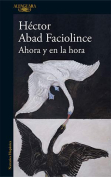

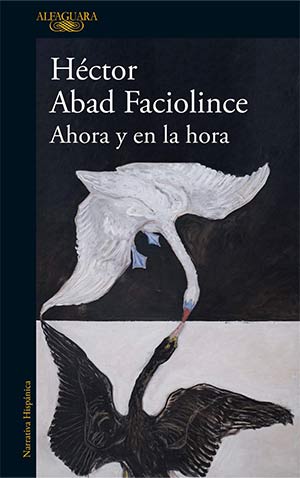
Alfaguara. 2025. 224 pages.
Héctor Abad Faciolince’s latest book is a personal account of the author’s firsthand experience in the war between Russia and Ukraine. On June 27, 2023, a missile launched by the Russian army landed on an Italian restaurant where the author was dining in the city of Kramatorsk near the Ukrainian frontline. The explosion injured some sixty people and killed thirteen of them, including the Urkrainian writer Victoria Amelina (1986–2023). Abad Faciolince had traveled to Kyiv to present the Ukranian translation of El olvido que seremos, his most well-known book. While in Kyiv, he decided to visit the heart of the armed conflict as part of a Colombian support group against the Russian invasion of Ukraine. Two years after these events, Abad Faciolince published Ahora y en la hora, where he reviews the reasons that caused him to visit the front and how he miraculously survived an attempt on his life while being a firsthand witness of Victoria Amelina’s death.
Ahora y en la hora is, in a nutshell, a tribute to Victoria Amelina, a novelist-turned-activist whose life Abad Faciolince explores in detail after her unexpected death at the age of thirty-seven. His account also offers detailed portraits of Colombian war correspondent Catalina Gómez, who has covered many important conflicts around the world, and activist Sergio Jaramillo, both of whom were with Abad Faciolince in the Donbas region in eastern Ukraine when the Russian attack happened. Although Abad Faciolince admits that Ukraine was at first a remote place he knew little about, his take on the conflict is now very clear: he sees the Russian invasion as a manifestation of pure “evil,” nothing short of “a detestable colonial war of destruction and conquest” led by Vladimir Putin.
Faciolince’s account is also a self-portrait of the author himself and the scars received from his time in Ukraine: that of a psychologically wounded individual who must reassess his priorities as a family member and as a writer in order to move forward. As a result, life, death, parenthood, old age, and, perhaps most of all, the guilt he experienced as a survivor all come into play in this moving narrative. Literature also plays a role in this healing process, but while many writers are mentioned to explain the place of Ukraine in the world (Grossman, Lispector, Pizarnik, Vakulenko, among others), it is Victoria Amelina’s writings that occupy center stage in this fine narrative.
Ahora y en la hora is a timely and well-documented book that underscores the struggles that Ukraine must endure to survive as a nation. Hopefully, Abad Faciolince’s important account will soon have an English version to bring a greater awareness to the tragic events currently taking place in that part of the world.
César Ferreira
University of Wisconsin–Milwaukee