
Ohio University Press. 2025. 194 pages.
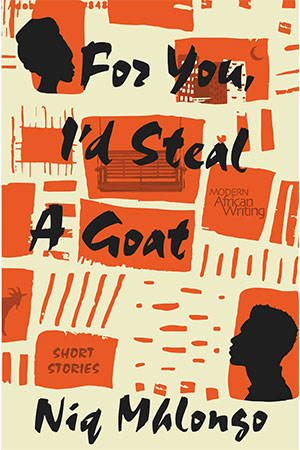
Niq Mhlongo’s short-story collection For You, I’d Steal a Goat has joined the Ohio University Press African Modern Writing series. The ten short stories are, as the reviewing cliché goes, diverse in scope and difficult to sum up. Mhlongo, moreover, as a Soweto-born Black South African writer, can be described as having his work characterized by its engagement with the post-apartheid moment. Such readings, while possible, risk being dull and won’t quite get at much of the narrative play that characterizes the text. The stories engage with South Africa’s past and present, and the frequency of twist endings suggests that the future should come unexpectedly.
Two stories set during the Covid-19 lockdown bookend the collection. They are “Unwelcome Guests” and the titular “For You, I’d Steal a Goat.” In the former, a family finds itself forced to share their home with an unwelcome woman. The father had lost his job due to the pandemic and defaulted on his bond repayment, leading the bank to sell it to this new woman. Neither is happy about their forced cohabitation and cannot wait for the courts to reopen so that a solution can be found.
In “For You, I’d Steal a Goat,” a South African performer stuck in Berlin during lockdown has the idea to steal a goat in order to appease his ancestors and expedite his return home. His German girlfriend, Ursula, offers to help (she’s even the one who says the line), but his South African friend Zwai asks if he’s been smoking too much weed. Zwai points out that this is not South Africa, noting that “there are surveillance systems everywhere.” But, like a good friend, he helps in the robbery and is present when the slaughter is set to take place in the bathtub of their Berlin apartment. He also offers solace when the goat does the unexpected, even in the face of its own death.
The narrator-protagonist of “Unwelcome Guests” also has friends who help him solve his own problem of unsettlement. The group of boys dress up in scary costumes, slaughter a chicken, and knock on the woman’s window. Naturally terrified, the boy’s invocation of malevolent presences prompts the woman to reconsider whether she wants to live in her new house with this family.
But the prevalence of uncanny beings goes beyond this in the story. The narrator notices the presence of rats on two occasions. The first is when he tries to find solace in the fact that this woman has invaded his home. The rats, at least, are a comforting part of an otherwise unsettling situation. The second instance is when, crawling on the roof, they act as confirmation to the woman that something supernatural wants her out of the house. What’s fascinating is how both of these stories present supernatural interventions in life as possible, but often not in the way one might expect, in terms of both their reality and their outcome.
Niq Mhlongo’s prose and general style has always been realist. Simplicity, for lack of a better word, allows his creativity to shine through in the plot. It also lends itself well to humor. The situations the characters find themselves in, like having a strange woman move into your house because the bank sold it without telling you, are funny in the same way that the solution is scaring her off with a headless chicken. The laughable and unlaughable can coexist. And by doing so, unique stories take form.
I cannot touch on all the stories in the collection to make my point, but I can discuss those that I like and hope that they fit. One such story, “Johustleburg Prison Cell,” is about a university student caught drunk driving for the second time. His father, insisting that he must grow up, refuses to bail him out. But, in jail, he ends up meeting someone who was born as a result of his father’s own illegal activities. It’s unexpectedly funny, unless you are either boy’s mother.
At risk of stating the obvious and oversimplifying the collection, the past affects the present and subsequently how one sees one’s place in it. This, in turn, builds upon the ability to imagine the future. Humor helps because it is a way to be hopeful. And hope, precisely because life is diverse, improbable, and unexpected, pulses through the collection like a goat’s wet nose. Mhlongo’s collection succeeds because it treats the unexpected, not as disruption, but as the very fabric of contemporary South African life.
Kris Van der Bijl
Cape Town