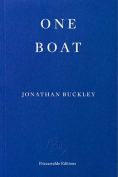


Fitzcarraldo Editions. 2025. 166 pages.
A variety of tensions animate this novel, which has recently been placed on the Booker Prize longlist: the tension between past and present; between the real and the imagined; crime and punishment; reading and writing; loss and mourning. Its narrator is a woman named Teresa. Nine years ago, after the death of her mother, she had visited a small coastal village in Greece; now, after her father’s death, she returns there.
Certain symmetries prevail between Teresa’s two stays in that village. During her first visit, she read The Odyssey; during her second, she reads The Iliad. During both visits, she wrote about her experiences and strained to find insight about her own situation. She encountered a set of people there, and then meets them again, nine years later: Niko, a diving instructor; Giorgios and his daughter, Xanthe, who own a café in the village; Petros, who grew up in Belfast under the name of Peter but now works as a garage mechanic in the village.
Despite their similarities, Teresa’s visits prove different in crucial ways. Nine years ago, gazing out at the bay from a set of ruins on a hill overlooking the village, she had had a vision of her mother’s death that plunged her into a state of ataraxia, but during her second visit, she cannot recapture that vision, nor can she achieve the same state of being. Such realization is disappointing to her and prompts her to call the logic of her second visit into question: “The previous visit, the success of it, was occupying the foreground. What I was doing was nothing more than re-enactment.”
With nine years separating those stays, some changes are of course inevitable: a man who had been Teresa’s lover is now married; Xanthe now has a child, and she has taken over the running of the café from her elderly father; a man who possibly committed a murder back then is now a poet. Yet Teresa feels that she herself has remained fundamentally unchanged. Moreover, she senses that she recognizes her former acquaintances in the village more readily and surely than they recognize her. Their humanity seems a bit more thin than hers, as if they were figments, rather than real beings; but perhaps that impression is merely a feature of the self contemplating the other.
Whatever may be the case, Teresa is led to reflect upon the contingency of human relations. She has always suspected that she herself is hard and unspontaneous, and she wonders if that prevents her from connecting more profoundly with the people around her. It is not the only question that vexes her during her time in the village. “I knew from experience that this place was conducive to introspection,” she remarks, suspecting, however, that she spends too much time looking inward. In the course of a long conversation, Petros suggests to her that it may be more healthy to look outward, and she resolves to try that approach: “Stop thinking, I told myself.” That proves easier said than done, for Teresa cannot turn off her thinking like one turns off a water faucet. Questions continue to bombard her, and notably what she refers to as “the Question of Questions”: Why is there something, rather than nothing?
She is certainly not the first to ask herself that question, and she will not be the last.
Warren Motte
University of Colorado Boulder