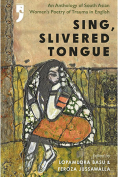

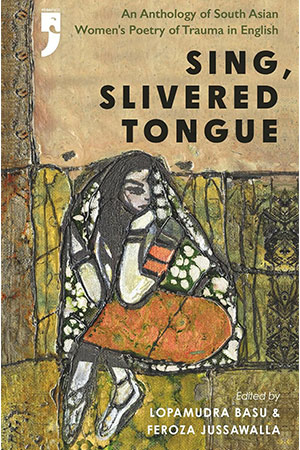
Yoda Press. 2025. 224 pages.
Sing, Slivered Tongue is a necessary and compelling collection that brings forth a chorus of South Asian women’s voices from both homeland and diaspora as a deep exposition of the trauma and despair carried within the body along with its identity. It masterfully explores the varied voices as they become a clarion call in bringing down the misogyny deeply seated in the culture carried forward for generations. The book features a plethora of voices ranging from the young and emerging to the well established. This imperative and pressing collection exposes the grim and shattered realities of the world as women continue to suffer because of these atrocities while offering a sacred space to the women’s voices. Together, the contributors share the embodied trauma as a result of cultural silencing while continuing to live with resilience and grit.
Various poems in this stunning volume explore violence and its long-lasting effects on the body and its psyche. “Hiraeth,” for example, is an homage to Jyoti Singh, who was a victim of gang rape in Delhi in 2012 and later succumbed to her injuries, causing a nationwide uproar. Another poem, “On Sakshi Malik Wrestling a Bronze at Rio 2016,” talks about the female infanticide and honor killings still prevalent in some parts of the country.
Repressed voices often relate to silence and oblivion, drawing inspiration from mythical and traditional roots, thus highlighting the fact that such trauma has been propagated for generations while suppressing the victims’ voices. The flagship poem, “Severed Tongue,” embodies the anthology’s emotion by mentioning the mythological figure Khona, whose tongue was severed for speaking truth to power after she refused to apologize, insisting on “truth” as her highest allegiance.
The editors, Lopamudra Basu and Feroza Jussawalla, both scholars of postcolonial and American multicultural literatures, give voice to the raw effusions of women who carry the weight of loss, upheaval, broken bonds, and silencing by political systems. This necessary and urgent collection showcases varied aspects of intergenerational trauma, toxic patriarchal structures, misogyny, and its deep exegesis.
This anthology is not solely a reflection on the pain of trauma but a testament to how women respond to adversity with resilience, adaptation, and, ultimately, transformation. While the poems give voice to profound grief and hardship, they also illuminate the journey toward healing and empowerment. The editors present these works as affirmations of women’s strength and the enduring capacity to find meaning and growth in the aftermath of loss due to illness, death, and separation from the homeland.
Rooted in a colonial past, South Asian poetry in English has evolved into a rich and diverse tradition. While this anthology predominantly features poets who write in English, it also embraces bilingual voices such as Renu Gupta, who translates her work from Hindi; Shamim Azad, who writes in both Bengali and English; and Shelly Naz, whose poems appear here in translation by Kamrul Hassan. In a diasporic, globalized world, poetry increasingly moves beyond linguistic and national borders, manifesting an ever-evolving, fluid identity.
These poems address the continued vulnerabilities of women, not to dwell in victimhood but to illuminate continued struggles and new paths toward justice. This stirring anthology of sixty-eight poets includes poets from Bangladesh, India, Nepal, Pakistan, Sri Lanka, and South Asian diasporas from the United Kingdom, United States, Canada, Australia, and Sweden. It balances the trauma narrative of modern and traditional poets with equilibrium and readability, making it a perfect textbook to teach South Asian women’s literature beyond prose.
Megha Sood
Jersey City, New Jersey