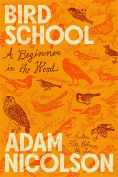

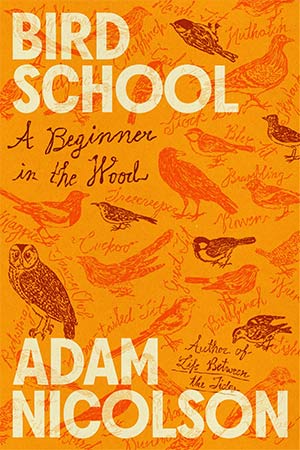
Farrar, Straus & Giroux. 2025. 440 pages.
At the start of this fascinating and sumptuously illustrated book, Adam Nicolson admits that, with the exception of seabirds—an early love—he “never paid much attention to birds.” The common species of wood and garden “remained a blank.” Bird School is the story of how that blank was filled in by a period of close observation, much of it undertaken at a specially constructed birdhouse built in an overgrown field on his farm in the English countryside. Nicolson describes his birdhouse as “a cabin with fold-down windows . . . a small shelter, big enough to sleep in but little more . . . a place for day and night, and a hide from which to see and hear the yearly show unfold.” He doesn’t want simply to observe birds “but to be with them.” The birdhouse isn’t an observatory, but what he calls “an absorbatory”—that is, a place “to take in, to dissolve, if such a thing is possible, the boundary between self and world.”
Two comments kept coming to mind as I read Bird School: Mary Oliver’s “to pay attention, this is our endless and proper work” (from Owls and Other Fantasies); and J. A. Baker’s “the hardest thing of all to see is what is really there” (from The Peregrine). Paying attention is precisely the work Nicolson undertakes as he engages with the challenge Baker identifies. The result is that we’re enabled to see past the obvious immediacies (and omissions) of vision to the wider truths that underlie them. Thus, when we look at a wren, for example, Nicolson shows how we’re “not just seeing a sweet little fragmentary being but the demands of life itself, the product of tens of millions of generations bundled into a tiny round cocktailed package.” Like every species he considers, the wren’s evolutionary history “is scarcely believable” when we stop to think about the incredible course it’s followed over eons to reach the present moment.
Nicolson recognizes that there’s “nothing new about the idea of a shed as a revelatory place.” His appealing hexagonal birdhouse, built on stilts, is “a descendant of a long history of the shed as a way of encountering the world.” One thinks immediately of Thoreau’s cabin by Walden Pond. But it’s another shed-building nature writer who puts his finger on why Nicolson’s approach is so effective. In Wake-Robin (1871), John Burroughs—who built Slabsides cabin in West Park, New York, and drew much of his material from what he encountered there—points out that:
If I name every bird I see in my walk, describe its colour and ways, give a lot of facts or details about the bird, it is doubtful if my reader is interested. But if I relate the bird in some way to human life, to my own life—show what it is to me and what it is in the landscape and the season—then do I give my reader a live bird and not a labelled specimen.
What makes Bird School such an engaging piece of writing is the way Nicolson doesn’t just list and describe the birds he sees with the kind of deadening detail that Burroughs identifies. Instead, in every instance we’re given “a live bird,” not “a labelled specimen.” At one point, Nicolson laments the fact that there isn’t “a portmanteau word in English” that means “the-beauty-of-the-thing-almost-grasped-as-it-passes.” There may be no such word, but here is an author whose prose repeatedly gives readers a sense of this fleeting, vibrant beauty.
The illustrated “Roll Call of Birds” at the end of the book offers some nice thumbnail characterizations of the different species, each accompanied by a QR code linking to recordings at the xeno-canto website. Nicolson’s wife, the renowned gardener Sarah Raven, also contributes some useful practical advice in a short section entitled “Birds in the Garden: An Aviary Without the Cage.” Nicolson has clearly immersed himself in various specialist ornithological sources. But these are drawn on with a deft hand to enhance, never to obfuscate in the way of some academic writing. The ornithological material sits comfortably with a wealth of literary references. This is a book enriched by a lifetime’s wide and careful reading.
“Is there anything in those facts that does not inspire awe?” Nicolson asks after giving details of the incredible journeys accomplished by the tiny goldcrest. It’s a question that could be posed after many of the facts the book unveils—the physiological importance of starlight in nighttime migration, the mechanisms and music of birdsong, the way environments “sculpt the birds.” Alas, far from being informed by awe, our interaction with birds is often massively destructive. In the US, 29 percent of breeding birds have disappeared since 1970. Bird School highlights the perils facing birds today and provides a portrait of just what it is we’ll lose if we lose them. Nicolson’s talent for catching in words what he encounters in the world makes the portrait a striking, if often tragic one. But he also recognizes that it’s incomplete. The “unknowable otherness” of birds means that “the more you look, the more you know how little you know. You can only be led towards them, as if into a mystery.”
Chris Arthur
St. Andrews, Scotland