
Canongate Books. 2025. 288 pages.
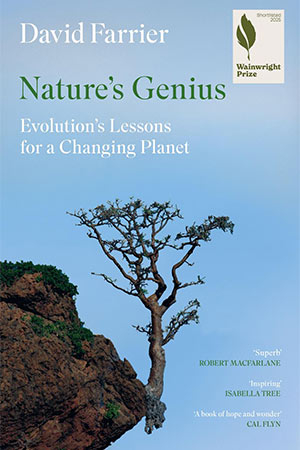
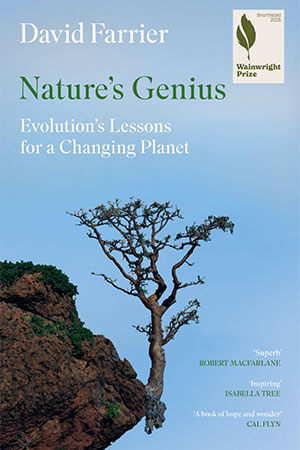
“Human civilization,” David Farrier tells us in the opening pages of his book, “is now the world’s greatest evolutionary force.” Looking at the impact of our species on the planet, Farrier’s assertion brings to mind a comment attributed to Mahatma Gandhi. When asked what he thought of Western civilization, Gandhi reportedly replied: “I think it would be a good idea.”
Whether we think of human civilization as a fait accompli or an aspiration we are very far from achieving, it’s clear that the rise of Homo sapiens to its current position of dominance has had massive consequences for many other species. Nature’s Genius maps aspects of the collision between humanity and some of the other creatures that live, or attempt to live, alongside us. Though this may make it sound as if the book is a catalog of environmental catastrophe, Farrier’s approach, whilst aware of the perils of the Anthropocene, is refreshingly upbeat. An indication of the underlying tenor of the book can be found in its dedication: “For all who choose hope over darkness.”
It’s easy to feel overwhelmed by the darkness cast by a whole slew of problems facing us. Climate breakdown; rampant urbanization; the impact of invasive species; the fact that, worldwide, “half of all bird species are in decline”; the trillions of microplastic particles we’ve set adrift in the oceans; the way “vast quantities of nitrogen and phosphorus washing off American farms” have created a dead zone of some six thousand square miles in the Gulf of Mexico, in whose oxygen-starved waters “only jellyfish and microbial life can thrive”; how “vested interests and denialism continue to work like toxins in the body politic”—we don’t have to look far to find reasons to be pessimistic. But while noting such cheerless aspects of our civilization, Farrier is not in the business of writing a jeremiad. His focus is set rather on possibilities of change, on new ways in which we might interact with our beleaguered planet and the wealth of other life-forms with which we share it.
“Nature’s Genius,” Farrier says, “is about the pursuit of human plasticity.” He stresses throughout how life, far from being set in the inflexible fixity of immutable forms, is responsive to change and capable of all manner of alternatives to better fit the conditions in which it finds itself. In other words, evolution continues to happen. The book starts by introducing readers to road-loving Californian cliff swallows. They have developed shorter and more rounded wings, this blunter form being better suited for the rapid swerves and takeoffs needed to survive amidst the heavy, fast-moving traffic with which they share their habitat. A chapter on domestication drives home the point that life is mutable, not fixed, capable of being molded according to blueprints that serve human purposes. Farrier talks about “the latent potential to be otherwise that lies in every cell of every organ of every living thing.” His approach brings to mind Barry Lopez’s astute observation that “a species is not so much a permanent thing as a point on the developmental line of that thing through time.”
In illustrating ways in which we might change our outlook and behavior as we move through our own developmental line through time, Farrier takes readers to some thought-provoking places. Three in particular stand out: Wikado playground (in Rotterdam), where a children’s park has been built entirely out of decommissioned wind turbine blades; the Pianodrome (in Edinburgh), which offers a performance space made from disused pianos; and the Future Library (near Oslo), where trees have been planted that will provide the paper for books that will be published in 2114, one hundred years after the inception of the project. Such things can help spark what Farrier calls “a fundamental change in perspective, an alteration of mind.” They can help us rethink our attitudes to waste, recalibrate our sense of time, open our eyes to using familiar materials in unfamiliar contexts.
Farrier described his previous book, Footprints (2020), as an “attempt to discover how we will be remembered by the very deep future.” Nature’s Genius is an exploration of where we stand right now and how we might reach a better future than the one many people predict for us. A key part in turning things around may lie in humans learning to become agents in “the evolution of other species.” It’s already clear that our cities act as “evolution engines—hothouses of plasticity and speciation.” Can we learn to tune our impact so that it becomes something deliberate and responsible, rather than being merely accidental—and often deadly?
If we are to play a creatively constructive role in the unfolding of the future, “honing of the imagination” will be an essential prerequisite. Natures’ Genius provides a whetstone fashioned precisely to enact such desperately needed sharpening. (Editorial note: Read Chris Arthur’s essay “Notes on the Literature of Birds” from this same issue.)
Chris Arthur
St. Andrews, Scotland