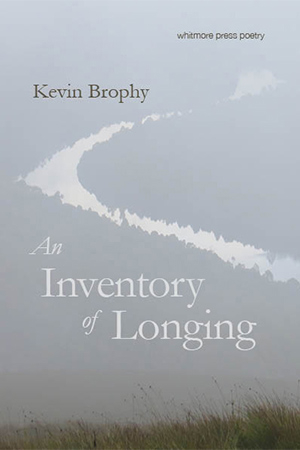

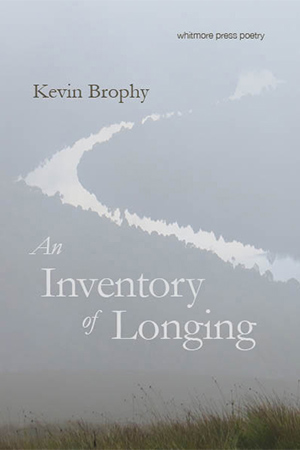
Whitmore Press. 2025. 104 pages.
From the outset, An Inventory of Longing proffers a suite of swirling scenes: amid police cars that fret, sentient cats, galleries and cafés, those who sleep rough on streets, and the bending light shafts containing birds as if “fist-size revelation[s],” Kevin Brophy casts an always-quizzical, mediating gaze. In a book that seems to ask, How might we participate (and why), these poems do not seek to take action so much as take note of the manifold structures we keep building around ourselves (and the inequities these contain, by design). Amid such irrealities, the defamiliarization in these poems is not so much imagistic, or figural, as existential.
Meandering through “mist among statues wearing garlands,” where time will never miss a beat in its sweep toward each living thing’s impending absence, Brophy sounds a resolutely wistful note. These are the poems of a wandering visage understanding themselves to be “a guest in this world.” Some may want more explicitly ethical, activist gestures in art’s responsiveness; for Brophy, holding open the eye is a method of holding open, too, the heart and mind. Essentially human, then, his is an approach toward intuiting how consciousness may be “no more than light fallen on a far valley crease,” repeating itself across eons. These deep dives into immanence remain oceanic in their calm; the poems know that “though the storm was out to sea last night, / it’s coming at us fast.”
The book’s most performative lines are located in “Author, bookshop,” where a fêted writer speaks at Shakespeare & Company in Paris. Like the older audience members in that crowd, this book, too, seems to “hold eagerness at bay,” to cast instead a watchful, loving gaze over its scenes in an act of recording that remembers, above all else, the sheerly strange wonder of it all. In a career that has spanned decades, this is a “human voice / on the grinding-stones of stories.” And yet, An Inventory of Longing does not read as if it is this much-loved Australian poet’s envoi.
A suite of ekphrastic poems, “These are not paintings,” delineates the book’s epistemological core: given the chance, art will humanize us in ways where life so often does the opposite. Like any belief system, it seems we must make a personal relationship with the art around us, and by these means the world’s myriad complexities stand to be apprehended. And not only art but nonhuman subjects, too: of a neurotic and often-vanishing feline, Brophy wonders what more “will we understand / about ourselves when you re-appear.” This is part of the openness that these poems endlessly demonstrate: decentralized, humble, and catalyzed by both respect and vigilance, it is by these means that the world and its artifacts might teach us what we must be and keep becoming.
An Inventory of Longing reminds us to remain “dazed by this life.”
Dan Disney
Sogang University (Seoul)