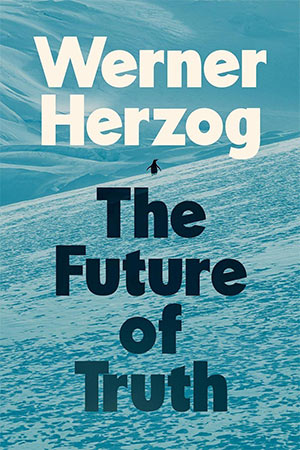
Penguin Press. 2025. 128 pages.
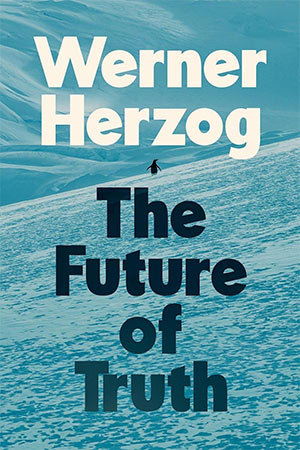
Growing up, my father instilled in me a love for the films of German filmmaker Werner Herzog, especially his beautiful earlier works with the infamous Klaus Kinski, such as Aguirre, the Wrath of God (1972), Nosferatu the Vampyre (1979), and Fitzcarraldo (1982). A romantic iconoclast, Herzog moved from Germany to Los Angeles in the late 1990s and has since become an international cultural icon. Now eighty-three years old, he has not tired of writing and directing. His 2024 book The Future of Truth has recently been translated by Michael Hofmann and was published by Penguin Press. Regrettably, it falls noticeably short of the genius behind many of his films.
Much of the history of philosophy has centered on the notion of truth. The twentieth- and twenty-first-centuries’ analytic/continental divide in philosophy is particularly one of methodology and epistemology. Whereas Bertrand Russell’s program and the work of other early analytic philosophers still looked to establish a rigorous notion of truth, continental philosophers since Friedrich Nietzsche have stressed the futility of such efforts. “There are no facts, only interpretations,” Nietzsche famously argued.
Today’s fraught public discourse has become increasingly unable to establish a shared reality on which constructive disagreement could function. As the narrative goes, we live in a “post-truth” era—fearful, angry, and isolated in disjointed social-media “filter-bubbles” of ever-increasing disinformation. Particularly today, a book on the future of truth has ample ground for tragically relevant questions to choose from—a task Herzog fails to meet.
In “The Future of Truth,” the reader gets one hundred pages of very loosely connected historical and cultural anecdotes, most of which somehow touch on lying, delusion, or some other form of occulting the truth. Many of these anecdotes pivot to the plot or making of one of Herzog’s movies. They do not build any kind of central thesis or criticism, nor an individual or collective path to some notion of truth.
The book’s anecdotes are interjected with moments when the author scratches the surface of philosophical complexity or current political and societal implications, yet never develops any depth on these topics. Its last half page opens a wholly new can of worms by referencing that neuroscientists “basically agreed that our brain creates a model of reality, it doesn’t picture reality itself.” This is symptomatic of the numerous times the author evokes theory or ideas without tying them to what he develops around them. Similarly, regarding the role of truth in our current lives and societies, the author asks early in the book: “Are we not living already in a post-truth age?” This is a question one might hope to have answered in the chapter on “the post-truth era.” However, the aforementioned carries little more than a list of seemingly random examples of (deep) fakes.
But, not to worry, the next and last chapter is entitled “What Is to Be Done?” Before getting to his answer, however, half of the chapter’s eight pages are spent referencing topics as diverse as the fake Hitler diaries, the 1930s radio program on Welles’s The War of the Worlds, which caused mass hysteria, or Conan Doyle’s “belief in Houdini’s supernatural gifts.” Herzog then moves on to his recommendations: he gives us one and a half pages on the merits of reading and traveling by foot, a one-page call for caution (“be suspicious, expect manipulation, propaganda, lies”), and two sentences on the importance of education, without any detail or prior analysis on the topic.
Unfortunately, the lack of depth and development of a central claim is not confined to the book’s final part. The chapter “Fake News: A Brief History” spans almost a quarter of its pages but does little to advance it. Instead, we find a list of five historical episodes, starting in 1275 bce (with King Ramses’ representation of the Battle of Kadesh) and ending shortly after the 1787 ce story of Potemkin’s fake portable village. It is unclear what this list adds to the book’s project. The fact that, throughout history, rulers have lied and been lied to about the grandeur of their achievements is hardly revelatory. Much less so in 2024 as the heart of a work on the future of truth.
Pressed for a guiding idea of The Future of Truth, I might volunteer the author’s distinction between what he calls “accountant’s truth” (facts) and “ecstatic truth.” The latter is laid out in an eponymous chapter, which opens with: “All my life, my work has been involved with the central issue of truth. I have always vigorously opposed the foolish belief that equates truth with facts.” Herzog presents ecstatic truth as the truth worth wanting yet never attempts an explicit definition. The concept seems guided by the artist deviating from pure fact to evoke deeper (“truer”) reflection and emotion.
Herzog gives numerous examples of where he has gone beyond the factual lives of the people that inspired his movies’ plots—and thereby amplified, rather than diminished, their artistic effect. He makes the case for artistic liberty in documentary filmmaking and art in general. Ultimately, however, the investigation of his concept of “ecstatic truth” remains superficial and quickly devolves into a mere catalog of art that is made better, more “ecstatically true,” by being less factual. No philosophical defense of the concept itself is provided.
In the age of digital, personalized public discourse, the rise of AI, cancel culture, and resurging absolutism, the future of truth is pivotal among questions on the future of our liberal societies and democracies. Yet, even now, it must be permissible to write on truth only in an abstract philosophical context—be it within logic, theoretical philosophy, or attempting a workable notion of truth in art. Herzog’s The Future of Truth, however, cannot decide what it wants to be. He concedes that he cannot “engage in the philosophical debate about truth” yet continues to flirt with it. He never claims to, or truly attempts to, write a political book but touches on topics and stories about fake news and life in a post-truth era. It seems he wants to state something meaningful about his notion of ecstatic (artistic and emotional) truth, but he never reaches any depth in discussing it.
The Future of Truth remains a loose collection of lies, fakery, and misinformation, sprinkled with memories of the author’s own projects, rather than a rigorous analysis that leads to a concise thesis or recommendation. It stands in contrast to the quality of many of its author’s films.
Felix Haas
Zurich