
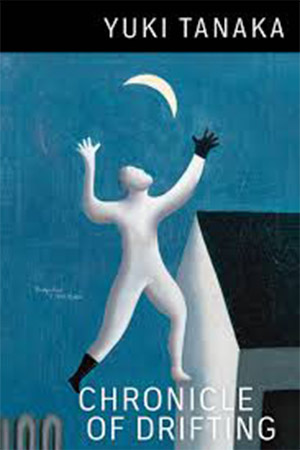
Copper Canyon Press. 2025. 80 pages.
Yuki Tanaka’s collection of poetry, Chronicle of Drifting, is the next stage of Japanese poetics in the English language. Tanaka’s work is not a translation. Yone Noguchi, Okakura Tenshin, and D. T. Suzuki wrote their books in English mainly to tell the West about Japanese culture: Japanese Hokkus (1920), The Book of Tea (1906), and Essays in Zen Buddhism: First Series (1927), respectively. Since then, not many Japanese writings in non-Japanese languages have been seen. However, today, pioneered by Yoko Tawada, writing in German and Japanese, we begin to see more Japanese writers creating in other languages.
The poems in Chronicle of Drifting are surreal, philosophical, and literary, filled with strange, unexpected metaphors that accentuate fragile beauty. The book consists of four sections, each showcasing different styles. Section 1 begins with an epigraph:
What should I compare this world to
Sami Mansei (Eighth Century)
The epigraphs for sections 1, 3, and 4 are poems from Manyoshu, an eighth-century anthology, rendered in Tanaka’s translation; however, he chose to keep only the first half of the poem. He kept the direct emotion of the poem and not the metaphoric part, the situation, or an image. For example, the bottom half of Sami Mansei’s poem reads: but the nonexistent trace of the ship that departs early in the morning (translation by the reviewer). His intention of fulfilling the missing portion of the ancient poem with his poems is successful.
“Prognosis at Midnight” is the opening poem:
I listen to the moon but it doesn’t say
much about my life.
Quiet night is for my cockatoo. He
keeps chattering
until my neighbor comes over to
complain. Then I read
a local newspaper: no murder, no robbery,
one grandmother
fell down the stairs and broke the
hip. . . . I will visit her
and comfort her . . .
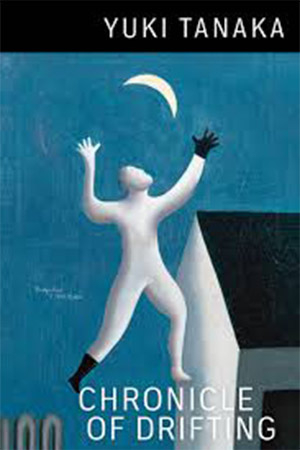
The moon and cockatoo along with the enigmatic cover art of Chronicle of Drifting can be compared to a flash fiction by the surrealist Inagaki Taruho (1900–1977). Interestingly, Italian novelist Italo Calvino quoted a Taruho story in full in his essay “Moon Chasing the Moon,” which is about his visit to the Silver Pavilion, a Zen temple with a moon-viewing mound in Kyoto (Collection of Sand, 1984):
The Moon in Its Pocket
One evening the moon was walking down the street, carrying itself in a pocket. As it went down the hill, one of its shoelaces came undone. The moon bent down to tie the shoelace and the moon fell out of its pocket and started to roll. . . . The moon chased after the moon, but the distance between them increased. . . . And the moon lost itself in the blue haze down there at the bottom of the slope. (From One Thousand and One Stories)
Yuki Tanaka with Mary Jo Bang translated the poetry collection of Inagaki’s contemporary, Shuzo Takiguchi (A Kiss for the Absolute, 2024). Takiguchi, acquainted with the French surrealist André Breton, was a central figure in Tokyo’s surrealist movement. In 1938 he organized an exhibition showing the works of such artists as Max Ernst, Joan Miró, Pablo Picasso, Man Ray, Henry Moore, Giorgio de Chirico, and René Magritte.
The poems in section 2 of Chronicle of Drifting are based on the photographs of thirteen “geisha girls” exhibited at the St. Louis World’s Fair in 1904. Two fluid couplets, “Exhibition of Desire” and “Empire of Lights,” are filled with nature images like the work by American imagist H. D.; however, Tanaka further juxtaposes his images, forming extended metaphors. They bring us right into the young women’s vulnerability. From “Empire of Lights”:
We are asked to stand at the pond. A sudden light
drowns us. Four empty turtles filled with flowers.
We use our bodies to grasp a foreign tongue.
Red-eyed fingers, porcelain skin, dark eyelashes
that never fall. Come, we say in unison, and they come
as ants gather around a slowly loosening sugar cube.
The third section consists of the title-sequence poem, which reads like a diary of a contemporary surrealist in Tokyo:
A trip to Kyoto. I wear a mask and read Snow Country on the train, feeling disinfected and happy. The alert is set off and the train stops in the middle of a rice field. The jingling of my apartment keys in my pocket seems to say this is our home, where is the door. A man sitting opposite me takes a banana from his briefcase. . . . When he wipes the window with his finger, the field enters his forehead, leaving in him a flame. I stay empty, a blue outline.
The epigraph for this section mirrors the sentiment of the sequence:
I thought I was the only one drifting
on a night boat
(but I hear rowing in the far distance)
—anonymous
The poems in the final section are about the living, dead, and in-between. The poem “One Arm” takes the title of a short story collected in House of the Sleeping Beauties, by Yasunari Kawabata, laureate of the 1968 Nobel Prize in Literature. The stories are about an old male protagonist’s obsession with female bodies. Yukio Mishima, who was also considered for the prize that year and wrote the introduction for Kawabata’s book, appears in this poem.
“One Arm” relates to the poem “Bone,” by Nakahara Chuya (1907–1937), a bright-star modernist poet. Nakahara and Tanaka both happen to be from Yamaguchi prefecture. The images they employ are more than images: strangeness defies us to focus on concrete images, but they are so tactile that they capture the existentialism of things which enable us to see the invisible. Thus the poems of Chronicle of Drifting, Tanaka Yuki’s debut book, present the beauty in fragility, tapping into the undercurrent of a Japanese aesthetic tradition.
Miho Kinnas
Hilton Head Island, South Carolina