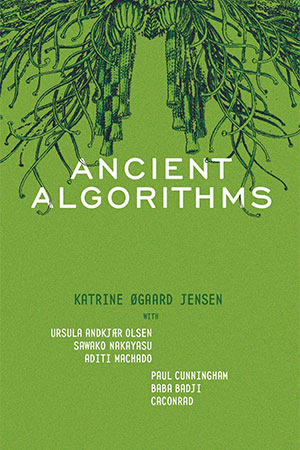
Sarabande Books. 2025. 120 pages.
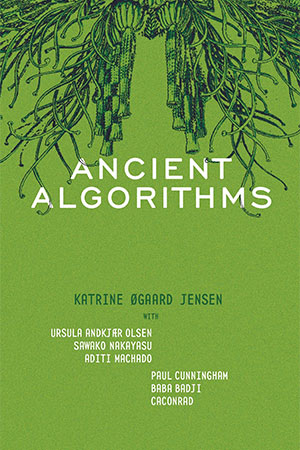
There are books of poetry and books about poetry, just like there are translated books and books about translation. Ancient Algorithms is all this (and more). The book originated with Katrine Øgaard Jensen’s English translations of three books by the Danish poet Ursula Andkjær Olsen, all published between 2017 and 2022 (see WLT, Sept. 2018, 24). While undertaking this project, Jensen “chose to let the English versions evolve in translation as well” and found a most suitable accomplice in the author herself, who “enthusiastically participated in rewriting her own texts in English.”
In her “Note to the Reader,” Jensen explains how “the resulting translations were hybrids,” with her “English voice imitating Olsen’s Danish voice, and Olsen, in turn, imitating my English voice imitating her Danish voice.” This led Jensen to escalate the collaboration further, first “by deliberately ‘mistranslating’ certain poems together,” and eventually by inviting other poet-translators “to pick a poem from Olsen’s trilogy to transwrite or mistranslate based on a set of self-imposed rules.” The latter requirement adds a new and fascinating dimension to the project and the book.
The collection is structured in eight sections. Six of them begin with a Danish poem by Olsen followed by Jensen’s English translation, followed by a couple of “mistranslations” based on rules established (and self-imposed) by a fellow poet-translator (Baba Badji, Paul Cunningham, Aditi Machado, Sawako Nakayasu, or Olsen herself), to which Jensen responds in kind. The first section, for example, features the Danish and English versions of a couple of Olsen’s poems, followed by Sawako Nakayasu’s implementation of her rule “One poem infects another,” followed by Jensen’s rewriting of Sawako’s poem “From the perspective of the woman in the chair of Peter Blume’s 1932 painting Light of the World,” followed by Sawako’s “Copy the words from previous poem in reverse order, adjust,” and then by Jensen’s “Feed an AI image generator lines from the previous poem and describe the images produced by the generator.”
In other sections, Jensen engages directly with fellow conspirators CAConrad and Olsen to create poems based on rules referring to rituals and card or word games, respectively. Jensen’s reliance on runic divination or “various online poetry generators” contributes an Oulipian touch to the project (it also validates the book title, derived from one of Machado’s poems), while the overall approach, with poet-translators challenging themselves as well as each other, is vaguely evocative of a medieval poetic contest—or a postmodern, technology-enhanced, posthumanist version of it, which is what the introductory question, “To whom do the poems in this book belong?” hinting at poststructuralist concepts of authorship (and its disempowerment), seems to imply.
And yet authorship (or authorcraft), rather than authorial individuality (and power), is central to the way in which—and the extent to which—ideas and themes originated in Olsen’s poems evolve, expand, and grow throughout the book, in the various “mistranslations,” transcreations, poetic transfusions, cross-pollinations and contaminations that make Ancient Algorithms one of the most original and engaging poetry collections today.
Graziano Krätli
North Haven, Connecticut