
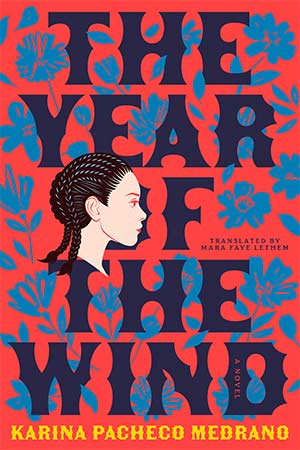
Graywolf Press. 2025. 240 pages.
Economists refer to the 1980s as Latin America’s “Lost Decade.” Uncontrolled foreign debt and inflation depressed incomes, leading to the region’s worst economic crisis in history. But in the impoverished highlands of Peru, this period is more hauntingly remembered as “the time of fear.” There, in the early months of 1980, a violent conflict erupted between the Maoist guerrilla group Shining Path and government forces. Twenty years later, nearly seventy thousand people were dead—mostly Indigenous—and thousands missing.
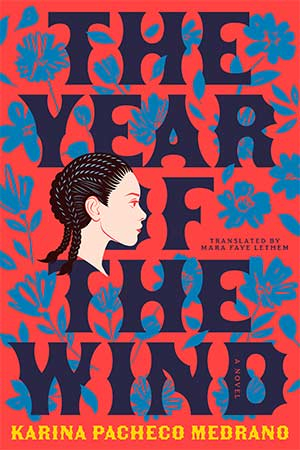
One of the missing is the subject of Karina Pacheco Medrano’s The Year of the Wind. The novel is narrated by Nina, a Peruvian writer living in Madrid, whose work is interrupted one day when she encounters a woman who looks remarkably like her once-beloved cousin, Barbara. Nina hasn’t seen Barbara in forty years and is shocked when her doppelgänger reveals that Barbara is dead, not living in Brazil as her family says. To uncover the truth, Nina travels back to Peru and to the Andean village where she once spent a joyful summer with Barbara and her grandmother, Bernarda. If Barbara truly is dead, could her death be traced back to “the time of fear”? And could the truth be worse than what Nina imagines?
This mystery pulls the reader along as Nina revisits childhood memories in the city of Cusco, where her family lived mostly unaware of the conflict in the highlands. Nina recalls how it once took them a week to learn that insurgents had blown up several telephone towers in the Andean town of Ayacucho. “Nothing about the attack appeared on the national television news,” she writes. Sheltered by geography and censorship, Nina spends her afternoons roller-skating and visiting the cinema, even as Barbara, six years her senior, exchanges letters with a secret admirer suspected of involvement with Shining Path.
According to Peru’s Truth and Reconciliation Commission, Shining Path was responsible for slightly over half of the conflict’s deaths; the military for the rest. But Pacheco Medrano is not interested in taking sides or assigning blame. Her protagonist is less troubled by the possibility that Barbara became an insurgent than by her own ignorance of the armed conflict. In the highlands, Nina encounters characters who reluctantly help her reconstruct Barbara’s fascinating, if troubling, story. It’s a story that mirrors their own. And the more Nina learns, the more readers feel the pain of losing the veil of innocence that’s protected her worldview for years.
This is a well-researched novel and the first of Pacheco Medrano’s to be translated into English. In her seamless, idiomatic translation from the Spanish, Mara Faye Lethem captures the clarity of the original prose and poetry (sections written in verse evoke Barbara’s grandmother’s voice). The author’s anthropological background is evident in her craft. Characters are carefully constructed, and the author’s gaze is unflinching, almost scientific, as they recount the atrocities they witnessed and endured.
Shifting between present-day Madrid and 1980s Peru, the novel’s structure can be, at times, confusing. Especially in the first half, one wonders if the narrative loses some energy by relying too heavily on flashback and retrospection. Yet this is as much a story of the conflict’s victims as it is of their surviving relatives. Many of them live in a tragic limbo—suspecting, but not truly knowing, that their loved ones are dead. A cruel uncertainty. Clinging to hope, however minuscule, these families cannot mourn. The Year of the Wind begs us not to ignore them. The “Lost Decade” should remain an economist’s term to recall a financial crisis, not a corollary of our collective, willful amnesia. (Editorial note: César Ferreira’s review of El año del viento appeared in the May 2022 issue of WLT.)
Krista Timeus Cerezo
Barcelona