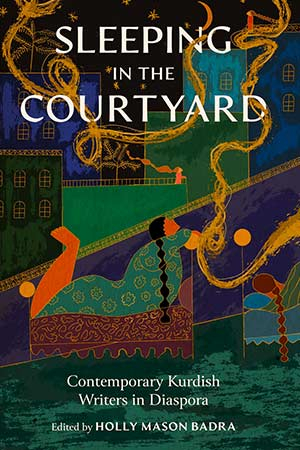

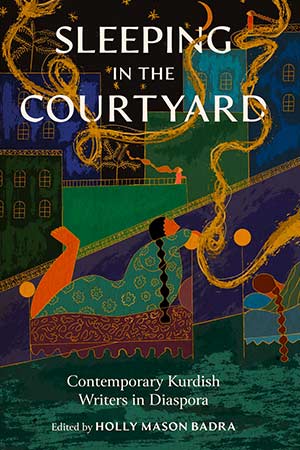
University of Arkansas Press. 2025. 138 pages.
There is nothing simple about explaining who Kurds are and what struggles they have survived. Furthermore, Kurdish literature has historically not been easily accessed in the English language. I met the editor, Holly Mason Badra, by accident on social media through another Kurdish friend. From there, I attended a reading of the anthology over Zoom, where I was able to hear several of the twenty-four authors read selections of their work from the publication. Something significant that I realized Badra had focused on for this collection was how contemporary Kurdish literature is exemplified by “female and nonbinary voices,” a unique addition among Kurdish publications.
Badra makes excellent use of the introduction to briefly acquaint the reader with Kurds and explain her methodology for building this collection. Here, Badra shares that the heartbeat of the anthology is “togetherness” and that, in accomplishing such a goal, “this collection resists confinement.” Thus, producing a publication of mixed media—poetry, graphic novel, prose excerpts, memoir—to allow diaspora Kurds the unbridled freedom to express themselves rather than curating ideas for serving a monolith of Kurdish identity often built by those of non-Kurdish identities. However, that doesn’t mean there are no unifying elements among the selections in Sleeping in the Courtyard. If anything, the conversation each piece has with other pieces is more vivid and active.
I read most of this publication while in Southern (Iraqi) Kurdistan, and a line of poetry called out to me from the page as one of the underlying themes that binds these authors together. Zhawen Shali, in her poem “Yesterday,” perhaps captures a significant, unifying reality of what it means to be Kurdish: “I am deprived of land / and tired of war.” In dialogue with that, I am still haunted by the excerpt from Maha Hassan’s work “In Anne Frank’s House,” where she writes in a diary (much like Frank, to the ghost of Frank) while living in her famous Amsterdam home during a residency. The seemingly unlikely discourse between an exiled Kurdish writer from Rojava (Syria) and a young, long-deceased Holocaust victim perfectly describes how the anthology can speak across cultures, identities, and struggles.
Although this is an incredible book of literature that showcases the complexity of Kurdish lives around the world, one does not need to be Kurdish to connect with the raw human experience captured in its pages.
Taylor Nasim Stone
Indiana University