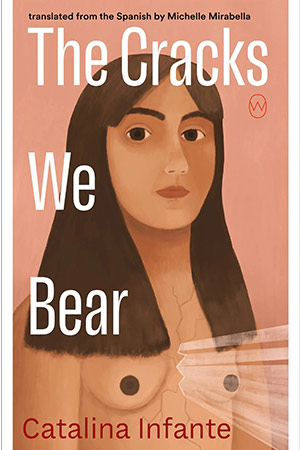

World Editions. 2025. 118 pages.
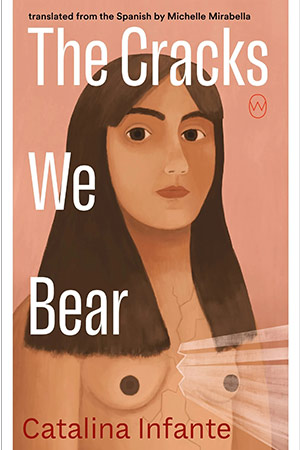
Chilean author Catalina Infante Beovic and translator of her work into English, Michelle Mirabella, are certainly no strangers to readers of World Literature Today. Infante Beovic’s story “Ferns” was published in June 2020; she authored essays that were published in 2021, 2022, and 2025; and an interview with her was published in August 2022 (all translated by Mirabella). The arrival of the first novel-length work from the duo, then, certainly seemed inevitable, and readers of English can credit World Editions for the opportunity to join Infante Beovic in the depths of what she terms “landscapes that are woven throughout this story” as well as “the landscapes within of grief and postpartum.”
First-person narrator Laura brings readers immediately into the realm of mothers and daughters. She and Felipe have brought their new daughter, Antonia, home to the residence that Laura has inherited after her mother’s recent death from cancer. The past and the future now reside under the same roof. This framework allows brief chapters to move fluidly between the past (Laura has memory dreams of times before her mother’s diagnosis and sees fragments of her parents’ exile during the Pinochet dictatorship in Chile) and the present (mother and infant bond; Laura doubts her capacity for motherhood; and the relationship between Felipe and Laura becomes strained).
Infante Beovic never allows us to forget the title of the book. Certainly, the plot elements can be seen logically as locations of stress fractures within an individual, between characters, or even within cultures. Logic, however, is not the true power of her work. Whether it is postcards found in the closet of the bedroom, a fight with Felipe, or an evening with friends while Felipe’s mother keeps Antonia for the first time, each episode reverberates with layers of strain and tension. We feel Laura’s desperation, her grief, her fatigue, and her despair: “My therapist says relationships are full of cracks . . . but I wonder just how many cracks a jug can bear before it shatters.”
The first half of the read has the feeling of just such an image—multiple cracks developing, growing, blending into one another without much of a linear plotline unless it is all leading to that jug shattering. Unsuspectingly, though, the story moves organically and archetypally forward. A solar eclipse provides Laura with the opportunity to contemplate her place in the cycle of female life: mother and infant lie in a hidden corner of the garden, resting on “freshly replanted grass.” The imagery of the scene strikes a multisensory chord of light and dark, youth and age, hope and fear.
If the nature of cracks dominates the first part of the book, then the “bearing” of the cracks as Laura and the reader move forward takes over later portions. Her memories seem to have the essence of answers as opposed to the brutal stab wounds they inflict earlier. On a road trip into the mountains with Felipe and Antonia, Laura is able to recognize and distinguish her physical fatigue, her postpartum, and “this belated grief.” She has moments of claiming her own journey and the view of a future.
Much can be said of the geographical and political contexts of the book. Chile during and after the Pinochet regime, Communist Cuba, and Paris all appear momentarily in the text but with gravitas and a Hemingway-esque significance. Notwithstanding, The Cracks We Bear is a text that transcends its context with character, symbolism, and themes universal. Infante Beovic is not simply a tour guide through her identified landscapes of grief and postpartum womanhood. Quotable lines are not commentary but exclamations and epiphanies of a woman feeling the fractures, naming the realities, desperately navigating those spaces for all who come along for the journey.
As a debut English-language novel for both Infante Beovic and Mirabella, The Cracks We Bear is a resounding success. The partnership between the two has created a relevant, rich literary statement. (Editorial note: Read the author’s short story “Nostalgia for Desire” from this same issue)
J. Walsh
Butler, Pennsylvania