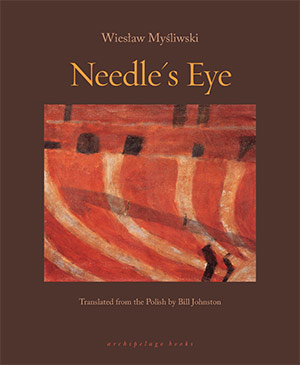

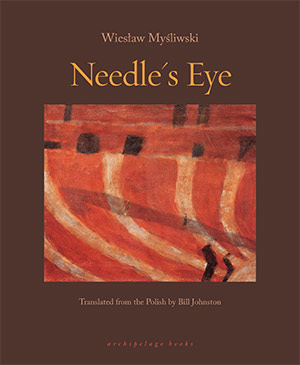
Archipelago Books. 2025. 418 pages.
To watch Alain Resnais’s 1961 film Last Year in Marienbad in real time is to understand half of it. Pause the reel anywhere and observe every detail; rewind to a place connected with the image and play in slow motion, then fast-forward to another scene to reach fuller understanding. You may have to do that several times to clarify the fuzziness of reality, identity, and memory characteristic of 1960s New Wave cinema.
Needle’s Eye seems to revive a sophisticated version of this deconstructionist genre of personality disintegration and chronotopic atomization. Like Anjet Daanje’s The Remembered Soldier or Gao Xingjian’s Soul Mountain, Wiesław Myśliwski’s narrator reminiscing is triggered by trauma. Old age revives the need to bring closure to his unfulfilled first love and sends him into a dizzying pollarding of memory that turns Needle’s Eye into a masterful phenomenology of introspection.
Time is “cunning as a fox . . . malicious. It can flow in one direction and simultaneously in the opposite one. . . . It pulls us where it will. Backwards, to when we didn’t yet exist, and forwards to where we’ll no longer be there. It plays with us, fully aware that there’s nothing we can do about it. It’s not hard to play with human beings.” Myśliwski illustrates this concept by making his narrator’s young and old selves interact with each other in Kafkaesque style. In the first chapter, an innocent bystander (the young narrator) is detained, interrogated by the police, and suspected of having witnessed and perhaps abetted a nonexistent crime on an old man (his older self) at a place called Needle’s Eye, where the older man fell down the steps and died. Self-doubt ensues, then guilt and imposter syndrome. But it is unclear whether these feelings come from his youthful shyness or from his inability to save his old self.
There are three prerequisites for good writing, says Myśliwski in online interviews and postings: taking the first step, using the right words, and reconstructing one’s own life in a sensible way. The most difficult part is the first step, for it is the heart’s. Naming things is no less important. “Naming is knowing. We need words if we want to know.” And “how people live is the hardest thing to explain.” As the novel shows, the “Siamese twins” of the banal and the sublime are separated by word choices. Opening with an unremarkable memory, each of the ten chapters climaxes in a searing, unforgettable image. As for reconstructing one’s life, the only coherent version of the narrator’s life is an official one given by his admirers, who invite their famous native son to visit his hometown for a public celebration of his life.
Memory exercises a “collective responsibility” that “obliges us to remember far more than we’ve experienced . . . even sets a norm for our memory that is appropriate for the time we live in. And the norms knead people’s memory like dough, so that whether we like it or not we adapt our memory to the norms laid down by one or another time.” This collective responsibility is assumed through the social and historical context of the novel that broadens the personal narrative into a portrait of the age in vividly realistic outbursts. From World War I to the age of the internet, through wars, authoritarianism, anti-Semitism, the Holocaust, and postwar communism (with an emphasis on the rebuilding years of post-1945), the encounter of rural poverty with modernist urban affluence is dissected with scalpel-like precision.
Needle’s Eye is first and foremost a love story between a Jewish girl and a shy teenager. Needle’s Eye, the segment of an ancient fortification wall traversed by steep steps, seems to fit an existing structure in Sandomierz. It is a metaphor for life’s ups and downs and for the divide between residential districts separated by a mythical “old wild green valley.” Furthermore, it is the place where the two adolescents used to meet. Memories whisper about the love that might have been; Jewish life emerges as a watermark; in a final reveal, the narrator sees his beloved running with her little sister to catch up with a column of ghetto deportees. This image mirrors his escape from the town’s well-wishers. His fragmentary memories continue to haunt him with final nothingness. Even though he has spoken as a child, a factory worker, a student, and a professor, the repetitiveness of key romantic memories bears a poignant resemblance to the droning daily routines of old age.
Born in 1932, Myśliwski is deeply rooted in Lesser Poland, where Sandomierz is a significant urban center. Needle’s Eye (2018) is his seventh novel. After earning a degree in philosophy from the Catholic University of Lublin, he worked on the editorial staff of the People’s Publishing Cooperative and became editor in chief of the cultural quarterly Regiony. He won the Nike Prize twice, in 1997 for Horizon and in 2007 for A Treatise on Shelling Beans. A quiet, retiring writer, he has been thrust into the limelight many times. The Brooklyn Rail describes him as “the sort of obscure Central European writer who shocks everyone and wins a Nobel.”
Alice-Catherine Carls
University of Tennessee at Martin