
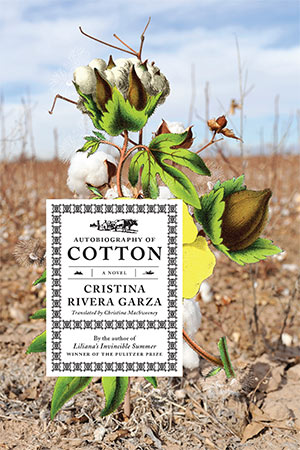
Graywolf Press. 2026. 264 pages.
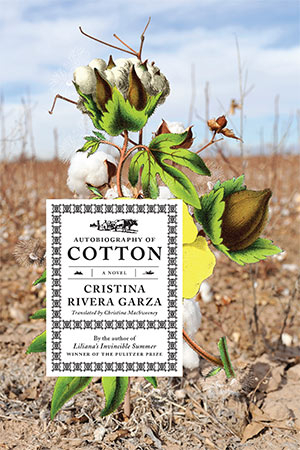
Pulitzer Prize–winning author Cristina Rivera Garza desperately wants to paint for us the tortured lives of her grandparents and great-grandparents who struggled valiantly working as miners and farmers, often traveling between the borderlands of the United States and Mexico. Her latest novel to appear in English, Autobiography of Cotton, is filled with poignant passages where we hear Rivera Garza straining to immerse herself in her ancestors’ lives.
Certain revelatory moments grab hold of us. One involves her paternal grandparents traveling with their two-year-old son, who would grow up to become Rivera Garza’s father. Her grandparents were going to Ciudad Anáhuac in the far north of Mexico during the 1930s, chasing a dream of finally finding a place for themselves in the world. They were part of a group of daring pioneers who believed they could transform a dry, vacant desert into a gigantic cotton plantation upon which they all could thrive. It would be built by diverting water to the region through a new and innovative irrigation system. Many thought the idea was mere folly, but Rivera Garza’s scrupulous research uncovers the forces that were supporting it, including the Mexican government.
The initial cotton harvests were promising, and Rivera Garza discovers how such a wild idea came into fruition. She writes, “Things are born and die several times in unpredictable cycles. One fine day, a general who has won the war looks out to the horizon and, instead of seeing a grim, dry wilderness, instead of seeing inhospitable prairies or empty spaces, sees neatly ordered parcels of land, sees crops and harvest. And he thinks: The agriculture will start here. His declaration would sound less grandiose if it weren’t true. In brief memoranda, he orders the construction of a dam at the confluence of two rivers.”
Rivera Garza captures the fragile hopes of those who went to Ciudad Anáhuac determined to make a life for themselves far better than the one they were living. Finally, there might be a chance for them to have the peace and dignity they craved. There was early promise things might work out. The workers united, pressing for a decent minimum wage and an eight-hour workday. A radical named José Revueltas was dispatched from Mexico City to help the workers organize and prepare to strike. But before any of this could be negotiated, the water system failed, followed by a huge flood, and then draught. Her grandparents fled, as did the others, disappointed that the Mexican Revolution that had offered them glimpses of hope for a new world order seemed now to be nothing more than empty promises.
The story goes back and forth in time, and in the short glimpses of the present we hear Rivera Garza speak about her frequent odysseys back to Mexico, repeatedly drawn back from Houston, where she lives and teaches at the university. These trips seem to have no center; there is a vagueness about her reflections as well as her wanderings. She drives down desolate roads staring at dawdlers. She walks quietly in cemeteries looking for graves of her dead relatives and sometimes gets lost from her partner and son as she wanders seemingly deep in thought. But we aren’t certain what it is she is thinking about. Nor does she tell us.
The author visits ruins and looks for commemorative plaques that speak to the degradations inflicted on so many Mexican people, but when she finds them, they seem like mere tokens of something already half-forgotten. When she visits the area of Ciudad Anáhuac where a miracle once occurred for a blink of time in Mexico’s volatile history and then self-destructed as fast as it materialized, she finds only a few huts and some stragglers along with a random priest. If she is experiencing any sort of personal reckoning, we are kept in the dark, lost in a melancholy vagueness.
Our spirits are briefly lifted when she speaks proudly of her grandmother Petra, who felt compelled to learn how to write, bewildering the others. Rivera Garza imagines her grandmother in the act of writing with a moving tenderness: “When she held the charcoal and leaned over a piece of paper, her siblings observed her with a hint of reverence they avoided showing when she would raise her head. . . . The position of the body was unheard of. A true revelation.” No one in her family had ever done anything like that before. It is one of the few moments when we feel the author’s exhilaration and think, perhaps Rivera Garza feels her grandmother’s ambition to learn to read and write may have been the initial prompt that resulted two generations later in her own career as a writer of worldwide renown.
But Rivera Garza seems uncomfortable around any sort of jubilation. There is a generalized lostness about her that remains unsettled. She admits she feels closest to those she meets on the road in Mexico’s far corners even though these encounters are transient and seem to be without any memorable substance. She isn’t sure why this is. She concedes that her desire to find things out about the past, or even to know herself better, is always fighting with the part of her that is afraid to know more. It is one of the few times in her brief appearances through the narrative that we hear her delicately embrace a blessed ambivalence, and we rejoice. Because we recognize her uncertainty as our own.
Elaine Margolin
Merrick, New York