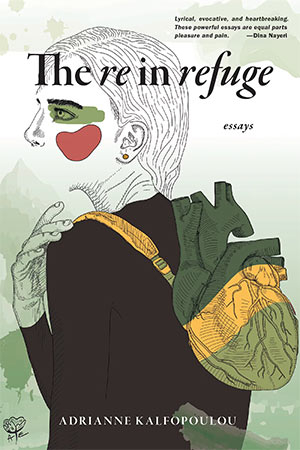

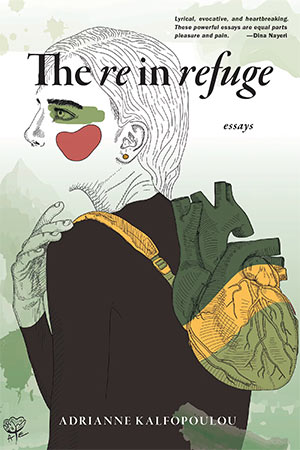
Red Hen Press. 2025. 181 pages.
At the heart of Adrianne Kalfopoulou’s The re in refuge is the experience of crossing borders—primarily international, cultural, and linguistic but also erotic, psychological, and intellectual, among others. A Greek American writer and professor based in Athens, Kalfopoulou offers a sensitive, wide-ranging meditation on displacement and belonging—her own as well as that of others—as she chronicles over a decade of working with refugee communities in Greece.
Her position as both outsider and deeply embedded volunteer gives her a unique perspective as she navigates the complex terrain between observer and participant and explores the intricate dimensions of her relationships with those struggling to reach a safe haven.
What distinguishes The re in refuge is Kalfopoulou’s refusal to romanticize her role or the experiences of the refugees she interacts with. Working at an abandoned school converted into a squat, she serves as volunteer, English teacher, and fellow human navigating displacement. She learns Arabic phrases from Syrian children, participates in community celebrations, and finds herself markedly changed by immersive encounters with families from Afghanistan, Syria, Kurdistan, and elsewhere.
She and fellow volunteers, dubbed “the Central Athens Irregulars,” recognize their meaningful work cannot eliminate displacement’s root causes. Yet within such limitations, she finds possibilities for genuine human connection. Those interactions become vehicles for forming a deeper understanding of displacement, privilege, and how personal narratives intersect with historical forces. Through them she begins to perceive Athens as the refugees might see it: abandoned spaces might become sites of community-building and resistance, while at the squat she, too, feels herself a guest.
Her volunteer work becomes a form of political witness, demonstrating alternative approaches to refugee support outside official frameworks. Serving alongside other volunteers, including poet A. E. Stallings and translator Karen Emmerich, she participates in art projects and poetry workshops that recognize refugees as complex human beings rather than merely aid recipients. Workshops become spaces of mutual learning where traditional helper/helped hierarchies dissolve.
Crossing borders, whether cultural, psychological, or emotional, also implies the blurring of that which was deemed separate. Throughout The re in refuge, Kalfopoulou skillfully weaves intimate and political dimensions, showing how working with the displaced illuminates aspects of her own self as well as numerous social, political, and systemic failures. She points out that boundaries both provoke and inhibit desire, just as the impulse to cross them, especially under duress, ruptures one’s adherence to generally accepted norms and laws. Borders hover in ambiguity and as such are thresholds of potential, both positive and negative.
Crucial to finding and attempting to sustain refuge is language. Most of the sixteen pieces in this collection address, and often challenge, the parameters of language, whether it’s the hand gestures, emojis, and ad hoc words between speakers who don’t share a language or the author reflecting on the tragic absurdity of teaching the rules of composition at her university day job while “the bodies of refugees were being washed up daily on the island shores of Lesvos, Samos, Leros, and Kos.” Or exploring how the word “refugee” contains “refuge,” suggesting that language and cultural identity are portals for myriad understandings of home. A key message in these essays, and a theme that links them, is that crossing any border is also crossing a threshold of signifiers, and as such engaging in shifting forms of discourse that both sustain and rupture meaning and its consolations.
In short, The re in refuge offers a compelling account of literary witness that neither exploits subjects nor retreats into abstractions. Kalfopoulou’s various relationships create a complex portrait of solidarity across differences of nationality, class, and circumstance. Taken together, her essays make a convincing argument that refuge is not “simply a place but a practice,” one that acknowledges both difference and common ground, mutual vulnerability, and the recognition of shared humanity.
Don Schofield
Thessaloniki, Greece