
Illus. Rina Yoon. Artepoética. 2025. 126 pages.
Nothing feels more vulnerable—more connective—than reading the writing of another; except, perhaps, relying upon emotion alone as our guide. Still, the more powerful voices connect us in ways that reason often cannot. I don’t need to have borne a child to understand the precarious balance of limitless joy and depthless worry, just as you do not need to have been a child burying a father to understand the ache.
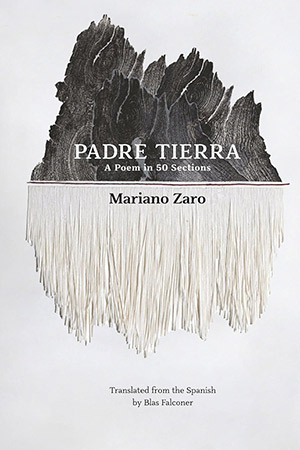
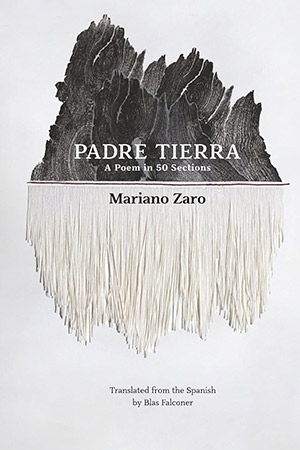
Spanning the lifetime of a father-son relationship, Mariano Zaro’s Padre Tierra explores their connection—which might just extend beyond the body to the very ground that claims them. Yet experience is not the only barrier to understanding. There is language, too, not just speaking but meaning. At this intersection comes Blas Falconer’s translation, cementing a bridge between the lines’ original Spanish and an intentionally wrought English expression. To say these lines is to understand the men themselves; Falconer paints the process as one of learning the other: “not only the literal meaning of [Zaro’s] words but the emotional urgency with which they are uttered” the more familiar they become.
Listening, then, is key. Pay attention to the sounds, the words themselves. For Zaro’s work in linguistics is masterful, manipulating a beautiful contrast of melodies and images, such as “seeds / hundidas . . . sunken” in refreshing “el agua de limón / lemon water.” We’re drawn under the immediacy of the image and ask what poetry often does. Why? Why that image for that feeling? What is the onion to legacy that nothing else could be, layered, in Naomi Shihab Nye’s “The Traveling Onion”? What is the purpose of the “reptilian” landscape poised against or within the home of Zaro’s work? And where do our father and son fit?
In translating the words, Falconer’s lines move like a current, ebbing softly between the beauty of the languages and stoking the intimacy of this work’s attention to the in-betweens: that of the speaker with his father and home; the translator and creator; the line and the listener. Reading it, simply, is one of the great pleasures of this collection. Within and beyond meaning is the melodic orality it invites of readers. And even if the best of poetic audiences feel daunted by the interpreting part, we love the sound of a great poem. In some poems, the language ripples like water: “Caminas descalzo / sobre la tierra / que te conoce y huele / como perro pródigo. You walk barefoot / over the ground / that knows you and smells you / like a dog once lost” (Poem 19).
We can hear the innate rhythm of language shift through what we don’t understand but can feel the truth of as emotion builds in the breaks. At such moments, Falconer proffers the full weight of the emotion: the comforting image of a home that has always known the man. Yet, regardless of your Spanish comprehension, Zaro’s work is sure to be enjoyed purely for the joy of speaking it. He has woven his lines with such a meter that to move your way through them creates a sensory immersion all its own, and readers can delve deeper into a tongue that only continues to give back.
I have much to praise here: the freeing rhythms, Zaro’s imagery, Falconer’s transference of it to a new tongue. I do have one suggestion: do not miss the foreword. Read it once before you start, then again, because Falconer’s perspective will change how you read the book. Now, opinions mean that different readers will have different interpretations, but for this work, Falconer’s earnest remarks on translation changed the way I will forever approach the form. Not just the work, but how I read those second windows into meaning. Framed by a lens of meaning, and the ideas of Jorge Luis Borges, Falconer’s work proposes that there is more to what we “mean to say” than in the words themselves. One may be the vehicle, but the other remains our destination.
Jessica Van Orden
Wilkes University