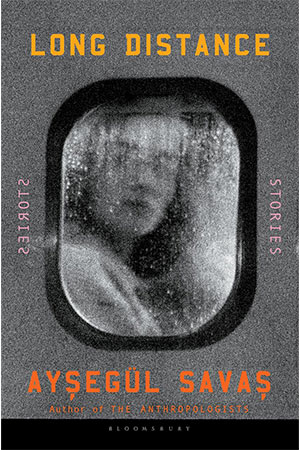

Bloomsbury. 2025. 240 pages.
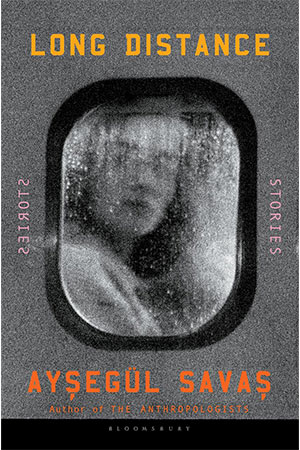
Most of the protagonists in Ayşegül Savaş’s new story collection, Long Distance, are women who have freshly arrived in a European city, and Savaş highlights their various trials and tribulations in these new places. The stories are concerned with distance, connection, and relationships in the current age of hyperconnectivity and how people grapple with them. Much like her previous novels, The Anthropologists, White on White, and Walking on the Ceiling, she probes the mundane with a phenomenological lens through these stories.
Savaş’s previous novelistic ventures are notable for their sense of levity, a subtleness to her characters who seem to be arriving at and settling in a new place, trying to eke out a life of their own. That sensation flows effortlessly through this set of stories, too. Playing deftly with a range of characters, Savaş’s stories are sometimes funny, sometimes generous, sometimes sweetly melancholic about a version of a person we’ve been in the past. They explore the various degrees of separation we experience from ourselves whenever we are flung out into a new place, making us just as new to ourselves as to others. A cognitive dissonance of being in two places at once—this new home and the one known before.
People on the cusp of change, at the precipice of an advancement or about to make that big, irreversible decision in their lives—Savaş is interested in them. In “Practicality,” the protagonist watches her mother move through a difficult new stage of life as her illness erodes her health. She fills the empty space of her pondering hours with thoughts that seem to help her hold on to the present. Savaş’s writing is feather light, casting the characters in a glow that makes them feel otherworldly yet of the present and now. The protagonist cherishes her time with her mother, seeing her mother slip away before her eyes.
Is this what life and death are supposed to be? “It wasn’t until several hours later,” the protagonist’s internal monologue goes, “when I went inside for a glass of water, that I realized the uselessness of my work: everything, not just the house but the garden too, would be demolished in the coming months.” Going through this journey, we see the protagonist suffer from a kind of emotional fatigue that doesn’t agree with her. Taking care of her mother, watching her pass away, taking stock of her own emotions—all these happening simultaneously arouse many emotions within her. In lesser hands, this would’ve come across as trite, a little too twee, but Savaş renders the pathos with the sincerity of an anthropologist. This is perhaps also what makes these stories, their characters, and, by extension, Savaş vulnerable and open like never before for us as readers.
The titular “Long Distance” is a meditation on the lives of a couple who are navigating the simultaneously new yet burdened and sullied waters of being in a long-distance relationship. It stands out in the depiction of the slightly neurotic Lea through whose eyes we see the events of the story unfold. She’s a researcher, and her boyfriend, Leo, is visiting her in Rome as she creates a physical, emotional, and mental itinerary for his visit. She holds him and their relationship in high regard in her head, wanting to make the most of his visit. In doing so she ascribes an almost unattainable, supreme stature to the imagined version of the relationship.
Through Savaş’s writing, we see how these high, unrealistic, and often preemptive expectations make Lea slightly neurotic, demanding and therefore closed off in her interactions with Leo. In imagining so much, she fails to live the present that is unfolding in front of her. Failed interactions, miscommunications, and several misread actions create an inevitable chasm between reality and expectations, leading Lea to think that Leo won’t be able to impress her colleagues, or that he is lying, or that he isn’t amply invested in their future. To the reader, Leo seems like a balanced individual who is tired after a long flight and wants to relax a bit before stepping out again, but inside Lea’s head we see the endless machinations that an overthinking mind can often spawn. Savaş excels at creating a funny, tight, yet vacation-like atmosphere in this story, masking Leo’s intentions, revealing Lea’s excessive detailing and the overall milieu of the place.
In casting most of her protagonists as expats, Savaş follows the tradition of writers such as Jhumpa Lahiri, Henry James, Ernest Hemingway, and James Baldwin—weighted names who each come with their own baggage. But Savaş’s characters are not bogged down by a preconceived sense of themselves and the places they belong to. They are open-minded, careful but also deeply curious about the new place, its people, and the motions of life there. The way Savaş pens them, the characters seem secure, which begs the question of their departure. If they were so secure, why move out? They seem to be in a place of inquiry, which comes from a position of comfort, making me question the origin of their wonderment in a new place. Perhaps she’s trying to work out the complexities of people through these stories.
In moving away from the usual tropes of expat writing—identity, selfhood, place, alienation, otherness, language, mannerisms—Savaş holds her characters in a humanity that’s affable and reassuring to read. As a foreigner myself in a new city, I know I will be returning to some of these stories again and again to find the laughter, the levity, and the faith that sometimes life doesn’t have.
Anandi Mishra
Gothenburg, Sweden