
Cambridge University Press. 2025. 322 pages.
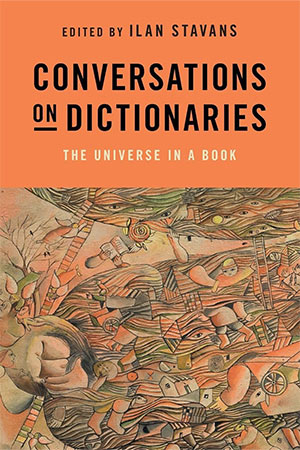
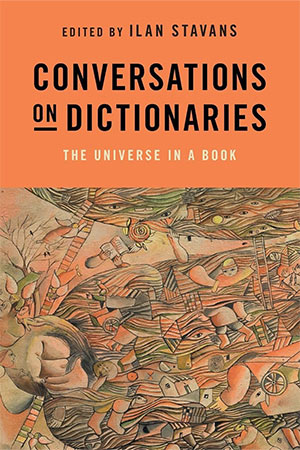
For anyone who has ever wondered where dictionaries come from, Ilan Stavans’s Conversations on Dictionaries: The Universe in a Book offers a collection of dialogues covering the lexicography of a sample of the world’s languages. From Nahuatl to Japanese to Esperanto, Stavans and his expert interlocutors dive into sometimes centuries-long histories, revealing the invisible threads running through dictionaries—and the men and women who labor over them—that connect them to every other aspect of life including politics, religion, culture, academia, and more.
Through the medium of conversation, Stavans invites us to question the role language and dictionaries play in our lives. As languages shift and morph, lexicographers aim to keep pace by capturing language in a time or place in the form of a dictionary. This is a task made difficult because, as lexicographer Peter Sokolowski describes, “language is the water in which we swim when describing ideas, which makes the changes over time hard to notice in our daily lives.” Surveying over a dozen languages, Stavans’s collection helps reveal these currents and offers a sketch of how technology has set a new and exciting course for lexicographers and the speakers they aim to serve.
While the book does not shy away from technical details, Stavans provides the framework to deepen understanding through explanations and a further reading list concluding each chapter. With this aim to appeal to beginners and experts alike, readers may find the book repetitive. The collection rewards a curious approach, starting with the language one finds most interesting and, over time, exploring the rest of the book.
The conversations and voices included in this book ring with clear and enduring passion for language and especially the people and cultures to whom languages belong. Though at its heart a book about dictionaries, readers will walk away with knowledge beyond definition—of history, people, and where we’re headed next.
Mary Ann Livingood
Norman, Oklahoma