
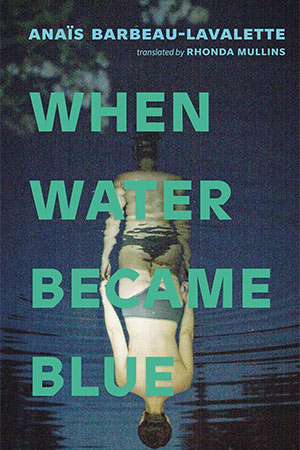
Coach House Books. 2025. 176 pages.
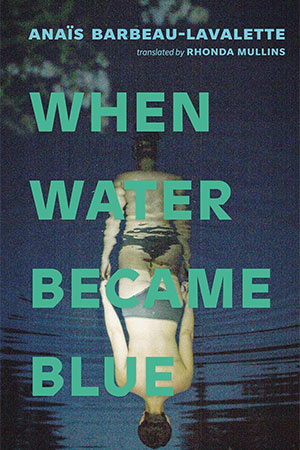
An artist with a mark on the iris of one eye appears in Anaïs Barbeau-Lavalette’s previous novel, To the Forest, whose narrator observes that “eyes could have punctuation” so that she has “found her full stop,” immobile in “this man’s prism.” When Water Became Blue wholly inhabits that prismatic view, that narrator’s suspension.
Barbeau-Lavalette’s use of language is consistent with her previously published work (Rhonda Mullins has translated four of this Québécoise writer’s novels): distilled and precise prose. This sense of elemental truth-telling resonates with the natural environs of an artists’ retreat, but the style here also accentuates isolation.
A focus on a passionate affair with this artist heightens the sensuality of everyday activities—from swimming to driving—albeit twinned with a sense of loss (including a chosen family member’s aging). This anticipatory disconnect has weight: the narrator’s understanding that she will leave this island and return to her husband and family at the end of the summer—and the artist will continue his solitary quest for the essential blue—is omnipresent beneath the surface.
The color blue has preoccupied writers from Dionne Brand to A. L. Kennedy, Douglas Bruton to Raj Kamal Jha, Percival Everett to Susan Abulhawa—whose blue narratives have also circled around memory and a metaphorical haunting, whether via mourning or an endless pursuit/desire. In this sense, Barbeau-Lavalette’s work settles into an established literary tradition, but it also reflects her filmmaking experience, via short visual passages that evoke moods swiftly and powerfully.
Most striking are the narrator’s swims with Narcisse, who chronicles the effects of changing environments on seaweed; she inhabits the same motel where all these artists temporarily reside, along the Saint Lawrence Seaway, but feels most at home in this underwater world. This is where Narcisse feels most connected to her faraway lover; via this relationship, the narrator finds unexpected beauty—breathlessness and mortality take on a particular hue.
In this plotline, but also in Barbeau-Lavalette’s wider work, simple and vital questions emerge—both personally and politically relevant. How do we sustain ourselves when we lack what is essential to our survival, and can we flourish in times of great change?
Coral can flourish while immobile, a starfish can survive with only four arms, and our narrator navigates unfamiliar territory when even the surface of her skin is chemically changed: “Capsized is my new state.” She is thirsty and desirous, and that’s “not a need; it’s a resource.”
Marcie McCauley
Toronto