
Homeward Books. 2026. 370 pages.
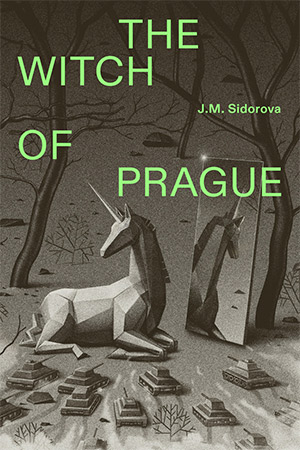
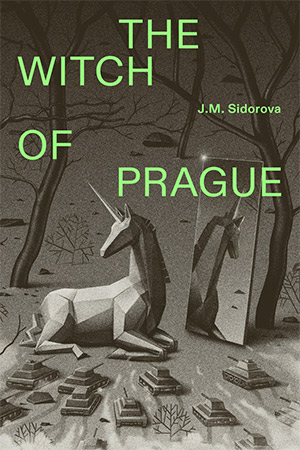
Riffing on Francis Marion Crawford’s gothic fantasy The Witch of Prague (1891), J. M. Sidorova’s transgeneric novel (e.g., history, political thriller, coming-of-age saga, philosophical/spiritual exploration) weaves its strands together with magic realism in a mesmerizing journey through Prague before, during, and after the Prague Spring of 1968. In twenty-nine chapters, seventeen-year-old Alica Hovanova charts her growth from insecure dyslexic teen to confident young woman. Longing to flee her boring school, drab working-class neighborhood, and sexually abusive stepfather, she answers an ad that offers typing lessons in exchange for “light housework.” Tutored by Agata Riedl, her new boss and titular Witch of Prague, she discovers within reality dimensions filled with intrigue and imponderables, a web of interconnected threads that entangle, confuse, and enrich.
From within official ministries, Agata once helped powerless Czechs survive the Nazi and Communist eras—all but her beloved Janek, whom she let security forces jail rather than give up her strength, dependent on virginity. Those powers long depleted, Agata and Janek now live chastely in adjacent flats, their “bible” Swedenborg’s Heaven and Hell. Both appreciate Alica’s potential. Janek teaches her to see more clearly; Agata grooms her as her successor, aided by a magic tapestry.
Metaphors pervade the novel, linking its many worlds, especially Agata’s tapestry, a doubly valent symbol. Fifteenth-century Flemish artists wove a popular six-paneled Christian emblem, The Unicorn and The Lady, portraying a magic beast whose horn can purify (whiten) water and a beautiful virgin who strokes him—the pure woman dispensing grace. But other hangings represent The Hunt of the Unicorn, whose greedy king wants the beast’s horn, the lady now bait or accomplice. As Janek explains to Alica, since Agata’s tapestry once belonged to a Holy Roman Emperor who collected female lovers, it comes steeped in royal misogyny, darkened by acts against women. Manipulated for Agata’s ends, Alica cannot tell which she is, the good lady or the bait-girl. She follows Agata’s mandate to stay a virgin despite male officials’ desires (or her own), rising in the ministries, but never fully claims the tapestry, unsure of its intentions and her role in them.
The utopias of Marx and Swedenborg oppose one another throughout the text, both metaphors describing ascents from base to pinnacle. But while Marx’s vision for a better world grounds communism, Alica maps her Czech reality, where tiny base and superstructure control masses living in fear. As Janek tells Alica, “Metaphor is how we humans got the idea of magic. Magic is someone’s metaphor taken literally by someone else.” Only ardent followers can realize such dreams, Mannheim’s ideological utopias, but their reasons may differ. Thus, Soviet communism succeeds because its zealots crave power, whereas Janek and Agata seek Swedenborg’s “other dimensions,” whose graduated rungs bring spiritual immortality. Within the novel, theirs emerges the better choice, granting serenity.
Patriarchy, too, becomes a central metaphor: Man = Power. Consider Alica’s stepfather, the officials’ depredations, Agata’s sacrificing desire to outmaneuver men; Alica’s rejecting her would-be beloved, Vasek, Janek’s son (who fuels her sexual dreams, as himself, the stag, or the Unicorn) to fulfill Agata’s aims. Appropriately, the founding legend of Prague (c. eighth century) presages this. The matriarchal Queen Libuše envisions a city, names it Praha, and has a castle built. But once she weds, her husband’s line (the Přemyslid dynasty, Bohemia’s rulers from the ninth through fourteenth centuries, from which historians trace the Czechs) seizes control. The Maidens’ War results, the women lose, and the last Amazonian, Skarza, throws herself from a cliff rather than yield. The “Girl’s Jump” has become a favorite tourist attraction.
As Alica enacts her tiny part in preparing the Prague Spring, she witnesses the geopolitical intrigues of the inner party circle, which affirm her initial view of its inverted Marxist structure. Power, not idealism, fuels anti-Dubcek forces. And when tanks arrive in Prague, she grasps the people’s role as quiet resisters. But the usual suspects return to power. Wondering how she can help other Czechs, Alica has a sudden epiphany, a vision of the vast world and its many threads, “like it was a fabric. Or a tapestry. Like I was part of it. Or it—part of me.”
Agata and the magic tapestry gone, she has internalized their strength and gained the wisdom to work from inside for those the regime would crush, as both bait-girl and pure lady.
A coda links the tapestry to Swedenborg. Our “fledgling witch” sees the missing, presumed dead Janek on a nearby bench. Following him to the “third bank” of Prague’s river, the Vltava, she discovers a beautiful forest and a lovely, whitened fountain surrounded by calm beasts. When “the fabric of my reach is too much to bear,” she will return to Janek’s “safe haven,” choosing Swedenborg’s peaceful utopia. The Witch of Prague, itself a magic tapestry, invites us to probe more deeply the metaphors we make and by which we live.
Michele Levy
North Carolina A&T State University