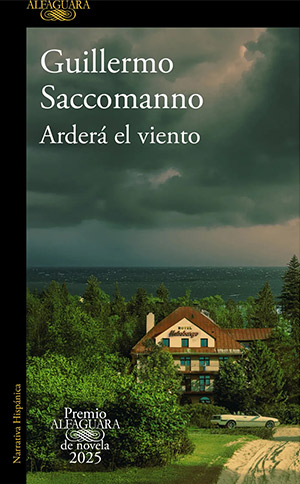

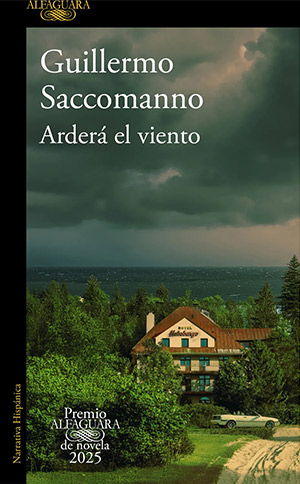
Alfaguara. 2025. 233 pages.
Considered one of Argentina’s leading intellectuals, Guillermo Saccomanno is a seasoned writer who has garnered many literary prizes for his novels and essays. His most recent novel, Arderá el viento (The wind shall burn), was awarded the Alfaguara Prize for 2025. The novel’s title was inspired by a quote from the Greek philosopher Heraclitus of Ephesus that serves as its epigraph and foreshadows an apocalypse: “Vendrá el fuego y juzgará todas las cosas” (The wind shall come and judge all things). Heraclitus viewed fire as the element of transformation, of both creation and destruction.
While fire plays this role in the novel, the primary agent of destruction is Monique Dubois, a nymphomaniac who arrives in town with her husband, who presents himself as the Count of Esterhazy, a Hungarian noble. The strange couple has two children: Aniko, their angelic daughter, and Lazlo, their evil son. The couple establishes the Hotel Hapsburgo upon the ruins of a failed hotel. Arderá el viento is the story of the malefic influence of this family upon a small Argentine beach resort, which in the past had been a popular spot for German immigrants, some of whom may have been Nazis or Nazi sympathizers.
The novel presents a dark vision of a society where evil and the seven deadly sins hold sway. Monique Dubois exploits her sexuality to seduce, control, and ultimately destroy the lives of the most powerful men of the town. An aspiring poet, she later turns her attention to authoring an erotic novel, El hotel de la lujuria (Hotel lust). In her depravity, she models her protagonist after her innocent teenage daughter. Her husband is a frustrated painter who realizes he will never be able to express himself. Lazlo, who fails to learn to play the piano, out of envy destroys the hand of his instructor, ending her dream of becoming a concert pianist. Aniko is an innocent, naïve girl who tries to interpret the present and predict the future of others. The aspirations of the father, mother, and son to create literature, paintings, and music are frustrated and end in tragedy.
The contemporary problems of economic disparity, political corruption, racism, drug trafficking, violence, and insecurity that plague Argentina and many other nations serve as the backdrop for this strange family drama. The novel consists of 127 fragments, which weave together the threads of the novel’s many story lines. A narrator, who serves as the collective voice of the community, cynically comments upon the views and beliefs of the town’s citizens who are keenly aware of what is transpiring but remain silent. Another of the novel’s characters, the journalist Dante, muses about the collective guilt and violence that plague their town. There is a sense that, despite cataclysmic events, the town and its citizens shall see no change or redemption.
In sum, Guillermo Saccomanno has produced an intriguing and suspenseful novel that explores the darker side of contemporary society.
Edward Waters Hood
Northern Arizona University