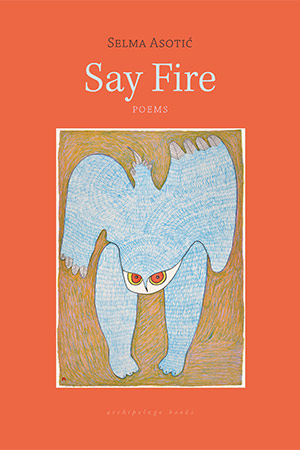

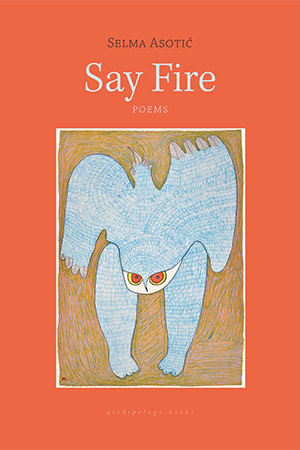
Archipelago Books. 2025. 64 pages.
Bosnian-born bilingual poet Selma Asotić earned her bachelor’s degree from the University of Sarejevo, a city marked by the tragic Bosnia-Herzegovina war from 1992 to 1995 in which around one hundred thousand people were killed, up to 80 percent of them Bosniaks (Bosnian Muslims). Her debut collection of poems, Say Fire, reflects trauma and its manifestations, many of which cannot be directly expressed or even remembered, but must find a method in the interstices of language and signification where a potent Wittgensteinian “silence” articulates the ineffable found in the scars, memory erasures, and losses of war.
The poems in Say Fire reconstruct a world of fragmented representation arising from the oblivion of snuffed-out lives, loves, and memories. War perverts and limits the efficacy of language: “Sometimes you need to lie to tell / the truth is what poetry taught me.” Thus poetics goes beyond truths and untruths and explores the territory of the untellable. Not only do words lose their ability to mean; bodies themselves lose their ability to stay whole as they are “pulped to dark.”
No one emerges unscathed from the war; trauma engenders trauma so that thirty years after the truce, casualties still occur as psychological manifestations: fugue states, depression, even suicide. Many of the poems center on the suicide of a relative by grenade. The reader slowly becomes aware, haltingly, in the prose poems interspersed with the lyrical, sometimes minimalist poems. They capture what being in the world is like for the survivor of direct and vicarious trauma. The shattering impact of the grenade detonating is a motif that repeats itself, echoing the theme of fragmentations that occur even as individuals seek connections.
And while each of the prose poems seems a diaristic account of traumatic events, each subverts itself by closing with “that’s not how it happened,” suggesting either the narrator or language itself is incapable of resisting the protective impulse to erase the past. The struggle to come to terms comes with emotional pain and self-reprisals. In “Ode to my nation,” the author adjures the reader to “come at me my debt un- / forgivable, Come / let me tell you something.”
Language’s fealty to meaning is questioned, and the poems interrogate whether or not language is serviceable enough to activate healing. The answer is suggested as the poems address the narrator’s mother: “I need you / to look at my arms and tell me / I’m blameless.” The final poem in the collection, “No one writes home,” rediscovers the healing memories of summers past, with “hands cupping fireflies” and the sun, sky, clouds, and horizon opening the mind to unity and love after all the fragmentation. The collection closes with the beautiful “I’m running / back to you, Mother, / all the time.”
Susan Smith Nash
University of Oklahoma