
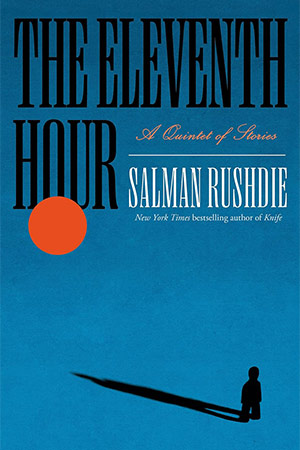
Random House. 2025. 272 pages.
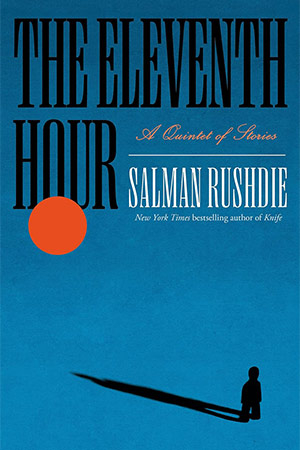
Salman Rushdie has authored fifteen novels in his long literary career spanning more than five decades. His first collection of short stories was East, West in 1994 (see WLT, Summer 1995, 650); the present collection, The Eleventh Hour, subtitled A Quintet of Stories, is his second short-fiction collection. Much has happened to Rushdie personally in the long hiatus between his first collection of short stories and his return to this prose genre, most notably his near-death experience following a knife attack by an assailant on the stage of the Chautauqua Institute on August 12, 2022, which he eventually survived, though not without losing one eye and an arm. Knife: Meditations after an Attempted Murder, published in 2024, was Rushdie’s memoir of that harrowing chapter in his life. The Eleventh Hour is his first work of fiction since his recovery, and it is a more indirect meditation on mortality and the meaning of life given the inevitability of death.
The quintet offers Rushdie the opportunity to experiment with several distinct prose styles, ranging from social or documentary realism to genres like magical realism and the gothic. In many ways, the exuberance of these dramatically different prose styles is reminiscent of the Rushdie of the 1980s and takes readers back to the classics of his oeuvre: Midnight’s Children, Shame, and The Satanic Verses. The first story in the collection, “In the South,” is a lyrical meditation on friendships in old age, something that provides human connection in its quotidian rhythms of walking together to the bank to cash a pension check, when other ties with children and extended family have attenuated. And the death of friends in old age can be as unexpected and arbitrary as those encountered earlier in life: whether occurring from a tidal wave unleashed by a tsunami or an accidental fall on a busy road, accentuating once again the essential loneliness of the human condition and the fragility of human connections.
The second story, “The Musician of Kahani,” is set in Rushdie’s beloved Bombay, in the neighborhood of his childhood, which surfaces in his novel Midnight’s Children. As in his early novels, Rushdie interweaves contemporary events, popular culture, and gossip into the fabric of his narrative. In this particular story, Rushdie’s satirical commentary is directed at India’s emerging billionaire class and their media shenanigans orchestrated by endless celebrations of personal events like weddings that showcase the world’s richest and most famous as guests. The endless retinue of pre-baby events that Chandni Contractor is subjected to by the megarich Ferdaus family, into which she marries, parallels the real-life excesses of the Ambani wedding celebrations. In this story, Rushdie’s satirical rage is also directed at fake godmen or gurus who lure people into religious cults promising spiritual salvation while enriching their own coffers.
This theme also parallels the historical episode of Rajneesh, who attracted a large Western clientele as well as many rich Indian followers because unlike most traditional approaches to spiritual salvation, these newfangled gurus proposed hedonism as a path to salvation. In this story, we thus witness the overarching sway of global capitalism that has commodified everything from intimate personal events like childbirth to spiritual quests. In the end, it is only Chandni’s music that is able to rage and destroy the stranglehold of capital on all aspects of human life. In a turn toward magical realism, Chandni’s music is able to wreak havoc on all aspects of the Ferdaus financial empire, and she can ultimately reclaim her own sense of identity as an independent artist rather than a pampered cog/daughter-in-law of the Ferdaus empire.
“Late” is Rushdie’s foray into the ghost story genre, but it is a profound meditation on life after death. What is the meaning of a premature death, and how do the dead complete the unfinished business of their lives? Through the interactions of a dead male writer and a young Indian woman scholar, we are given a glimpse of the life of a person who had struggled to fulfill his vocation as a writer and assert his true identity in life. Death offers him a liminal space for seeking closure.
“Oklahoma” is a literary detective story where a writer is ostensibly in search of a mentor figure who has disappeared, and clues are left in manuscripts. This is possibly the most literary of the stories because Rushdie is alluding to Franz Kafka’s incomplete early novel Amerika as one of the clues in finding the disappeared author. However, the ending of the story does not offer the traditional dénouement of a detective story. In fact, the mystery moves into a dreamlike unreal state, and we are left questioning the identities of both the protagonist and the person he is trying to find.
The final story in the collection, “The Old Man in the Piazza,” is an allegorical meditation on the shifting power balance between language and ethics. Set in an unnamed country, the story begins with a representation of censorship imposed on language, against which there is eventually a people’s rebellion. Similarly, when the protagonist, an old man who has been an observer of the times, ascends to the role of a prophet or judge adjudicating on right and wrong, there is once again a rebellion unleashed via language. Rushdie seems to be advocating passionately for openness and the multiplicity of possibilities afforded by language and its corollary, literature, rather than the privileging of any single, narrow interpretation of moral issues.
The Eleventh Hour reiterates Rushdie’s stature as one of our greatest living writers, one who has been steadfast and committed to intellectual freedom against various orthodoxies, as well as a writer who has not lost his ability to have fun with his craft, even while fighting the great battles of his life. This collection dwelling on mellower themes of mortality and aging dazzles with the same savage satire and literary erudition that characterized his works from the previous century.
Lopamudra Basu
University of Wisconsin–Stout