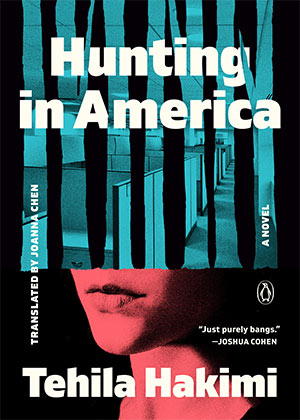

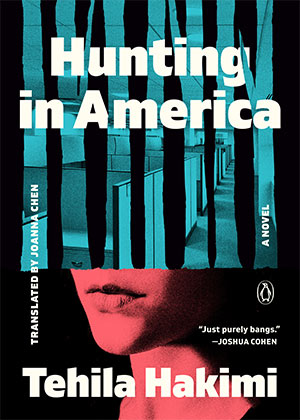
Penguin Books. 2025. 208 pages.
Hunting in America, by Israeli writer Tehila Hakimi, is a slim, sparce novel that, within its muted, wintry setting and its plainspoken and somber tone, subtly probes the conflicted, oscillating line between conscious will and the return of the repressed.
Its unnamed first-person narrator is an Israeli woman in her late thirties, working in high tech, who has relocated to the American branch of the company she works for. The story unfolds against a backdrop of corporate America reminiscent of the TV series Severance. The working day is long, filled with projects and meetings held in sterile offices and boardrooms. There are business trips involving waits in airports, hotels, dull food in dull restaurants. The narrator welcomes the alienation and anonymity that this routine provides, as though she is on the run from everything in her past life in Israel and also, primarily, from herself.
Early in the novel, a colleague, David, invites her to go hunting with a group of men from the office. As she explains: “Once again I was the only woman, but I was used to this. Most of the time I was the only woman on the team, the only woman in the meeting. Sometimes I was the only woman in the entire building.” Though hunting animals is new to her, handing a rifle is not. Having served in the IDF, she already has the knowledge and the skills required, and also, a set of phrases that surface instinctively, calling up a very different, almost forgotten identity. For example, when David, speaking of an official plan to reduce the local deer population, explains that “the idea was to shoot to kill, but also to scare them off, to move them away from the most densely populated areas,” she replies, “Like warning shots.” When it begins to rain and David explains that “it would make it harder for the animals to feel our presence,” she replies, “Under the cover of rain.” Both of these telling expressions are rooted in her army service and the geopolitical reality of Israel.
Likewise, when David takes her shopping for a gun, she finds that she has forgotten nothing:
I pressed the pin located next to the grip with my right thumb. The pin slotted through to the other side, and I pulled it out with two fingers. The rifle opened and then folded. I removed the charging handle together with the bold carrier and held them in one hand. Everything happened like clockwork. It was like muscle memory, in one smooth motion, a swift sequence of automatic actions.
David’s marriage has deteriorated, and he and the narrator soon become lovers, though their relationship is based on mutual admiration more than passion. The book follows a series of hunting trips, some taken together, some with others, and some alone, and it is here that the real drama of the book plays out. Though the narrator is eager to learn about local shooting regulations and hunting practices, she soon begins to experience difficulties in shooting:
We walked some more until David came to a halt. We hunkered down, and not long after that, we saw them moving toward us. There were two of them, side by side. It was my turn, and I watched them slowly advancing, entering my line of fire, but something prevented me from squeezing the trigger. I couldn’t focus. It wasn’t my fingers. It was cold but my fingers weren’t numb. By the time I managed to steady the rifle, both animals had exited my line of fire. I was dizzy as I lowered the rifle to the ground.
It is clear that something is going on, psychologically, but Hakimi refrains from analysis or heavy-handed explanations, relaying the narrator’s psychic state through succinct but telling descriptions. Joanna Chen’s superb translation of Hakimi’s prose captures both the feel and tone of corporate America as well as the psychic disruption that the narrator experiences.
Hakimi, who trained and worked as a mechanical engineer, is an award-winning author and poet, and the first draft of the book was written while participating in the International Writing Program at the University of Iowa. About writing this book she has said: “I had in mind both Israeli and American gun cultures, and, of course, the ties between the two countries. There’s a web of links between the two when it comes to weapons and the use of weapons, culturally, politically, and financially.”
With its themes of relocation and unstable identities, Hunting in America is very much a twenty-first-century novel, a tale that rewards patient reading and an ear for what is powerfully expressed between the lines.
Rehovot, Israel
 Janice Weizman is the author of the novels The Wayward Moon and Our Little Histories. Her writing has appeared in World Literature Today, The Los Angeles Review of Books, Ha'aretz, and other places. Originally from Toronto, Weizman has lived in Israel for over forty years.