
W.W. Norton. 2025. 334 pages.
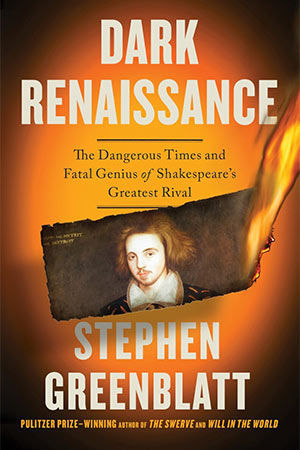
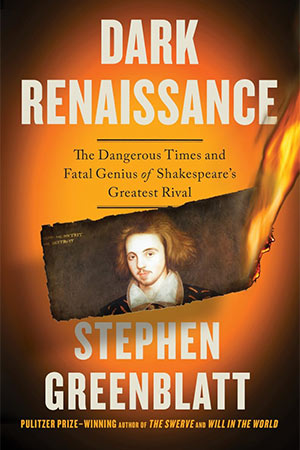
Christopher Marlowe, son of a cobbler, obtained an MA from Cambridge through the political intervention of the Privy Council, gave up studies for the priesthood at Rheims to enter the dark world of espionage where he made his money, showed no interest in the day-to-day operations of a theater company, no business acumen, or interest in planning a future. His contemporary Thomas Kyd contended that Marlowe’s signature quality was “suddenness” or “rashness” that enabled him to get away with bold transgressions by surprising his targets. Stephen Greenblatt thickens things by using Friedrich Nietzsche’s concept of “the great separation” to show that Marlowe had a similar condition which drew him “away from his family, his peers, his social class, his religion,” allowing him to do extraordinary things but “hurtling him toward his destruction.”
Marlowe was decidedly against the grain. His play Dido, Queen of Carthage opened with Ganymede sitting on Jupiter’s lap and requesting that he spend all his time in Jupiter’s “bright arms.” Rejecting the academic trend toward scholastic abstractions, Marlowe (only in his mid-twenties) translated Ovid’s Amores, earning no money, only a public burning of the books in 1599. Marlowe’s disapproving view of English intellectual life mirrored that of Bruno, Erasmus, and Roger Ascham. Though he studied for the ministry at Cambridge and Rheims, he remained a heightened skeptic of the Bible, God, and Christian moral laws. He indulged in public brawls and same-sex affairs, and preferred living for “the ruthless satisfaction of desire and the triumph of the will.”
No bare-bones account, Greenblatt’s book is possibly the most cogent and colorful history of Marlowe’s times and life, combining an expert guide’s synoptic knowledge with probing intelligence. It brings social, political, and cultural history to bold life, and it leaves no stone unturned, almost to a fault, but is marked by its cautionary discretion, which takes the form of such qualifiers as “perhaps” and phrases such as “may have” and “could have.” Greenblatt does occasionally wander into speculation, but he generally resists any authorial urge to either pontificate or spin a fanciful novelistic re-creation of historical fact (as in Anthony Burgess’s brilliantly imagined A Dead Man in Deptford).
Greenblatt’s biography creates a vivid, if horrifying, image of repressive Elizabethan England, where foreigners are suspect and popular entertainments take the form of savage animal fights and public executions of hideous butchery. It is also a world of government censorship and religious authoritarianism. But the true argument of Dark Renaissance is that Marlowe’s political and social connections, his service in espionage, and his transgressive imagination and writing were essential parts of his provocative identity; an identity “all bound together with his poetic genius,” a quality that exceeded Shakespeare’s for a time, though both poet-playwrights (in the words of Joseph Conrad) were “secret sharers” in matters of provincial origin, class background, insatiable curiosity, queer desires, and an imagination seemingly without limits.
It was Marlowe who discovered The English Faust Book, which he used to compose Doctor Faustus, a play with “a tragic hero unprecedented not merely in his own writing but in all English drama,” according to Greenblatt; Edward II dared to be a play about sexual addiction, with an English king risking his entire kingdom for homosexual pleasure; and it was the philosophy of Machiavelli that Marlowe offered to his patron and playgoers in the figure of Barabas in The Jew of Malta, where Barabas deploys ruthless cunning and double-dealing to his own sadistic advantage till his eventual doom. When the theaters were closed because of the plague that returned in 1593, Marlowe turned back to poetry, such as Hero and Leander, in which gender doesn’t seem to matter, and where the line “Who ever loved, that loved not at first sight?” was quoted by Shakespeare in As You Like It. Greenblatt summarizes Shakespeare’s connections to Marlowe beyond their collaboration on Shakespeare’s Henry VI plays: Aaron the Moor’s hyperbolic rhetoric echoes Tamburlaine’s, and The Merchant of Venice, Richard II, and Venus and Adonis answer Marlowe’s The Jew of Malta, Edward II, and Hero and Leander. Shakespeare acknowledged an immense debt to Marlowe for offering “poetic liberation” through an astonishing style that allowed the English language to make a great leap forward, but Shakespeare never sought to be another Marlowe.
It wasn’t sadistic theater of cruelty, lewd poetry, or political subterfuge that accelerated Marlowe’s doom. Robert Greene, who attacked Shakespeare (“an upstart crow beautified with our feathers”), denounced Tamburlaine the Great for “daring God out of heaven” as well as for echoing the heretical views of Giordano Bruno. Richard Baines quoted Marlowe’s blasphemous views on Moses (“a juggler”), Jesus (“a bastard”), Mary (“dishonest”), John the Evangelist (“bedfellow to Christ”), and the entire New Testament (“filthily written”). The upshot was Marlowe’s sudden death at the age of twenty-nine at widow Eleanor Bull’s house in Deptford (a town on the outskirts of London) on May 30, 1593. But the motive and precise circumstances remain in high dispute, as Greenblatt summarizes. In 2002 Constance Kuriyama agreed with the coroner’s report that Marlowe died in a heated argument with two acquaintances, one being Ingram Frizer (a loan shark and extortionist) who killed Marlowe in self-defense. In his 1992 book The Reckoning, historian Charles Nicholl reveals that virtually everyone Marlowe encountered had a plausible reason to be involved in the assassination, but in his 2005 biography, Christopher Marlowe: Poet and Spy, Park Honan pointed the finger at Frizer for wanting to protect his own financial security in the employ of Thomas Walsingham, courtier, literary patron, and master spy.
However, Greenblatt’s own view is the one advanced by David Riggs’s 2004 biography, The World of Christopher Marlowe, which argues that Marlowe was killed at the fatal command of Elizabeth I because of his atheism. Baines’s report to privy councillors concluded: “I think all men in Christianity ought to endeavour that the mouth of so dangerous a member may be stopped.” Indeed, it was, causing absolutely no displeasure to the queen or any churchman.
Keith Garebian
Mississauga, Ontario