A book about a bird is more than just a book about a bird. As Chris Arthur urges here, the literature of birds has a role to play in perhaps the most urgent task facing environmentalists today: finding some effective strategy to recalibrate the mindset that is wonder-blind and therefore nature-careless.
When I’m in the company of friends who are indifferent to birds, I’m often reminded of a remark made by the nineteenth-century Sanskritist Max Müller. When he was entertaining a house guest who did not share his belief in a benevolent creator deity, Müller declared: “If you say that all is not made by design, by love, then you may be in the same house, but you are not in the same world with me.” I have a similar—albeit nontheological—feeling when I’m out walking with someone who has no interest in the birdlife we encounter. We may be side by side in each other’s company, following exactly the same path, but it feels as if we occupy different worlds.
Many readers won’t be drawn to the literature of birds. The primary audience for this type of writing will be those for whom, like me, birds are an existing interest. Yet it would be a shame if the books concerned were spurned because, à la Müller, they’re viewed as occupying different worlds, alien to those outside them. Far from being work that merely occupies a special-interest niche, this is literature that has perceptive things to say about the same house of human existence that we all inhabit.
Take J. A. Baker’s The Peregrine. In one sense, yes, it’s about the peregrine falcon of the title. The book condenses into the compelling narrative of a single half-year its author’s decadelong experience of watching these magnificent birds of prey. But Baker raises far wider issues than those that pertain solely to one raptor species. His book is a master class in observation and the difficulties that attend it. He writes with beautiful exactitude; his startlingly unexpected phrasing traces the contours of his experience with uncanny precision. Yet, for all his observational acuity and brilliance in the art of prose description, Baker is adamant that “the hardest thing of all to see is what is really there.”
At the outset of his book, he refers to illustrated identification guides that give pictures of the peregrine: “Large and isolated in the gleaming whiteness of the page, the hawk stares back at you, bold, statuesque, brightly coloured.” Though such illustrations may claim a high degree of verisimilitude, there’s nonetheless a significant mismatch between their technical accuracy and what they purport to show. As Baker puts it, when you shut the identification guide, “you will never see that bird again.” In the field, it will be “deep in landscape” and “always at the point of being lost.” Pictures, however painstaking the depictions they create, are dismissed as “waxworks” beside what Baker terms “the passionate mobility of the living bird.” It is this vibrant mobility, the mercurial voltage of a living creature, that he’s concerned with, rather than the construction of some kind of dully static waxwork facsimile. One is reminded of Montaigne’s insistence: “I do not portray being: I portray passing.” Baker flags up the impossibility of fully catching what passes as he observes peregrines—and yet he manages to convey a potent sense of their (and his) quicksilver life-threads.
It is this vibrant mobility, the mercurial voltage of a living creature, that Baker is concerned with.
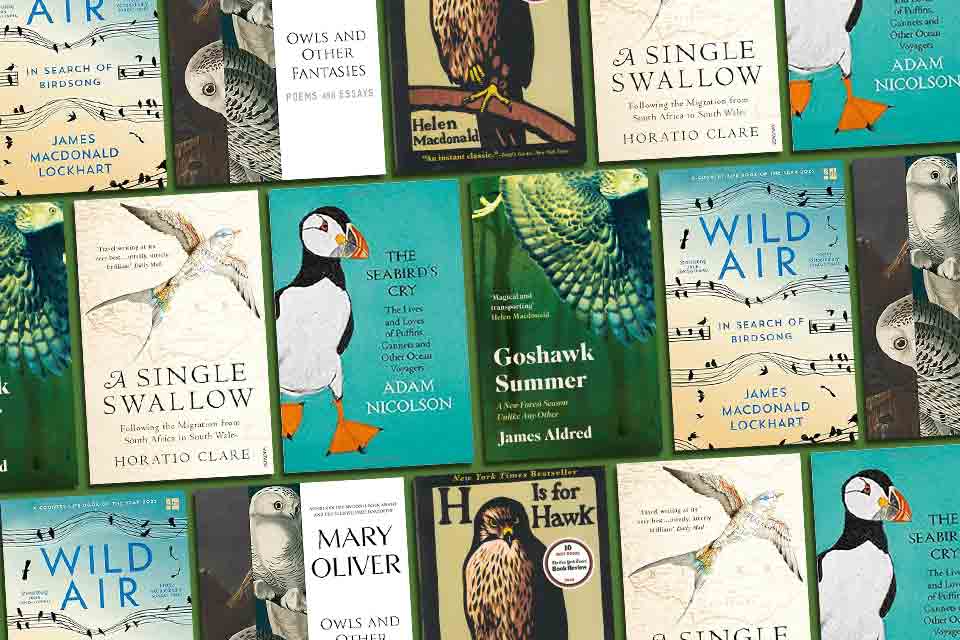
In Owls and Other Fantasies, Mary Oliver says: “To pay attention, this is our endless and proper work.” The literature of birds could be seen as writing where Oliver’s dictum has been put into practice in a sustained and imaginative way. Where Baker pays close attention to peregrines—and in so doing conducts a rigorous meditation on the art of portraying life’s passing moments—Adam Nicolson directs his attention to seabirds. His The Seabird’s Cry—appropriately, the title is taken from one of Seamus Heaney’s poems in Seeing Things— offers profound and highly personal perspectives on the lives of several seabird species. Informed by his eclectic reading and by his own extensive travel and firsthand experience, Nicolson’s book is an extraordinary piece of writing well deserving of the accolades it has garnered. As Robert Macfarlane says, “It is a work that takes wing in the mind.” Like Baker’s The Peregrine, it would sell it short simply to catalog it as a “bird book.” It is, rather, a richly resourced and beautifully written mix of elegy and exploration. Not only does it take us on an empathetic and revelatory voyage into the unique lifeworlds—umwelts—of some fellow inhabitants of our planet, it also shows the often-disastrous consequences when our lives collide with theirs.
Forget the mundane take on gulls or cormorants we might adopt on day trips to the seaside; for Nicolson, seabirds constitute “otherness as a dimension of the real.” He describes how, as a boy, he watched fulmars flying around the cliffs of a remote Scottish island. They soared past closely enough that he was able to stare them in the eye, “a straight and vertiginous look into the consciousness of another animal.” They were, he says, the first birds “that ever made me wonder what life consisted of.” The Seabird’s Cry is a careful adult outworking of this youthful curiosity. The book offers intriguing glimpses into what life appears to consist of when considered through the lenses that become evident when Nicolson taps into the “imaginative reservoirs” offered by the ancient, marvelously well-adapted life-forms that have so entranced him.
A helpful touchstone for bringing the nature of this kind of literature into focus is offered by an eminent figure from a previous generation, John Burroughs. In the introduction to his collection of bird essays, Wake-Robin (first published in 1871), he says:
If I name every bird I see in my walk, describe its colour and ways, give a lot of facts or details about the bird, it is doubtful if my reader is interested. But if I relate the bird in some way to human life, to my own life—show what it is to me and what it is in the landscape and the season—then do I give my reader a live bird and not a labelled specimen.
“Labelled specimen” and “live bird” surely makes a similar distinction to Baker’s “waxwork” and “passionate mobility,” and to Montaigne’s “being” and “passing.” The emphasis on the latter elements in these pairings is a characteristic feature of the literature of birds.
The approach Burroughs pioneered is evident across much of the best contemporary writing about birds. For instance, if we look at Helen Macdonald’s deservedly popular H Is for Hawk, we’re not primarily dealing with the ornithology of goshawks or the principles of falconry (though we learn about both). Rather, we’re taken on a personal odyssey that shows what training one particular goshawk meant for Macdonald in the wake of the bereavement she suffered after her father’s death. H Is for Hawk is more a spiritual autobiography, concerned with exploring how one individual copes with love and loss and memory, than it is a straightforward bird book.
Or, if we look at Steven Lovatt’s Birdsong in a Time of Silence, it’s not just a paean to the appeal of birdsong and how it became more evident—and more important to more people—during the pandemic lockdowns. The book reads at times like pages from a journal of a plague year. It charts what birdsong came to mean for the author as he struggled to cope with life in the shadow of Covid-19. It does, of course, celebrate the beauty and mystery of birdsong, but it also reflects on the way we’re living and how that might be bettered.
At one point, Lovatt presents birdsong as “an almost forgotten aspect of the grammar of reality.” That’s a phrase that could be widely applied across the literature of birds. Whether looking at peregrines or puffins, goshawks or gannets, swifts or shearwaters, the authors are bringing to our attention aspects of “the grammar of reality” that we tend to overlook. In doing so they also show how we have parsed that grammar so destructively in the age of loss that our species’ dominance has ushered in. Unsurprisingly, the threats to birds that human activity causes have been a recurring theme in writing about them since Rachel Carson’s landmark wake-up call, Silent Spring, appeared in 1962. The number and complexity of issues that have led to the environmental catastrophes now unfolding can make them hard to grasp. An impressive effort to do so is made by Mark Cocker in One Midsummer’s Day. The author offers a lucid summing up of what he calls the “troubling matrix of anthropogenic problems” that are now threatening the survival of so many species. But while aware of the problems and adept at providing an expertly concise—and chilling—statement of them, Cocker’s book is far from being an ecological jeremiad. It is, rather, an engaging, often celebratory, portrait of “the events of a single day as I watch a flock of common swifts.” In describing the course of that day, Cocker’s imagination ranges over territory as wide as the swifts’ migratory journeys, and his approach has something of the exhilaration suggested by these birds’ deft aerobatics. The subtitle he’s chosen, Swifts and the Story of Life on Earth, is less exaggeration than an indication of the breadth of the canvas he paints. He writes with equal lyricism about the ancient unicellular organisms we’re all descended from and about such complex, multicellular creatures as swifts. He ranges with impressive fluency over the eons that stretch out between life’s origins and the Anthropocene.
The number and complexity of issues that have led to the environmental catastrophes now unfolding can make them hard to grasp.
Leonard Lutwack’s Birds in Literature looks at the symbolic role given to birds by a wide range of writers over the centuries. There’s surely now room for a sibling volume on the literature of birds, looking at works in which birds take center stage instead of being used merely as metaphorical adjuncts. In the cluster of titles I’ve referred to, birds are the primary point of focus, not pieces of incidental symbolism playing walk-on parts in someone else’s story. Clearly, I’ve touched on just a fraction of the work that might be considered. This essay is intended only as a marker buoy pointing to a growing literary territory, rather than a detailed survey of the writing it comprises.
John Burroughs made clear that in writing about birds—if an author wishes to hold readers’ attention—it’s important not simply to compile a mass of ornithological facts. Burroughs’s point is echoed in an excellent anthology of bird-related writing that appeared a century and a half after Wake-Robin. Spark Birds offers a selection of material published over the last thirty years in Orion magazine, one of the anglophone world’s premier journals for environmental writing. Jonathan Franzen, who co-edited the volume, expresses the view that the most effective nature writing doesn’t proceed in a straightforwardly descriptive manner. Instead, it “places a person in some kind of unresolved relationship with the natural world.” It is the exploring of such relationships that gives the literature of birds much of its interest.
One of the contributors to Spark Birds, Kathleen Jamie, deftly puts her finger on another reason for the appeal of this kind of writing. Musing about the ringed storm petrel whose body she found lying on the shore of an uninhabited island, Jamie reckons that thinking about the bird—recognizing something of its history, biology, and individual life story—came to have a transformative impact on her. This storm petrel, she says, has “extended my imagination.” Throughout the literature of birds, there’s a strong sense of writers’—and thus readers’—imaginations being stretched by their avian encounters.
Repeatedly, across the varied territory of this type of writing, authors touch on something Mark Cocker states explicitly in the prologue to One Midsummer’s Day: “matters we assume to be everyday and ordinary are, in fact, wonder filled and extraordinary.” Paying attention in the way that Mary Oliver suggests soon leads to the realization that how we usually refer to things simply doesn’t tally with what is actually there in the world around us. For the most part, we scarcely notice life’s extraordinariness. Our quotidian take on our surroundings relies on simplification, approximation, and omission. It shears away the sense of amazement that’s fostered by a more attentive approach. The books I’ve mentioned nudge us toward a vision of birds that’s more closely aligned with what they really are than our routine labels for them suggest.
For the most part, we scarcely notice life’s extraordinariness.
At one point in The Seabird’s Cry, Adam Nicolson writes: “The songlines of the albatross are laced around the world; their umwelt is one to which the only sane reaction is one of awe.” Alas, when it comes to our usual reaction to birds, as with how we treat a host of other creatures, we seem deficient in the ability to feel the kind of awe and wonder with which Nicolson’s book—typical of the literature of birds—is richly imbued. Given the catastrophic impact our species’ behavior is having on the ecosystems on which we all depend, some of our actions surely have little claim to sanity. With this in mind, and thinking back to the comment by Max Müller with which I started, perhaps the most urgent task facing environmentalists today isn’t combating climate change, the pollution of the seas, or the destruction of the rainforests but rather finding some effective strategy to recalibrate the mindset that is wonder-blind and therefore nature-careless. All eight billion of us humans occupy the same amazing house of planet Earth. We live alongside a plethora of other organisms, including some eleven thousand bird species, many of which are now imperiled. Our shared planetary house can accommodate many worlds in terms of allowing a rich diversity of life-forms to flourish, each in its own unique umwelt. Earth’s capacious house can likewise host a huge variety of interests and outlooks. But to treat it with the disregard that’s now too often evident seems calamitously lacking in both sense and sanity.
In The Wild Places, Robert Macfarlane warns that we have fallen under the spell of road maps. By ignoring many features of the natural world, these maps exert what he calls “distortive pressure” on the imagination. The land is seen “only as a context for motorized transport”—an outlook that promotes an erosion of wonder. Such an outlook is the opposite of paying attention in the manner Mary Oliver advocates. Obviously, reading a few books won’t solve the problems of the Anthropocene. But—like much nature writing—the literature of birds has more than just literary significance. It invites us to look more closely at what’s around us. Its avian cartographies offer alternatives to the road-map mentality. Following them promises routes through life that are guided by a sanity-enhancing sense of wonder.
St. Andrews, Scotland
James Alred
J. A. Baker
Horatio Clare
Mark Cocker
William Fiennes
Charles Foster
Jonathan Franzen & Christopher Cox, Eds.
Steven Lovatt
Helen Macdonald
James Macdonald Lockhart
Jonathan Evan Maslow
Adam Nicolson
Mary Oliver