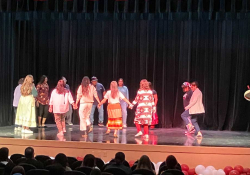
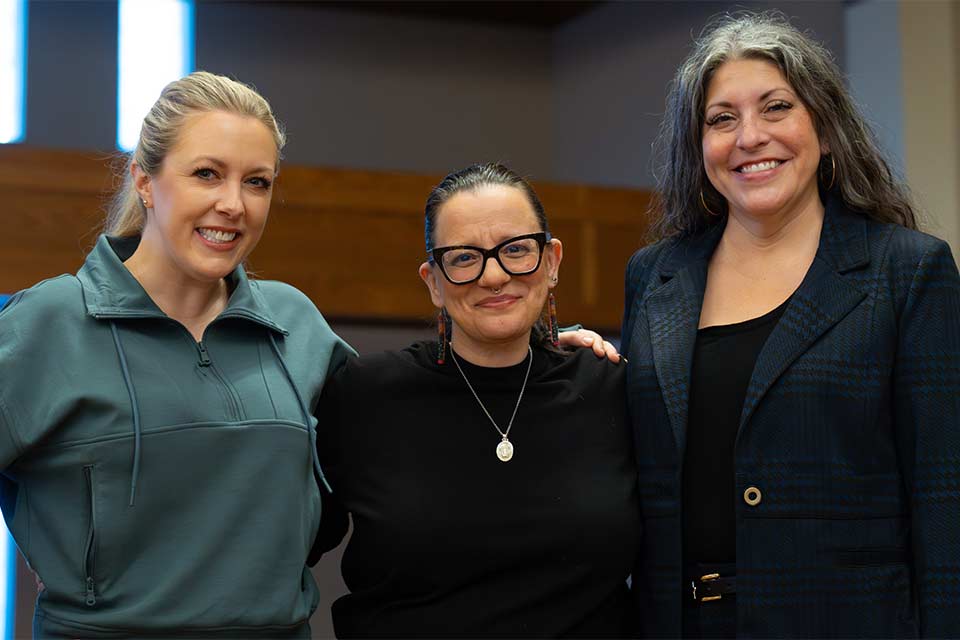
The 2025 NSK Prize ceremony featured a video greeting from OU President Joseph Harroz Jr., a powwow exhibition dance in Dimaline’s honor, and the formal prize presentation by the Neustadt sisters. After receiving the award, Dimaline received a standing ovation, then delivered the following acceptance remarks, which have been slightly revised for publication.
It’s difficult to put into words how meaningful winning the NSK Prize is—and I am a writer, so you’d think I could find words. I’ll give it a shot here.
I want to express gratitude and love to the people who hold me up and remind me that, as small as my stories are, as limited as my life is, they matter—we matter, because the Universe needs us.
Robert Con Davis-Undiano wrote that in 1975, the University of Oklahoma speakers’ bureau invited Angela Davis to campus for a talk. Davis, of course, was politically active in the Communist Party and Black Panther Party. When, inevitably, that visit was opposed on political and ideological grounds, Walter Neustadt Jr. publicly supported her. He reminded detractors of the university’s important, unique role as a major forum for free speech and open debate. Davis-Undiano went on to say, “We would do well to remember Walter’s example of working tirelessly to advance that goal even when doing so meant that he had to stand alone.”
Luckily, in many ways, he didn’t stand alone—he had his brilliant and like-minded family by his side. And today we are lucky enough to have those same people—Walter’s girls—at our side. By continuing the Neustadt legacy and supporting these innovative and community-focused programs and awards, Nancy, Susan, and Kathy demonstrate a remarkable understanding of the importance of story in the world—especially now. Stories are instruction, map, celebration, archives, and obituary. They are how we know who we are and who we need to be, and through their support, we have a better chance of making it. An investment in education, students, and story—fostering new generations of informed and thinking young people who have access to diverse and grounded blueprints on how to survive is the surest way I know to change the world. Kathy, Nancy, and Susan are much beloved in Norman, Oklahoma. Coming to the university and seeing the impact of not only their very generous financial support that brings so many people together in a good way, but the ways in which they show up with their hearts open and their infectious joy and belief in us—I understand completely that love. The Neustadts are a legacy of the change and enthusiasm we desperately need right now.
Stories are instruction, map, celebration, archives, and obituary.
There are so many people to thank for their tireless work on the Neustadt projects and awards. Each year, the best of the best in global literature come together to carefully consider impactful works and make the extremely difficult decision about who should take home the prize. Being on a jury is not easy, particularly when the outcome gives a platform for change and inspiration. It is often thankless work, but each year the Neustadt jury carries it out with respect and all the weight that carries. We honor that work.
I have so much gratitude to and affection for the University of Oklahoma for hosting me as a writer and in working to support the incredible students who make up this campus. Special mention must be made of RC Davis-Undiano, his partner Molly, and the gracious Daniel Simon. I am so grateful that my family has expanded to include Dr. Dustin Tahmahkera and Dr. Kimberly Wieser-Weryackwe, who shared insight, thought, and care. I was also lucky enough to spend time with Dr. Laura Harjo, whose dedication and brilliance is benefiting an exciting cohort of OU students. She is my hero.
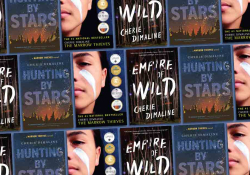
During my visit, I had the distinct honor of witnessing how story can translate and move beyond the page when the OU School of Dance, under the direction of the brilliant Alma Borges, performed their original dance based on my book The Marrow Thieves. I don’t think I’ve ever been more challenged to create than in that moment, watching remarkable artists and technicians live and breathe story.
I want to take a moment to talk about my good friend and incredible colleague Danny Ramadan, who put me forward for this award. I met Danny at a writers’ party during the Vancouver Writers Fest years ago. Since, at the time, we were some of the only people left on earth who still smoked when they had a drink, we went outside to share his coveted menthols, and we started talking—it should have been mundane. But I remember being there, under really bright stars, which is unusual in Vancouver since there are so many lights from the city and the weather is usually cloudy. I remember those stars, and Danny was talking, and I was listening. I remember thinking, Pay attention to this moment. Pay attention to those stars, and to this man, because something is happening, something is changing, and there will be a day when you want to recall this first meeting with all the clarity it demands.
And then, there I was, in Oklahoma, years later after that first meeting, receiving this huge honor that was facilitated through Danny’s belief in my work and his eloquence with words. In that time, I have grown to love Danny and continue to be awed by his writing, advocacy, and spirit. That’s what makes this award so special—that it comes from community, from magical storytellers and courageously skilled artists.
My mentor, the great and prolific writer and teacher Lee Maracle, once gave an acceptance speech for an honorary doctorate. In that speech she said, “My life has been a very slow journey over very sharp rocks, but dammit if I didn’t dance over every last one of them!”
Our storytellers are educated with centuries of knowledge and are generous people. Lee often talked about this: How can people get it wrong? All they had to do was ask. I’d like to point out that it can be joyous work, the asking. It can be rewarding and life-changing. The Neustadts are an example of doing that good work, the work that changes lives.
I was raised by storytellers—my grandmother and her sisters chief among them. They carried the stories of our community—the relocations, the struggles, the invisibility imposed upon us, and the ways in which we continued on with our culture, our language, our hunting, and our survival, even unseen. I lived in a small place without much access, but when I was almost five, my mother found a postcard in a magazine to send away for books. It was the Dr. Seuss collection, and you would get three books mailed at a time. I vividly remember sitting in a sleigh being pulled through the snow to the post office to pick up that first parcel. I remember carrying the box back on my lap, the weight of it. When we got home and opened it up, my grandmother explained, “A book is a house where a story lives.” And suddenly, those books felt accessible, felt like they could truly belong to me. I knew stories. Stories were family. So I decided at five years old that that is what I wanted to do with my life: build homes for stories.
Not every house needs to be the same. Not every house should be the same. But every house should have the capacity to hold us, to keep us fed, to provide the means to rally and celebrate, to challenge and rest, with all the different understandings of what that may mean. No one should have to bow down to enter, to have to use a different entrance, to be reminded that their stay is short or has been forced. No one should have to walk into a room where the people already there ignore them or, sometimes worse, assume that they know everything there is to know about the guest without that guest being able to introduce themselves with their own understanding of who they are. Not every house has to be massive, but they all need to have a way to get in. The thing about houses is, if you have enough of them, well built and considerate in their plans and maintenance, you end up with a community. This is one of the central roles of a school or a library—to provide the space for community.
Thank you for showing me love, for standing behind my work, for providing the support that five-year-old Cherie could never imagine she would find. Thank you for allowing me to continue to build houses. I hope that we will always live in community among them.
One of the first gifts we are given in life is words, because so much can be accomplished with them—connection, ability to ask for what we need, to express what is happening, to understand what to do and how to be. Words as vessels that carry everything else.
Survival is about carrying the teachings and words that locate us and one another.
Survival is not just about living or cheating death. It’s about having the original words to call out to family members. It’s about carrying the teachings and words that locate us and one another. It’s about knowing our responsibilities so that we can move forward in a good way for the community and the land.
With writing, we are essentially using words to manifest what we want readers to feel, see, hear, all toward getting somewhere—to a lesson or a moment or a feeling. So, we are choosing and laying out in sequence a series of vessels that collectively hold an experience for the reader. Curating a gallery experience with word choice. And the best gallery experiences are the ones that shift under your ribs, that change the architecture of how you live in the world.
For Joseph Grand, the Writer from Albert Camus’s The Plague, his entire life is consumed by one sentence, even as he assumes he is dying.
One fine morning in the month of May an elegant young horsewoman might have been seen riding a handsome sorrel mare along the flowery avenues of the Bois de Boulogne.
He tells his friends, “Once I’ve succeeded in rendering perfectly the picture in my mind’s eye, once my words have the exact tempo of this ride—the horse is trotting, one-two-three, one-two-three, see what I mean?—the rest will come more easily.” I used to think it was sad and defeated: How is that a worthy way to live—obsessed over capturing this one image, conveying one feeling? But then I realized Grand was chasing a single moment of perfection, of art—in essence, he was praying.
We are a story the Universe is telling. And in return, we tell stories back to it through the living of our lives. A few of us stop to pray, write down words with intent, speak them aloud, etch them into paper and fold it up and push them back to the stars. We are just a story the Universe is telling, and we owe it stories in return.
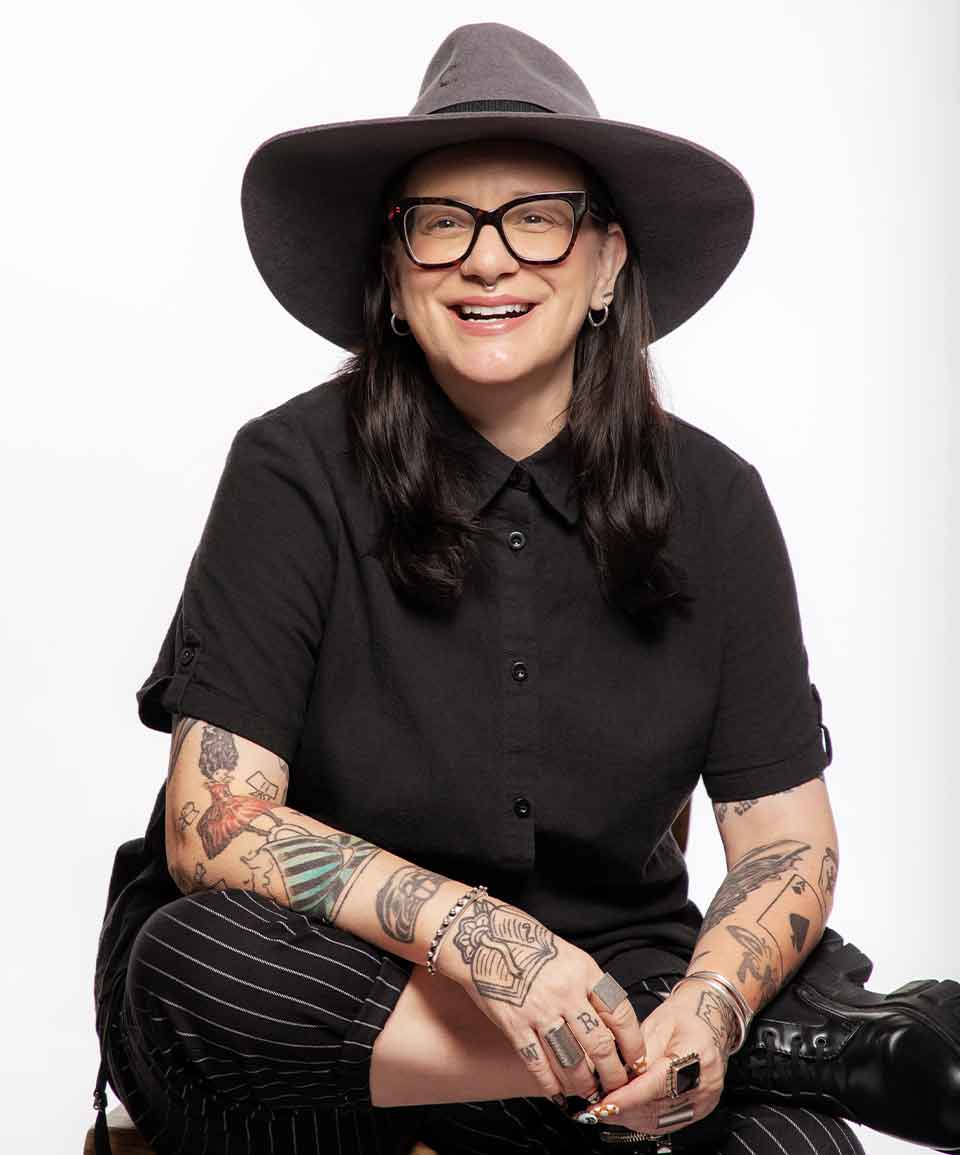
We are a story the Universe is telling.
That’s a life worth living.
I know it’s difficult to feel optimistic about the world right now. I talk to many young people who don’t see a viable future ahead. But I think it’s important to remember that, while things are bleaker than they’ve been, we are also more engaged, educated, and globally aware than we have ever been. We now have access to stories and teachings and histories and understandings of cultures around the world. This means that instead of one point of view, we are now standing in a room with limitless windows. The work now is to make sure no one takes away those views—those windows—those openings and ways forward. This is why we have to fight against book bans, the collapse of the free press, and the flow of individual story and freedom. If ever in doubt what a world without free press and books and art would look like, reread 1984.
If you haven’t read the book The Marrow Thieves, it takes place in a potential near future where cataclysmic climate change has altered the shape of the known earth, so there has been a lot of sickness and relocation. Perhaps the most impactful change has been the loss of dreams—the general population seems to be left without the ability to produce dreams. We know that without dreams, the mind is prone to illness and confusion. In the end, the government is left with a people they can no longer govern. So, it becomes imperative that they restore this ability. Looking around for answers, they find that there is one people left with the ability: the Indigenous people of North America. And they seek a way to corral these populations in order to do the experimental work of extracting this ability—rumored to be housed within the marrow of our bones—and to do it in such a way as to not diminish the dreams until they have found a way to take them.
And they quickly realize that they have already done this in the past, that they created places where Indigenous people were brought, kept, and where regardless of the hardships, the people never lost their dreams or their hope: residential schools in Canada and boarding schools in the United States. These of course are the schools where Indigenous children were forcibly taken, where languages and cultural practices were forbidden, where abuse was perpetrated—all in the name of Canada’s first prime minister, John A. MacDonald’s, mandate to “Kill the Indian, save the child.” And so in this future world, the schools are reopened. The story follows Frenchie, a fifteen-year-old Métis boy who has lost his biological family to the schools but who has found new family in other survivors as they travel into the north, where it is said there is still a strong community managing to hide and regather strength.
Some of my favorite sentences that I’ve ever written are in The Marrow Thieves. Coincidentally, they are from one of my favorite scenes within my own work, which is the very last one. It was the best I could do to explain the way we persist and thrive as Indigenous communities, in spite of, or perhaps because of, it all. It was a way to include the ancestors and their sacrifices (the sky) and to address the erroneous Western path forward (the ground) while acknowledging the ability to dream the future into being as essential to the Indigenous experience:
He held his hands out, palms turning upwards in a slow ballet of bone, marrow intact after all this time, under the crowded sky, against the broken ground. And I understood that as long as there are dreamers left, there will never be want for a dream. And I understood just what we would do for each other, just what we would do for the ebb and pull of the dream, the bigger dream that held us all: Anything. Everything.
Norman, Oklahoma
October 22, 2025