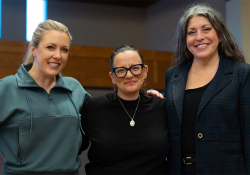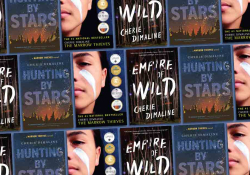


For a roundtable conversation devoted to Cherie Dimaline’s work that ended with the author gifting pieces of jewelry to the panelists, Kimberly Wieser-Weryackwe tied together themes of storytelling, Indigenous futurisms, and going home in Dimaline’s writing. The following is an adapted version of her talk.
As a professor of Native American literatures and rhetorics, I have been blessed to meet many writers whose work I have studied as a scholar. Only a few of these, from my personal, spiritual perspective, do I consider to be seers, prophets: Leslie Marmon Silko, Joy Harjo, ire’ne lara silva, and Métis novelist and NSK Prize winner Cherie Dimaline.
None have affected me in quite the same way as Cherie. I hope you will overlook here the unconventional behavior of calling an author by their first name. After having met her in person, my connection to Cherie just seems a lot closer than that.
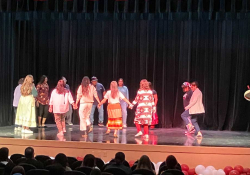
Perhaps it was seeing her win the NSK award—for writers, a feat only surpassed by winning a Nobel Prize. Perhaps it was the heightened atmosphere of the Neustadt Festival itself, which began for me with round-dancing—Cherie holding my right hand and Osage writer Chelsea Hicks my left. It’s pretty cool to meet one of your favorite writers by dancing with her.
Meeting Cherie reinforced everything about her work that resonates with me each time I return to her words: Story, Memory, and Prophecy. Cherie’s work draws on the past and reaches into the future—knowing that they are the same thing, that our future is our past and that the map to navigating them both is Story.[i] Story is the map, what Joy Harjo calls in the work by this title, Our Map to the Next World. Being a storyteller born from generations of storytellers is really handy if you want to be a mapmaker for the future of humanity. Cherie is that storyteller.
Being a storyteller born from generations of storytellers is really handy if you want to be a mapmaker for the future of humanity.
Story really is sort of the center of everything I do in my scholarship and is quite important in my life outside of work. Loving Story this much, I’ve been in love with Cherie’s books for quite a while. I teach The Marrow Thieves regularly in my classes, mostly Native children’s and young adult literature and “Indigenous Futurisms.” I find it to be an important story, a story that helps us answer the central question of my Indigenous Futurisms course, in fact: “How can humans envision a future in an ‘apocalypse,’ and how do Indigenous Futurisms model that?”
When I teach The Marrow Thieves, we talk about all the things that Story does. Story carries knowledge. It’s why our ancestors want us to remember those stories. Since I always draw on popular science when it has finally caught up to Native knowledge, I let students know that it takes the average adult seven repetitions to remember anything, so the more times we hear certain stories, the better off we are. Another thing that Story does—besides carrying knowledge, besides entertaining us, besides, in fact healing us—is binding us together. Students get attached to the characters in The Marrow Thieves as though they are actual humans because we know all their background stories. Those “coming-to” stories allow us to form relationships with characters who are actualized as people not just in the text but in our spirits, where we council with stories.[ii]
Humans bond through the vehicle of story. Scientists say that Story is tied to how we shape our memory.[iii] The stories in Cherie’s books push us to remember that stories are a means of survival. I always define Tradition as Continuity + Change in Balance. For Native people, the apocalypse in this novel is not mere fiction but has been going on for five hundred years. As I was reminded while part of a research group in Alberta working on First Nations homelessness, There were not homeless Indians in 1491. There just weren’t. We didn’t have the issues that we have in our communities now. Those came with colonization, both individual and intergenerational trauma.
Science tells us that trauma continues in our gene pools for seven generations. Koreans have long had a word for this: Han, trauma carried down. There’s a lot out of balance to heal from when Change interferes with Continuity too rapidly and without consent. Too much rapid change forced on the community—not embraced, planned, welcomed, or incorporated—can cause a culture and individuals to become lost. Knowledge of Story binds us to our ancestors, binds us to one another, and binds us to a future we desperately need as well.
A prophet is someone with memories of the future.
A prophet is someone with memories of the future. Neuroscientists speculate that this is what foresight is.[iv] We need prophets these days, much as we need the magic to change things. One of the most terrifying things I saw when I was living in Alberta was some graffiti. Graffiti, usually not frightening, is a rhetorical move marking who you are. Tags on trains stake identity and belonging, for instance. The graffiti that terrified me, a claim staked by Indigenous youth, said merely two words: “No future.” That’s terrifying . . . and it is precisely why we need Cherie and her stories to prophesize us into a future. These stories concentrate on how we survive when the systems around us are aimed at eliminating us after, or if, we are (no longer) useful for capitalism, when there’s nothing left to be extracted from us. When we’re at that point, Story is all you have to reenter yourself and tell you who you are. Because the capitalist world will tell you that “you are nothing.” It will measure you by money. It will measure you by what can be extracted and taken from you. But that’s not who you are. Who you are is made up of the stories you carry inside of you.
Cherie’s stories detail movement, the notion that life always involves motion, which reminds me of something that Namšem told me. I’m not Cheyenne by birth. I was adopted about thirty years ago by the person who was then the oldest living Sundance priest, Eugene Blackbear Sr. Namšem taught me a lot, including the Cheyenne wisdom used when people were lost in the past. When you don’t know which way to go, always go right. If you think about it, if you keep getting lost, and you keep turning right, where are you going to end up? Back where you started—right back where you started. You go home. Movement, whether we think about time or movement through space, is a circle in Indian Country because you are going Home. Another elder, my former chair, Leroy Little Bear from the University of Lethbridge in Alberta, met me in his office as soon as I arrived. He said, “Indians, they’re always going home. So what’s going to make you leave Alberta?”
Indigenous people are always going home. An important line in The Marrow Thieves occurs with Frenchie’s mom talking to Frenchie’s dad when they’re young, and he’s gone to the city. He has sort of fallen into imbalanced behavior, which, I think, so often in this work, but also in a lot of other Native work, comes forth as monstrosity. When we are no longer ourselves, we are not recognizably ourselves, we are monstrous. Story is what reminds us of that, reminds us who we are and leads us to where we are going. It leads us Home, to our people, to ourselves.
Frenchie’s mom says to Frenchie’s dad that to run successfully, you have to run to something, not just from something. We know what these characters are running from. They’re running from their own trauma. They’re running from intergenerational trauma. And trauma is a fracture, not just in the body, but in the spirit, a fracture that has to be healed. Indigenous peoples do have traditional ways of dealing with that, but these kids aren’t in a world where they necessarily have access to an elder who knows how to work with medicine, knows the ceremonies, to do this, “to bring the soul back.” In Indigenous cultures in Mexico, for instance, susto is caused by the spirit jumping out of the body from a shock, from trauma, and can be treated traditionally. Cheyenne people share this concept and call the spirit back from shock with Indian names.
We must think about what Cherie’s characters are running to; they’re going where we’re always going. We’re always going home. They don’t know what home is in this world that they’re in. We may have a hard time with that, too, because home is so much more than a place. Home is family. Home is belonging. Something that these kids want, something that we all desperately need as humans. We need to belong. We need to feel safe. And that’s what home represents. Home may move around like a tipi from a nomadic Plains tribe. Home can be moved, goes with you, because like Story, you have to carry Home “under your ribs,” in Cherie’s terms. Home to who they actually are is where they’re going. They just have to find it. It has been there all along, waiting for them to catch up to it.
University of Oklahoma
Works Cited
Be, D. J. “Feeling the Future: Experimental Evidence for Anomalous Retroactive Influences on Cognition and Affect.” Journal of Personality and Social Psychology 100, no. 3 (2011): 407–25.
Ferris, Charles, et al. “Hippocampal-cortical Networks Predict Conceptual Versus Perceptually Guided Narrative Memory.” Journal of Neuroscience, October 20, 2025.
Kim, Sandra So Hee Chi. “Korean ‘Han’ and the Postcolonial Afterlives of ‘The Beauty of Sorrow.’” Korean Studies 41 (2017): 253–79.
O’Keefe, Victoria M., et al. “‘Someday, I’ll Be an Ancestor:’ Understanding Indigenous Intergenerational Connectedness through Qualitative Research to Inform Measure Development.” American Journal of Community Psychology 76, nos. 1–2 (2025): 110–20.
Teuton, Christopher B., with Hastings Shade, Sammy Still, Sequoyah Guess, and Woody Hansen. Cherokee Stories of the Turtle Island Liar’s Club. University of North Carolina Press, 2012.