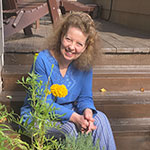


The news from Russia and Ukraine, places to which Yana Kane is linked by her own past and family roots, touches her deeply. For the past three years, she’s dedicated most of her creative energies to discovering and engaging with contemporary Russian-language poetry of witness and antiwar poetry that call to her as a translator. She’s translated Ukrainian poet Dmitry Blizniuk more than any other, drawing strength from his ability to see and reflect life as magical and luminous, even while he is keenly aware of the terrifying, infuriating, tragic, dreary, and absurd aspects of reality.
For a few days, my email conversation with Dmitry Blizniuk, a poet who lives in Kharkiv, Ukraine, is free of any mention of war. We talk about his Russian-language poetry, which I translate into English and Blizniuk translates into Ukrainian. I am excited to share good news with him: a literary magazine I respect and admire has just accepted a large set of my translations of his poetry. Dmitry, too, is excited and pleased. I then pivot to one of his recent poems that I am translating. I have a few questions about his use of punctuation. He decides to revisit his text and tweaks the punctuation. This leads me to read the original a bit differently and make changes to my draft of the translation.
Unfortunately, periods when poetry is the sole topic of my correspondence with Dmitry do not last long. A couple of days after the good news about the forthcoming publication, a short message from Dmitry arrives in the same email thread. He tells me that his neighborhood is being pummeled by shahed suicide drones. More short messages. There’ve been about ten hits already, close by. Dmitry doesn’t hide his fear and his rage. Yet there are glimpses of his inimitable irony even in these dispatches. And among the words of Russian, the language we have in common, a Ukrainian word stands out: Незламні. I don’t know Ukrainian, but over the last three years I’ve learned the meaning of this word from songs and posters: “unbreakable,” “indomitable.”
My heart in my throat, I stare at the time stamps of his emails. He was alive as recently as two minutes ago. What about right now? The next message arrives. It has a video attachment. I open it—frantic—as if the speed of my reaction can make a difference in what is happening five thousand miles away. Darkness fills my screen. Here and there, blackness is interrupted by small rectangles of dimly lit windows. A faint howl grows menacingly: something is coming in from a distance, tearing the air as it flies. Flames leap up. A heartbeat later, the sound of an explosion. More howling; another explosion. A moment of quiet. My mind is racing. What—no, worse—who might have been destroyed by these strikes? At the same time, I am transfixed by the surreal beauty of the scene, a kind of beauty that surprises me in Dmitry’s wartime poems. The gold-and-scarlet brocade of the burning sky is embroidered with inky tree branches. I can make out the silhouettes of small clusters of blooms on the nearest twigs. Maples, most likely. Trees are blooming in Kharkiv, outside Dmitry’s home, just like they are blooming in New Jersey, near my home. Against the backdrop of fire, I can now see the dark bulk of the apartment building that contains the scattering of lit windows. Are blackouts useless against attacks by shaheds? A double explosion. The video ends.
Fragments of Dmitry’s poems float in my mind, like the visual ghosts that follow suddenly extinguished bright light:
a balcony torn off in an explosion—
a headless horseman—
dangles down the flank of a white, mangled horse
to pick the tulips
planted with warm hands by apt. 56 . . .
Why do I feel so acutely shocked by these messages? For years, the digital front pages of the newspapers I read have presented video snippets of explosions that destroy homes and lives in cities all over the world; in cities in Ukraine; in the city of Kharkiv. Perhaps the difference is that I am witnessing something that is happening in the moment, rather than a record of something that is already in the past.
I sit and wait. Time stretches. My mind, like a hand fingering beads, touches one by one the lines of Dmitry’s poem about a woman hiding in her bathroom during a massive bombing of Saltivka, a residential district in Kharkiv:
the night crawls past her
slowly-slowly
like a viper across black glass.
Like much of poetry, this poem is a record of several layers of experience. Emotion—or an amalgam of multiple emotions—supplies the primal energy that sparks the process of creating a poem. The body manifests this energy through patterns of breath, heartbeat, butterflies in the stomach, chills in the spine, a voice trapped in the chest or exploding through the mouth.
The mind—or, perhaps, the soul—tries to interpret these patterns. It searches for words, weaving a web of associations that spreads, rootlike, through deep layers of personal memory, of cultural memory, and of communal memory abstracted as language. The elements of culture and language—words, grammatical structures, allusions—gathered by these roots are the substance that grows into the text of the poem. They cease to be disembodied abstractions, units of information. I believe that it is the physicality of the underlying emotion that organizes them into poetry. The unfolding of that physical experience drives the flow of time that gets expressed through grammar and form. The nature of emotion underlies the mood of the poem. Emotional complexity, which can mingle smiles and tears and make the blood “run hot and cold,” manifests itself in the interplay of harmony and tension by establishing and then conforming to or disrupting expectations. These relationships between concordance and conflict, between closeness and distance, structure elements of meaning in the poem—ideas, metaphors, and allusions. They become encoded in its sound through rhythm, rhyme, alliteration, and assonance. They also form the shape of the text when the poem is set down on paper.
Much of this work of a poem coming into being is usually hidden from the poet’s conscious mind; it proceeds by trial and error, without a preconceived plan. Some of it may be done consciously either by the poet alone, or communally, for instance, when he or she incorporates feedback during a workshop.
When I read a poem, I experience a mirror image of the process of its creation. Patterns of words in the text activate a web of associations in my mind. Some of these associations are shared between the poet and myself based on our common lived experience and cultural background as well as what I know about the historical and biographical context in which the text was written. Some are unique to me as an individual. Good poetry is usually spacious enough to have room for multiple creative, reader-specific perceptions. These associations, together with the physical experience carried by the sensory patterns of the poem, turn into my own sensations and drive my emotional reaction to the poem.
I believe this process is not unique to poetry but occurs in any creative work—literature, visual arts, dance, music. . . . Emotion is experienced by the creator’s body and is interpreted by the mind as a set of sensory patterns. These patterns activate a web of associations, the network of “roots” that gathers raw material for building the work. The material gets structured by these sensory patterns. This structuring forms both a record and an expression of the artist’s sensations and, through them, the original emotion. Each reader, viewer, or listener responds to the work in a way that is both shared with and uniquely different from that of the creator and of other members of the audience.
To me, poetry is where this process is most intelligible because it is expressed through the material of words. In poetry, unlike other literary genres, considerations such as building a narrative or delivering a message are usually secondary to the emergence of the web of associations and to the encoding in words of the underlying emotion’s sensory experience. Or perhaps poetry is simply the art I am most familiar with, one that engages me in multiple roles: as reader, writer, and translator. This feeling of the mysterious emergence of the right words that become poetry is expressed in Blizniuk’s prewar poem:
sometimes I perceive
that the right words are somewhere close . . .
like when at night, I emerge on the bridge of a yacht,
to see a pod of giant whales (seven, or maybe six)—
they rise like submarines
to the surface of the inky night,
and moonlight plays, over their sloping bodies,
its knife-toss game.
heavy, like molten crystal,
it pours off their black, lacquered skin.
Blizniuk writes in Russian, and I am composing this essay in English for readers who, most likely, don’t know Russian. To convey my experience of reading and recalling Dmitry’s poems, I translate them into English. The right words and other language structures that have emerged in the language of the original in the mind of the poet need to reemerge as the “right words” in another language and cultural context in the mind of the reader. As a translator, I need to make that possible.
When I consider how the process of poetry translation feels to me, I am reminded of the words of Olga Sedakova, a prominent Russian poet and poetry translator, the recipient of several major European literary prizes. In February 2002 Sedakova said in an interview with Elena Kalashnikova that she doesn’t consider herself a professional translator. She clarified that she takes seriously the practice of poetry translation and her own work in this area. But, she views her practice of translating poetry, not as a separate discipline, but as an extension of writing her own poetry. In order to take on the task of translating a particular poet’s work, it is not enough for Sedakova to love that poetry and know it well. The poets and the poems she translates are complementary to her own writing: they express something that pulls her in, that matters to her greatly, yet lies outside her own set of themes and characteristic imagery. As a translator, she represents the author of the original, but not in the sense of becoming that person with their entire worldview and biography. Rather, she is interested in the poet “in the act of speaking.” She said, “I need to sense something akin to their physical nature, like ‘cold’ / ‘hot.’ Only the text itself can provide that” (my translation).
The impulse that drives me to translate a poem is akin to what Sedakova describes in that interview. For me, it is a continuation of the process of transformations that links the experience of the poet “in the act of speaking” to my experience as a reader. I read a poem; its text activates my own web of associations in the original language and structures that web in the sensory space; the combination of meanings and sensations becomes the basis of my emotional reaction. Because my mind is shaped by two cultures and two languages, the emotion, the sensations, and the web of associations leap across the gaps between my russophone and anglophone inner realms. If this spillover effect is strong enough, I get pulled into the process of translation, of re-creating in the words of a different language all that I experienced when reading the original text. If this doesn’t happen, I don’t feel that I can translate the poem, no matter how much I might like the text and its author—just as I can’t write a poem of my own by sheer effort of will.
The nature of my impulse to write or translate poetry is personal and internal, rather than political and public. Yet within my inner world, I respond to what is happening outside. The news from Russia and Ukraine, places to which I am linked by my own past and by my family roots, touches me deeply. For the past three years, I’ve dedicated most of my creative energies to discovering and engaging with contemporary Russian-language poetry of witness and antiwar poetry that call to me as a translator. I work with texts from Ukraine, Russia, and the russophone diaspora. Among them, I’ve translated Dmitry Blizniuk more than any other poet. I draw strength from his ability to see and reflect life as magical and luminous, even while he is keenly aware of the terrifying, infuriating, tragic, dreary, and absurd aspects of reality:
in the evening, a squirrel in a pine tree flashes bronze
like a bundle of wires
and glides into the tree crown.
a bat sprays everywhere with its ultrasound—
a small flying fountain,
the mark of a night predator.
how fine this feels.
never mind there’s a bomb over me,
and under me a diesel tank.
A new message from Dmitry arrives. Another video. More gold and scarlet. More explosions. Spectral, light-limned billows of dust rise from behind the boxy apartment building. It looks as if a genie is magically raising a many-domed palace in the burning sky.
My own window is filled with the blue light of an April afternoon. The old birch tree lightly veils the sky with the black lace of twigs highlighted with golden-green catkins. The sharp cries of a pair of bluejays crisscross the lilting call of a robin. I put my hands on the keyboard. What does one say in such a situation? If I had been brought up in a religious tradition, perhaps a ritual would offer me guidance, a pattern to follow—reciting a prayer, lighting candles or incense, or performing some other action that would send into the world a petition for the safety of a specific person and of a whole city. All I have to guide me in this labyrinth is poetry. I pass through my mind lines of Dmitry’s poems as if they were a mantra, a prayer, a protective spell. I write to him that I am doing that. I also tell him that in the evening I plan to attend a Red Wheelbarrow Poets workshop and discuss my translation of his recent poem.
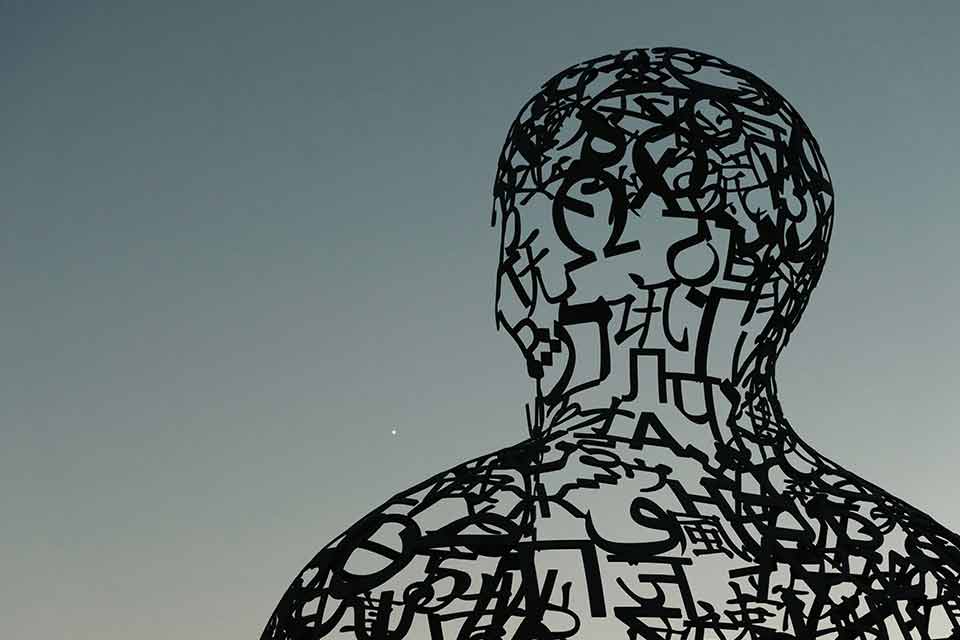
All I have to guide me in this labyrinth is poetry.
I originally joined Red Wheelbarrow Poets, a New Jersey–based group, to help me grow as a poet. But when Russia invaded Ukraine in 2022, I shifted from focusing on my own poetry to translations. Participants in the group extended the scope of our discussions to support me in these efforts. In the workshop, we engage with my translations the same way we go through an English-language poem brought by a participant: one of us reads the text aloud, then we talk about what is successful, what needs polishing. Over the past three years, I’ve brought several of Blizniuk’s poems to these sessions. The participants in the workshop know and appreciate his writing. They ask probing questions about those lines in my translation that “don’t sound like Blizniuk,” and most often these are, indeed, the spots where my translation needs sharpening.
My husband, Bruce Esrig, who edits my English-language texts, also knows well who Dmitry is and is familiar with his poetry. As soon as I see Bruce, I tell him about what is happening. He gives me a stricken look, then offers a hug.
After some time, a new message arrives from Kharkiv. Dmitry writes that the attacks seem to be over for the time being. He has given his mother medicine, and they are going to sleep. He’s grateful for my improvised prayer. It made a difference for him. I feel a rush of gratitude in return, for the fact that Dmitry and his family made it through unharmed, and that, powerless as I was to do something practical to protect them and their neighbors, the words that I sent managed to convey support and concern.
A few hours later, I listen closely as the latest draft of my translation of Dmitry’s poem is being read and discussed by the participants of the workshop. Russian doesn’t have the same set of tenses as English. We consider what verb tenses to use in the lines in which the full moon illuminates the yard of an abandoned, half-destroyed house. I ponder the comments and suggestions. Eventually, I choose what seem to me to be the “right words” based on the associations, sensations, and emotions they contribute to the poem:
the full moon enters the yard in her high heels,
wearing camo paint haphazardly smeared,
an arrow stuck in her rasping chest.
As I read and experience a poem, I feel insistent roots reach out, weaving a web of associations in my mind, stretching from Russian to English. A translation is starting to grow.
The day after the workshop, I send Blizniuk an updated version of my translation. In response, he asks me to transmit his greetings to the Red Wheelbarrow Poets group. Dmitry tells me in his usual wry style that, as an accompaniment to the so-called peace negotiations, the Russian army is likely to continue to “iron out” residential areas of Ukrainian cities, including his own neighborhood, with nightly attacks by shaheds. He quotes the mayor of Kharkiv reporting on the impact of the previous night’s attack: the number of civilian casualties—how many are children, how many are adults, the count of damaged apartment buildings. “Still,” Dmitry continues, “[we] will break through. We are fatalists, realists, optimists, Ukrainians. Незламні, for sure. I’m smiling. Mama carries the tomato seedlings out into the sun every day; in the evenings she brings them back in. The tulips swell into the first flower buds; the apricot tree is starting to bloom; life goes on.”
I open the file with the most recent batch of Blizniuk’s poetry. As I read and experience a poem, I feel insistent roots reach out, weaving a web of associations in my mind, stretching from Russian to English. A translation is starting to grow.
Madison, New Jersey
Author note: Descriptions of and quotations from my correspondence with Dmitry Blizniuk are included here with the author’s permission.
Kharkiv and Odesa were featured in WLT’s July 2022 city issue devoted to Ukraine, guest-edited by Ilya Kaminsky and Katie Farris. The March 2023 issue included a cover feature on “The Russophone Literature of Resistance.”