
Music can reach parts of the soul that have never been touched, leading to new revelations. Here, a classical musician traces the influence of Radiohead and other bands on his own development and how music can be one path to a new place.
Though a classically trained violinist, I have mostly listened to pop music since I was a teenager. In fact, almost exclusively. I was introduced to it at the age of ten or so, when a Michael Jackson–obsessed classmate played “Smooth Criminal” on a boombox as part of a school project. I still remember the impact that song had on me, how fresh and new it sounded to my ears. I became part of a tiny and short-lived Michael Jackson fan club for a year, just me and two friends. We would meet up once a week, listen to songs, eat chips and drink Coke, then go outside to play soccer.
Back then, naturally, what drew me to pop music was the coolness factor. None of my friends at school listened to classical music, so I didn’t either. It was the normal soundtrack to a childhood in the early 1990s. Nothing unusual about it. A few years later, Metallica and similar bands provided the perfect outlet for rebellion. It was music for a certain stage in life, a phase, an attitude. It provided things classical music could not.
When I discovered Radiohead, something changed. I listened to Kid A on a warm summer evening, not knowing what to expect. I had bought the CD on a whim, slightly mystified by the cover art, which showed an abstract but strangely alluring mountain range. I put the CD on, opened the door to the yard, and walked outside to join my family, who gathered there, sitting on a large, wooden four-person swing.
The first notes started to play. “What’s this cat music?” my father asked almost immediately.
As I was listening to the album for the first time and didn’t know anything else by this band yet, I could not say much in its defense. Plus, to be honest, I was flummoxed. It sounded like nothing else I had ever heard. An odd mixture of warm and cold sounds wafted out of my room and rolled over us on the August air. Warm in the sense that it seemed to want to envelop listeners and spin them into a protective cocoon. Cold, because it also sounded inhuman and distant, like the music of an alien life force. This impression gained strength when the singer entered, his voice scrambled beyond all recognition. More than a human bandleader, Thom Yorke sounded like E. T. extending his long, gnarled fingers skyward while mumbling otherworldly grievances.
After that initial blast of strangeness, I quickly cut the listening session short. The music obviously caused the rest of my family discomfort, and I wasn’t yet enamored, either.
But with Radiohead, I kept at it. There was something there, something important. I don’t remember how long it took me to decipher Kid A and fall prey to its weird charms, but I did. The album wormed its way into my consciousness. My favorite song was soon “Idioteque,” which starts with a driving beat and eschews warmth entirely for paranoia and intimations of the obscure mountainous landscape of the cover art, a frozen, crystalline world on another planet. “Ice age coming, ice age coming!” Thom Yorke intones.
Along the way, I also understood that it was music not necessarily best enjoyed in the company of others. This was a new concept for me. Of course, I had listened to music by myself before, but while other music consistently gained in energy and importance when shared, Radiohead seemed to lose something vital.
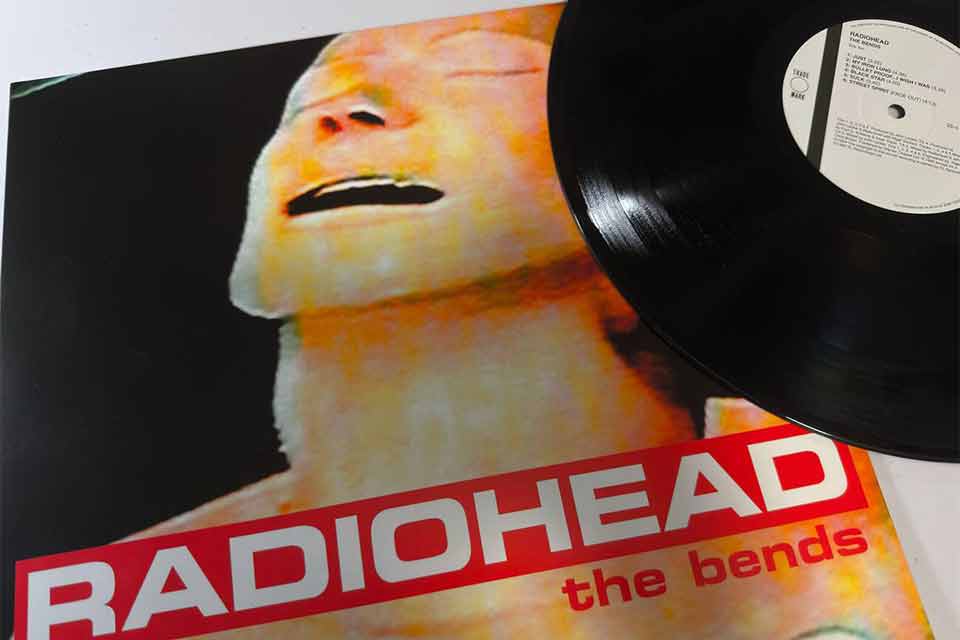
From Kid A, I moved on to an older album, The Bends, where I found only warmth and no icy distance. While listening to songs like “Fake Plastic Trees” and “Bullet Proof . . . I Wish I Was,” I just wanted to curl up on my bed, sink into the mattress, and never get up again.
My memories are even stronger of the 1997 album OK Computer. This was two short days after September 11, 2001. I had just returned from a violin master class my teacher had organized in his home country of Bulgaria. The CD was a birthday gift. Coming back from the airport, I fed it into the player, pressed play, and, for some reason, skipped to track two, “Paranoid Android.” It was like a gut punch. One of the strongest, most visceral reactions I ever had to any piece of music. Here was a hint of the eerie remoteness of Kid A but with more humanity still attached. OK Computer was still very much a product of this world.
What Radiohead taught me to recognize was a split running through all of music, dividing it into two unequal halves: one, the vast majority, was concerned with the everyday world of concrete objects, a companion to objective reality. This was music you could blare in your car with the window rolled down. It could make you enthusiastic, or sad, or wistful. It could get your adrenaline pumping.
It was like a gut punch. One of the strongest, most visceral reactions I ever had to any piece of music.
The other half—the one I discovered through Radiohead—worked differently. It cut through the din and clamor of reality, choosing instead to speak to an inner voice and effect change in an invisible realm. It is important to note that this does not include all music that is simply quiet or melancholy. Most music of that kind is still concrete, the sadness it contains of a here-and-now quality.
By then, I was on the road a lot, driving my car almost every day to university in Essen, where I studied violin performance at the Folkwang School of the Arts, and to various auditions, competitions, and concerts. The trip to Essen took about an hour one-way, and it was here that I did most of my listening. Meantime, graduating from the School of Radiohead led to all kinds of new discoveries, bringing me to the Flaming Lips, Wilco, Beck, Death Cab for Cutie, Sufjan Stevens, Devendra Banhart. Obscure finds abounded: the Fiery Furnaces, the Dismemberment Plan, Neutral Milk Hotel. I went through a Tom Waits phase and a Bob Dylan phase brought on by his magnificent Modern Times album. I scoured underground hip-hop, too, stumbling on Aesop Rock, Cannibal Ox, El-P, MF Doom. I was on the hunt for something, but for what?
At one point, my health forced me to take a breather. I had been burning the candle at both ends for more than a year, leading to deep exhaustion and everything else that comes with it. At the time, my condition was something of a mystery to me. Yes, I had been foolish, but so had others—in fact, everyone else. After all, this was college. Why was I so down in the dumps while others could seemingly shrug off much worse offenses with ease? Why was I being punished for the slightest of transgressions?
More than once, I made half-hearted attempts to get better before jumping right back into old habits, until I was finally forced to a full stop. By then, I could hardly sleep anymore, once even going completely without for a full week. I was starting to hallucinate. Heart palpitations, extreme exhaustion, dizziness. Going into more detail would be beyond the scope of this essay. Suffice it to say that I was feeling my absolute lowest, so low that I realized I had to start from zero again, completely air out my head, and try to get physically fit, if I could. I started slow, getting a gym membership. I went swimming, took long walks, and discovered new bands. Weezer’s Pinkerton became an unlikely ally. The band provided the perfect backdrop with those harsh, grating riffs painting a picture of imminent collapse, and Rivers Cuomo was so brutally, unabashedly honest in his lyrics.
It was painful—cringeworthy, sometimes—but also, in a self-deprecating way, full of humor and resilience. At the start of my quest for better health, I inhabited that album, silly as it sounds. I listened to it every day, driving to the swimming pool. It gave me comfort and instilled in me a desire to fight back, to get better one day at a time. As such, it was music of the first type again. Music of the real, tangible world.
A few weeks later, Arcade Fire released its debut album, Funeral, and it became the soundtrack to digging myself further out of that hole.
Recovery took a while to arrive, but when it did, it was a joyous process, helped in no small measure by my musical treasure hunt. Around that time, Pitchfork published a glowing review of Joanna Newsom’s album Ys (pronounced yeesh), awarding it a 9.4 out of 10, and I bought it on a whim. What an odd, pure, and strangely uplifting piece of music. I had never listened to the harp in a pop music context before. But there was something else at play with that album, and it didn’t take long to surface.
Healthwise, I was already much improved. It was like a rebirth. My head felt clear. I was filled with optimism. I still went swimming and continued to take those long walks over the fields in Pulheim-Geyen, the little village near Cologne where we lived. I always headed out at the same time, so that I would catch the sun going down around five or so in the afternoon as I ventured over the wide-open fields, dry and hardpacked then, as it was winter. In those weeks, the sky took on spectacular colors, a little different every day. I still owned a Walkman then and carried it with me on my walks, playing Newsom’s album, which seemed completely removed from time and place and whose magic was further amplified by those wondrous sunsets.
At first, I was not aware of any change. It was only later that I noticed I was listening to music in a different way, no longer simply letting it wash over me but becoming an active participant. While it played, I made an effort to still my thoughts and direct all concentration inward. This worked best while driving, as the flow of motion and landscape contributed to that strange, alchemical process for which I still lacked a word. As if a child again, I went by intuition alone and let it guide me. Little by little, in that way I was able to sink deeper and deeper into both the music and myself, and I began to feel something reach back out, a fledgling, amorphous being that existed in the world only for a short moment before collapsing again. As time went on, the being could be coaxed to stay for longer and longer durations. This took work and perseverance.
Soon it became my only reason for listening to music, and I learned what artists and albums lent themselves best to the endeavor. I would listen to two albums side by side for a set amount of time, usually for two or three weeks, during which I would try to unearth the full potential inherent in the music and make as much headway in my adventure as it would allow. I keenly felt that I had made the most important discovery of my life and vowed to stick to it until I found out where it would lead me. At the same time, I didn’t breathe a word to anyone else for fear of ridicule. This was a personal journey. Even if I had wanted to share my experience at the time, I would have lacked the words to describe it.
I listened to Nick Drake, Björk, Fleet Foxes, Grizzly Bear, Deerhunter—as well as its side project, Atlas Sound—Fiona Apple’s 2012 album The Idler Wheel, Bon Iver, and Sigur Rós.

During a car ride to Cologne, something gave. It was the week before Christmas. My father was sitting next to me, and we were listening to “Gila,” track three of an album by the dream-pop band Beach House titled Devotion, which I had bought that same day. As always, I had already reached out to that inner voice and was driving under the influence, so to speak, when, without warning, a part of my chest tingled weirdly. At that moment, we were going over the bridge that spans the river Rhine, heading toward the city of Cologne and its massive Gothic cathedral that, from a distance, looks like an alien artifact dropped from above or a giant black tooth buried in the earth.
I was stumped. What was happening to me? My father is a doctor, and I thought about casually mentioning it to him, but then, somehow, I didn’t. The sensation was strong enough to qualify as a potential medical issue, and it was completely unfamiliar, too. I had nothing to compare it to. At the same time, it wasn’t altogether unpleasant. In fact, after the first surprise had worn off, I realized it had to be the result of my constant efforts at reaching some kind of apotheosis through the music, of willing something into being that I knew nothing about, not even if it existed at all. For the longest time, it was nothing but a hunch.
A blizzard of pinpricks raced over the inside of my chest, not exactly the heart region, but the very center of the chest, above the solar plexus.
The sensation no longer scared me. Instead, I felt elated. I had been given a clear advantage. From now on, I would know exactly on what point to concentrate my attention while listening to the music: the center of the pinprick storm.
As if to teach me a lesson, the sensation proved elusive for weeks. Bringing it back took all my willpower, but I knew for certain that it had appeared once and that prolonged, honest effort would cajole it to return. I learned the mechanics better. It seemed at least possible that finding the right combination in the future would depend less on chance than on knowledge and ability. Thus, that became the goal: being able to slip into that mysterious state at will.
Along the way, I gave it a name, too: the secret heart cave.
Over the months and years that followed, I worked hard at reaching it more often and for longer periods of time. Sometimes, it seemed I was drawing nearer, but then there were setbacks, even times when I thought it had all been a mere figment of my imagination. In the end, dedication and devotion were key.
These are some of the quasifacts I collected about the secret heart cave: that it probably does not belong to objective physical reality, like a mini-organ, but instead is superimposed on the chest region; that simply calling it like a djinni is never enough, something has to give the sanction first; to receive that sanction, humbleness is paramount; along with an abolition of thoughts, the whole ego sense has to disappear; a certain breathing technique is of prime importance (in this, exhalation is more important than inhalation; inhalation has to be kept short but never rushed); in the beginning, the secret heart cave reveals itself during exhalation only and disappears again during inhalation; with practice, then, it becomes possible to sustain presence during inhalation, too; the ideal posture is straight-backed, not leaning back, and the eyes should be neither wide open nor closed; it helps to envision a connection between the eyelids, drooping slightly, and that point in the center of the chest, the eyelids acting like a shutter, pushing down on the secret heart cave and activating it; within the chest, imagine a system of chutes, one after another, leading progressively deeper; alternatively, a system of buckets: a bucket is upended, hurling consciousness down into the deep where a second bucket catches it, swings to and fro with its weight, and again upends, throwing consciousness further into the depths.
Although I relied heavily on music to reach the secret heart cave, I knew all along that it was, ultimately, only a gateway, one portal among many others in the world. I had found a personal, individual path. There had to be others.
Although I relied heavily on music to reach the secret heart cave, I knew all along that it was, ultimately, only a gateway, one portal among many others in the world.
It was a source of vexation that for the longest time, I could not do without the music. I was incapable of reaching the same state on my own. There was a chasm—unbridgeable, it seemed—between those blissful moments and what inevitably followed on the heels of even the most profound revelation: the sheer drudgery of the everyday where, despite my discovery, I was still buffeted by the same forces as before, if not more so. What good was knowing about the secret heart cave if it could not be used to transform daily life, too, to inform its many conflicting facets with this newfound light? To end baffled striving and defer in all matters to its guiding force?
This was my tactic: to let the music play until I was firmly rooted in that space, the connection to the secret heart cave strong and my chest ablaze with its wonder, and then abruptly pause the music and keep the divine from slipping away.
Progress will always be incremental, dependent on patience and perseverance—and on faith. In that way, however, it became possible to prolong the sensation for a few seconds, then a bit longer. And in time, to conjure it from thin air, without the music as catalyst and crutch. The most important lesson, however, was this: to never take it for granted, and never to put less than a wide and all-encompassing effort into it.
I was still very young when I stumbled on my secret path, not versed at all in the religious writings of this world. What an immense relief it was when, much later, I found out that what I had experienced was well-documented elsewhere, and not in medical handbooks, either. I began to devour both Western and non-Western scripture and mystical writings, and was simply bowled over by the living presence of these ancient facts, ideas, and archetypes and their ability to take on new forms whenever and wherever to work the same age-old wonder all over again.
I was also suddenly able to find the same access in my work as a classical violinist and concertmaster, applying what pop music had taught me and searching for the secret heart cave while performing Mozart, Beethoven, or Brahms. Now it worked just as well. The most fertile ground, for me, was opera, where you could steer an arc over three hours or more and try to remain fixed in that state throughout, drawing energy from the music and feeding it back into the performance. Richard Wagner’s Tannhäuser became my favorite opera, the half-dozen performances seared in my memory.
And yet, away from work, I still preferred a certain kind of pop music, which I continued to scour for portals. Scott Walker was an enigmatic figure who entered the stage in the 1960s and underwent a similar transformation to Radiohead’s. Indeed, even more so, as his metamorphosis from a member of the sunny Walker Brothers to composer of dark, abstract soundscapes in albums such as Tilt, The Drift, or Bish Bosch is almost incomprehensible. In fact, the only explanation for his latter-day work is that he was guided by his own vision of the secret heart cave, which he followed uncompromisingly with no regard to reception or the vagaries of popular taste.
In the song “Epizootics!” off the 2012 album Bish Bosch, I found the clearest expression yet of the secret heart cave: for the first time at 2:24 and several times thereafter, the sinister, foreboding music is interrupted without warning by sublime brass blasts conjuring images of snow-capped peaks, with Walker’s arty croon entering shortly afterward to soar on dark wings over a crystal world.
To me, it was the sound of the secret heart cave itself, taking flight.
Hilchenbach, Germany
by Mika Seifert
Fiona Apple, The Idler Wheel . . .
Arcade Fire, The Suburbs, WE
Devendra Banhart, Smokey Rolls
Down Thunder Canyon, Flying Wig
Beach House, all albums
Beck, Sea Change
Björk, Vespertine
Bon Iver, all albums
David Bowie, Blackstar
Vashti Bunyan, Lookaftering
Nick Cave, Ghosteen, Wild God
Deerhunter, Halcyon Digest, Fading Frontier,
Why Hasn’t Everything Already Disappeared?
Lana Del Rey, Did You Know That
There’s a Tunnel under Ocean Blvd?
Nick Drake, Bryter Layter
Fever Ray, Self-Titled
The Flaming Lips, American Head
Fleet Foxes, all albums
Godspeed You! Black Emperor, Lift Your Skinny Fists Like Antennas to Heaven
Grizzly Bear, Yellow House, Painted Ruins
Julia Holter, Aviary
Joanna Newsom, Ys, Have One on Me
Angel Olsen, Big Time
Jessica Pratt, Here in the Pitch
Radiohead, Kid A, In Rainbows
Sigur Rós, ( )
The Smile, Wall of Eyes
Sufjan Stevens, Carrie & Lowell, A Beginner’s Mind (with Angelo De Augustine), Javelin
Talk Talk, Spirit of Eden, Laughing Stock
Tame Impala, Currents, The Slow Rush
Scott Walker, Tilt, Bish Bosch, Soused (with Sunn O))))
Weyes Blood, Titanic Rising
The xx, Coexist