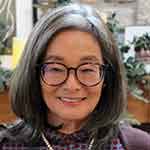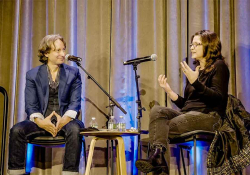

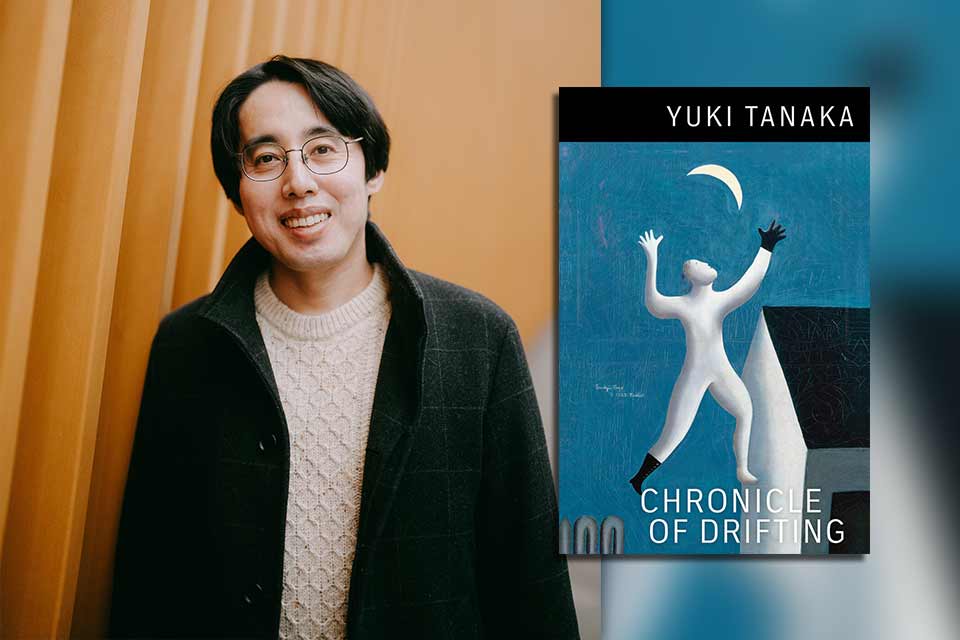
In November 2025 I met poet and translator Yuki Tanaka at his Hosei University office in Tokyo, where he has been teaching poetry and creative writing in the English literature department since 2019. He is the author of Séance in Daylight (Bull City Press, 2018) and Chronicle of Drifting (Copper Canyon, 2025), longlisted for the National Book Critics Circle Award. He also co-translated A Kiss for the Absolute, by Takiguchi Shuzo, with Mary Jo Bang (Princeton University Press, 2024). His poems have appeared in The Nation, New Republic, Paris Review, Poetry, and elsewhere. We talked in Japanese about his poetry journey, the process of translation, writing in a language other than one’s native language, and more.
Miho Kinnas: How did you choose your MFA program? How did an MFA help you?
Yuki Tanaka: I went to the Michener Center for Writers at UT Austin for my MFA, partly because it offered three years instead of two, which was important for someone on a student visa. I also liked their interdisciplinary structure: I got to take not just poetry workshops but fiction workshops, and we were constantly encouraged to branch out into different genres. During my time there, I wrote a lot, but I kept very little from my MFA years, maybe ten pages or less. I tried so many different things and failed at them, and that helped me grow as a writer.
Kinnas: I admire your book Chronicle of Drifting (my book review is published in World Literature Today’s March issue). How did you come to work with Copper Canyon? How was your experience with them or the process?
Tanaka: I submitted my manuscript during their open submission period, and it was picked up by my editor, Ash Wynter. Working with Copper Canyon was a wonderful experience. Their editorial and proofreading processes were extremely meticulous, and the whole team was so encouraging. I imagine it was a risk on their part to publish someone who is not based in the US for promotional reasons. I’m forever grateful for that.
Kinnas: The book is divided into four sections, and the poems differ in content and style from one section to another. The section 1 poems are surrealistic. They made me think of a Japanese writer, Inagaki Taruho, the contemporary of Takiguchi Shuzo. Your poems are fantastical like Taruho stories. For Western readers, it may be helpful to know that Italo Calvino adored Taruho’s work.
Tanaka: I don’t know Inagaki Taruho, but surrealism was a big influence on many of these poems. It mostly came from working on my co-translation project with Mary Jo Bang. When I was a graduate student at Washington University in St. Louis, where she teaches, we started translating Shuzo Takiguchi, who was a prominent surrealist in Japan.
Kinnas: The second section consists of poems written after photographs of young Japanese women who were geisha, exhibited at the St. Louis World’s Fair in 1904. Did you come across the pictures while you studied there? What made you write about these photographs? How do Japan and things Japanese come into your poems?
Tanaka: Yes, I came upon those photographs of women at the St. Louis History Museum. I literally wandered into the museum during a walk through the park. Somehow I felt engaged with the photographs. It felt so eerie to find Japanese people in the heart of America at the beginning of the twentieth century. I wrote two poems while I was in St. Louis and then another after I moved back to Japan. I don’t know why I’m still haunted by these photographs.
Kinnas: Then you have a series of prose poems. I love the feeling of contemporary life in Japan, yet I noticed from these poems that you were a fan of Kawabata Yasunari. Takiguchi Shuzo also wrote many prose poems. What are your thoughts about prose poems, zuihitsu, and haibun as poetic forms?
Tanaka: I’ve never consciously written zuihitsu or haibun. But I do love writing prose poems. Prose helps me expand my vocabulary. For example, I’d never dream of using everyday words like “lettuce” and “oysters” in my lineated poems. Prose relaxes my syntax and removes the pressure of the line ending, where I often feel I need to create a surprising turn. Without that pressure, new rhythms and possibilities emerge.
Kinnas: I understand you don’t write in Japanese. We talked about pronouns. What’s interesting, for example, is that we have so many options to represent “I”—depending on your age, gender, social situations, etc., in Japanese, and we find it, contradictorily, confining. What’s the attraction of writing in English and not in Japanese?
Tanaka: Pronouns in Japanese are tricky. As you said, each choice of a pronoun reveals a lot about your status in society. Maybe that’s part of why I never feel comfortable writing poetry in Japanese: the English “I” makes me feel I can be free and be anyone.
The English “I” makes me feel I can be free and be anyone.
Kinnas: The poems in the final section are more romantic and also remind me of modern poets like Nakahara Chūya, language-wise and thematically. Will you talk about “Aubade”? Who influenced you the most to write poems like these? Any other memorable poets you might have interacted with?
Tanaka: I’ve written about the origin of “Aubade” in an essay for the Poetry Society of America website. But to give you a short version of my answer there, Philip Larkin was a big influence. He wrote a poem called “Aubade,” where his speaker is alone in a room, loveless. It’s his modern variation on the genre of aubade, where you would normally expect a lover speaking to another at dawn when they are about to part. I admire Chūya, who is from my home prefecture and has a beautiful poem about bones, but he wasn’t a direct influence.
Many of the poems in the final section were influenced by W. S. Merwin’s The Lice, a great collection about the Vietnam War and extinction. I was taken by the elegiac mood he creates in the book: the world is coming to an end, and even the speaker seems ghostly. The Lice also showed me how to write lyric poetry without insisting on the ego, by thinning out the speaker and allowing the voices of others, including the living and the dead, animals and inanimate objects, to enter the self.
Kinnas: Lastly, about your brilliant epigraphs. You quoted waka from Manyo-shu (the oldest Japanese poetry anthology, completed in the eighth century), but only the first half of each poem. What role do those fragments play in the book?
Tanaka: A full translation would have felt too complete, but the sense of incompletion, I think, gives the book more forward momentum. These fragments were also a way to create unity in a book that wasn’t a “project book.” Chronicle of Drifting wasn’t written with a single theme in mind; I just wrote one poem at a time over the course of eight years or so. The epigraphs helped create atmospheric coherence and foreground a thematic arc.
Kinnas: You worked for a very long time on translating Takiguchi Shuzo, the most famous Japanese surrealist poet, who was also an artist and art critic. Why him? What was the process of working with Mary Jo Bang? How did translation affect your writing?
Tanaka: In St. Louis, I was starting to write poems in English, and Mary Jo Bang took me under her wing. She taught me so much, and I owe her my life as a poet. She’s an incredible poet, teacher, and translator. I’m grateful to be able to call her a friend as well, after working together on our co-translation project for over ten years and getting to know each other so well.
I first started to translate Takiguchi because I liked his use of imagery. I thought it would translate very well into English. Then Mary Jo and I started to work together. Throughout the translation process, she taught me how to calibrate language in order to control meaning, and how every choice must have a reason behind it. A single word can be translated in many different ways, but whatever choice you make, you need to be able to explain why. That mindset has been invaluable when I revise my own poems.
A single word can be translated in many different ways, but whatever choice you make, you need to be able to explain why.
Kinnas: We agreed that so little of Japanese poetry is translated into English. However, things may have changed in recent years. What are your views of translanguage literature today?
Tanaka: Contemporary Japanese fiction has become so popular in the English-speaking world, and even older writers like Osamu Dazai are being rediscovered. But Japanese poetry still has a very small readership, except for haiku. Amazon has a category called “Haiku & Japanese Poetry,” as if haiku were as big as Japanese poetry as a whole.
As you pointed out, there has been some change in recent years. In 2015 Sawako Nakayasu’s translation of the modernist poet Chika Sagawa was published, which had a huge impact on Sagawa’s reception back in Japan. Mary Jo and I published our translation of Shuzo Takiguchi in 2024, and a collected edition of Chūya Nakahara is coming out from Penguin Classics in 2026 in Jeffrey Angles’s translation. I also know several Japan-based anglophone poets who are translating younger Japanese writers. Hopefully, this trend will continue.
I also know several Japan-based anglophone poets who are translating younger Japanese writers. Hopefully, this trend will continue.
Kinnas: We talked briefly about Bungo Stray Dogs. I learned about the manga series about the great Japanese writers from my niece, who was born in 2000. Through Bungo Stray Dogs, she and I talked about writers such as Nakahara Chūya and Dazai Osamu. In Japan, many young people do not read. You teach students today. How would you characterize college students in Japan?
Tanaka: Recently one of my students told me she writes poetry, and that she became interested in poetry through Chūya, and in Chūya through Bungo Stray Dogs. Other than that, much like in the US, college students here tend to prefer prose, and poetry is marginalized, both in readership and institutionally. Tanka has become popular among young people, as opposed to free-verse poetry, partly because it’s short enough to be shared on social media.
Tanka has become popular among young people, as opposed to free-verse poetry, partly because it’s short enough to be shared on social media.
Kinnas: I would like to ask you about Japanese free-verse poetry today. We recently lost Tanikawa Shuntaro, one of the few poets who earned a living from writing poetry. I was taken to the performance by Yoshimasu Gozo in Yokohama a couple of years ago and have been a fan of Yotsumoto Yasuhiro and Itō Hiromi. Who do you find interesting right now and why, perhaps someone younger?
Tanaka: Among younger poets in Japan, I want to single out Martha Nakamura. She writes surreal poems, often in prose, and uses Japanese folklore in ways that resonate with me. Her work is difficult to translate because of its cultural specificity, but I hope to translate her someday.
Another poet I admire is Shizuka Omori, who writes tanka. I’ve been translating her work over the past two years, and you can find my translations online. I admire the brevity of the tanka form (thirty-one syllables) and the depth of feeling she is somehow able to convey. She’s also quite strange, and to see that quirkiness inside a traditional form that is over a thousand years old feels refreshing.
Kinnas: What are you working on? What will you be doing next?
Tanaka: I’ve just finished a translation manuscript tentatively titled Silver Crow: Selected Poems of Shizuka Omori. I’m also working on a new manuscript that is a narrative-driven, book-length poem about my hometown. There are recurring characters, almost like a novel in verse, but I don’t want to jinx it by revealing too much here!
Editorial note: Read Kinnas’s review of Chronicle of Drifting here.