
Halfway tree. The journey of our life found me
there at midnight in a ramshackle state,
for to tell you the truth my feet had strayed.
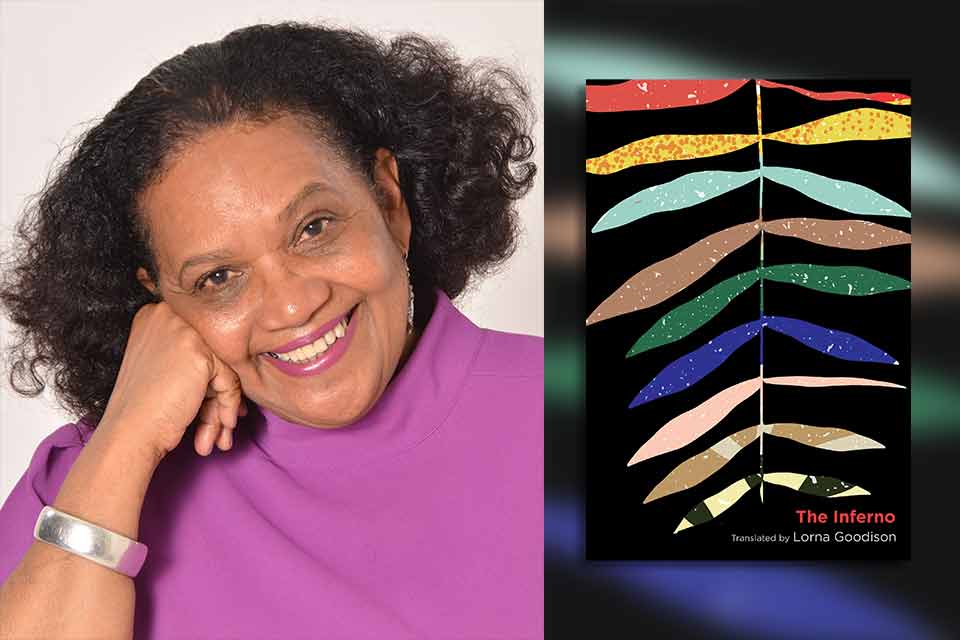
So begins Lorna Goodison’s 2025 translation of Dante’s Inferno—in her own version, in her own Jamaican vernacular, yet following the form and allegorical content of Dante’s 700-year-old masterpiece canto by canto. Reviewers praise the result in superlatives, such as “an entirely new vocal music and power,” “hypnotic narrative,” and “spellbinding translation.” Whether considered a translation, transformation, conversation, or adaptation, Goodison follows in Dante’s own radical footsteps. Just as, in the fourteenth century, he chose not to write in traditional Latin but in a Tuscan vernacular more accessible to ordinary people, Goodison in the twenty-first century chose to write in a hybrid English Jamaican vernacular that she hopes will invite wider appreciation of this work that she believes “has medicine” for all of us, especially during these perilous times.
An iconic figure in her own right, Goodison is a prolific postcolonial poet, memoirist, and essayist born in Kingston, Jamaica. A painter before she became a poet, she was educated at the Jamaica School of Art and the School of Art Students League in New York City. During her illustrious career, she has published fifteen books of poetry and received numerous awards and honors, including the Windham-Campbell Literature Prize and the Queen’s Gold Medal for Poetry. She has held teaching positions at the University of Michigan, where she now has emerita status, and the University of Toronto and was writer-in-residence at the University of the West Indies. Much of her work focuses on the history and culture of the Caribbean with clear-eyed compassion and sensitivity, whether the legacy of colonialism, the physical landscape, or the resilience and creativity of her people.
Goodison’s Inferno (Véhicule Press, 2025) takes place on specific Jamaican terrain: e.g., the Blue Mountains, Bog Walk, the Ugly River. Her hell is replete with figures from Jamaica’s past and present, including Nanny of the Maroons, Bob Marley, Usain Bolt, and Kamau Braithwaite as well as other Caribbean politicians, reggae musicians, and Rastafarian elders. Most notably, her Virgil, Dante’s guide through the underworld, is the legendary Louise Bennett-Coverley (1919–2006) who championed the use of Jamaican patois as an art form in performance and poetry. There’s serious social criticism and moral philosophy here, yet Goodison has fun mocking “politricks” and poking fun at the likes of “Elon the Geek.” The circle of sinners condemned for carnality features “lusty saga boys and queens of concupiscence.” There’s even a bit of gossipy comeuppance when she imagines Theresa May (“T.May”), formerly prime minister of England, boiling in a river of blood for breaking “the hearts of Windrush Citizens,” a sly reference to the wrongful detention or deportation of Caribbean people who had moved to the UK while Jamaica was part of the British Empire.
Dante scholar Elizabeth Coggeshall describes how Goodison pays homage to this canonical text: “As a translator, Goodison has hewn closely to Dante’s original, maintaining its form and structure, architecture, and topography. But as an adaptor, she has revitalized his work in a deliberate remapping of his figures onto new soil.”
Goodison generally eschews analyzing her motivation and agenda for this translation, though she is unreserved about her passion for the work and its author and what they have to offer contemporary audiences. Throughout her reimagined Inferno, she proudly honors her commitment to celebrate and elevate the spoken language of ordinary people and never loses sight of the fact that within Dante’s political and social criticisms, his Inferno is first and foremost a spiritual journey. In a 2022 interview with Pádraig Ó Tuama, she referred to Rastafarians as “Old testament prophet men who would stand on the streets of Kingston and call down destruction on Babylon, meaning empire. They were naming destruction and pointing out what was so terribly wrong. They formed me, and I became very aware that you shouldn’t just accept words that were given to you or language that was demeaning to you.” That deeply profound and universal statement about the connection between language and identity is at the heart of Lorna Goodison’s Inferno.
The following interview was conducted via Zoom and email in March 2026.
Renee Shea: The rave review of your translation in The Walrus is headlined, “Hell Is a Lot of Fun in Lorna Goodison’s Update of Dante’s Inferno.” I can’t resist asking: Was it fun for you spending all that time in hell?
Lorna Goodison: I’m going to say no. I entered into the whole thing unwillingly. But you know what happened—it wrote me as much as I wrote it. I didn’t have much time to think when I was in the midst of it except to keep pushing on through. I felt I was in deep and had to get out. Sometimes I was thinking that this is unbearable. I had such a range of thoughts.
Shea: I’d like to start by talking about your process. Apparently, you began the full translation in 2022 after the Dante Society of America hosted you as the keynote speaker of their symposium. But it sounds as though this idea and actual work on it have been percolating for years—beginning when you saw that Henry Holiday painting of Dante being snubbed by Beatrice as she walks by him without so much as a glance. So, is it two or three years or half a century?
Goodison: Something like that. I tell this story about being in an art history class at St. Hughe’s High School in Kingston when I encountered the Henry Holiday painting of Dante and Beatrice for the first time while I was studying for my A-Level art history exams. When I saw this painting with Dante clutching his heart and looking completely undone, I had a visceral reaction. I don’t know why, but I was terrified. I felt I was going to faint and tried my best to keep away from anything Dante after that. You might say this thing started way earlier. Then in 2000 I was invited by the Southbank Center in London –the 700th anniversary of Dante’s Divine Comedy. They invited nine poets and said choose a canto and rewrite, re-present in a version of your choice. I had just gotten married and moved to Toronto where my husband taught at the University of Toronto. I said I can’t do this, and he said, no, you have to. And he brought home every single translation of The Inferno from the university library. So, I literally spent my first year of marriage in hell! I read version after version, and I kept coming back to Canto 15. The first time I just went into it was glorious. It seemed that I was meant to do it, and it worked. It got a good response, and I thought I was done with it.
I read version after version, and I kept coming back to Canto 15.
Then once a year or so, I’d look at another canto. I had no intention of doing the entire thing, yet somehow I kept getting drawn into the Dante project. Right after Covid, when I was invited to the Dante symposium, I was eager to get back into the world, and they [the sponsors] were very kind and supportive. At the end of it, they kept saying, “You have to do this.” So, I came back to Half Moon Bay in British Columbia where we live, stared at the sea, and decided I had to dive in. I did and kept looking at the sea and working on it for years.
Shea: As soon as I began to read your “translation,” it was in quotes in my mind. I thought—interpretation, transformation, conversation, resistance? Miho Kinnas, a poet and translator, commented to me, “The goal for the translator is to replicate the experience of reading the text, not to produce an equivalent in another language.” Do you think you’ve done that?
Goodison: Maybe, but I really don’t have any thoughts about what the goal of the translation was. I was just doing what I was doing. I had such a feeling that I had come into something valuable that would help me personally and that might help others along the way. I like these people who can tell just what their intentions are—but I’m not like that. I had the good fortune to take a [painting] class with Jacob Lawrence. I am just now realizing how being close to somebody as great as that helped me in that he would say, “Don’t get into these convoluted discussions of your life: just do your work.” That’s what I live by.
Shea: It seems that a turning point of the project was your decision to replace Nobel laureate Derek Walcott as your Virgil with Louise Bennett-Coverley, better known as Miss Lou, a poet and giant of Jamaican culture who championed the use of Jamaican patois. Could you talk about how that shift came about?
Goodison: I sometimes tell my students that your first draft of a poem, or the first stanza, is usually to get you cranked up. I use the analogy of those old cars. My father was a driver, and he had to crank them up to get the car going. Those early drafts are a sort of crank to get you started.
I would have gone through with Derek, who was a dear friend of mine, except for one thing. I went back to the poem I had written and had published—the first stanza where Derek was my Virgil. But one day I just heard in my mind—“Halfway tree. The journey of our life found me / there at midnight in a ramshackle state.” Instead of “Midway in our life’s journey . . .” I heard “Halfway tree” –a specific place in Jamaica. I burst into tears. I knew then that was where the poem was supposed to start. Very logically, if I was going to write a poem that was situated in Halfway tree, I needed a Jamaican guide. Derek was not going to help me at that point. And that is true: there was no way I could be shown through the hell in Jamaica with anybody else but a Jamaican. And who more suitable than Louise Bennett?
Shea: Could you describe what “Halfway tree” is?
Goodison: Half Way Tree is now one of the busiest and most congested urban centers in Jamaica. It was named for a massive silk cotton tree that, up until the 1800s, stood at the halfway point between Kingston and Spanish Town, which was then the capital of the island. This tree provided a resting point for travelers. Today I think of Half Way Tree as nonstop movement, constant buying and selling, people on the move night and day, buses, taxis, multiple shopping centers, the noise, the hustle, the bustle, and the absence of stillness.
Shea: In the [2022] interview with Pádraig Ó Tuama, you remarked, “I liked the idea of the fact I’d be able to consult her [Miss Lou] at every turn.” Was she ever a critical, challenging, or perhaps even a scolding presence during your journey?
Goodison: Not scolding but firm in her own kind of Miss Lou way. She was a wonderful and interesting person. Louise Bennet lived in a centuries-old great house named Enfield, in the village of Gordon Town, St Andrew, which is located in the foothills of Jamaica’s Blue Mountains. She was a close friend of my sister Barbara Gloudon, who also lived in Gordon Town, as did a number of Jamaican artists, writers, actors, and other members of the artistic community. I rented one of several cottages owned by Miss Lou.
It wasn’t difficult in any way for me to reach for Miss Lou’s voice. It was just there. She might come across as somebody sort of jocular, laughing and pleasant, but she could be very firm when it came to matters of justice. She was a fierce defender of ordinary Jamaican people, and she could be really firm when anybody tried to take advantage of her people.
Shea: If I’m not mistaken, you do not read or speak Italian –so were you translating from an English translation of Italian, or perhaps many different ones?
Goodison: I have lots of them, all right here. If you just want to know what’s happening, A. S. Kline is really helpful; it’s prose, so you don’t have the poetry. But for that, I would read many different ones. Sometimes I would read the Italian. I now understand much more Italian than when I started. But reading it for the sounds and the rhythm helped me decide how I was going to proceed.
Shea: Do you worry about readers unfamiliar with the vernacular that you’ve acknowledged is heavily informed by Rastafari? I love the playfulness of “downpression” instead of “oppression,” “boonoonoonoos,” but why did you choose not to offer any glossary or endnotes to explain?
Goodison: Glossary? That’s not my job. I had a wonderful reading last fall at the London Review of Books office, a lovely gathering. Someone came and asked that question, and Michael [Schmidt], my editor [at Carcanet Press], said that’s not our job. We publish poetry; scholars can do the rest.
Anyway, I don’t see why people shouldn’t learn some new words—and they’re lovely words. “Downpression” is a very necessary word right now because when somebody is keeping you down, when you’re under somebody’s heel, they’re not oppressing you; they’re downpressing you, literally. “Boonoonoonoos” is a wonderful word—it means something absolutely lovely, sweet, beautiful, delectable. Some of the translations use the word “delectable,” which is exactly what “boonoonoonoos” is. Instead of being delectable all the time, you could be boonoonoonoos!
“Downpression” is a very necessary word right now because when somebody is keeping you down, when you’re under somebody’s heel, they’re not oppressing you; they’re downpressing you, literally.
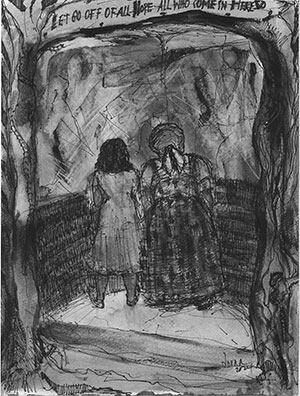
Shea: You’ve talked about the contemporaneity of Dante’s Inferno and how studying it can deepen our understanding of much of the world today. In that context, I’d like to talk about Canto III, which is about those who fail to take a stand. Miss Lou explains: “This wretched state that dem in now, / is what ordain fi all who live out this life and must / live gwaan, and give praise nor blame to no one . . . who tek no side nor stand fi nobody but dem one.” She calls them “nowherians, ” like “that duppy that must be the first man / who refused to sign the Emancipation proclamation.” Today maybe we think of John Lewis’s “good trouble,” and some contemporaries who have taken a stand—Zohran Mamdani, perhaps? But this canto brings into high relief the impact of those who craft their actions not to reflect their principles or values, whatever they may be, but to bow to authority or social norms. Do you think that thoughtful reading of Dante, and your translation, will help us through some “dread times,” as the Rastafarians say?
Goodison: I hope so, it certainly helps me on a personal level. I fully agree with Dante’s scathing opinion of people who do not take a side. If the Jamaican word “Nowherian” gives voice to that condition, I am pleased to have brought it to the attention of the wider world. I have no other way to respond except that this book has medicine. It speaks to every possible human situation. Reading this makes my feelings about people who don’t take a stand clearer. Dante shows you how terrible the consequences can be of something seemingly unimportant. People say I’m just going to mind my own business, but he shows us the terrible consequences that something seemingly unimportant can be. It’s helped me to be a more careful person.
Yet, sometimes I feel great sadness for Dante—that he would have been walking around carrying all of this in his mind. It must have been a terrible thing given to him to do, both terrible and wonderful.
Shea: Given that your translation includes all manner of actual places in Jamaica, historical figures as well as pop culture icons, and in the voice largely of the vernacular, why not write something more like Walcott’s Omeros, which has been described as a loosely inspired by Homer’s Iliad and Odyssey? Or write a different perspective, such as Madeline Miller does in her novel Circe?
Goodison: I’m so in awe of this man’s [Walcott’s] achievement that I think it would have been presumptuous of me to do something like that. That was not my intention. I wanted to present this in a way that my people can understand and will read. I’m not trying to play with the big boys. I found that I had wandered into something in that dark wood. There was so much medicine and healing that I came out of that experience a different person. It’s that book, those words, those experiences that I am interested in. As I’ve said, it wrote me as much as I wrote it.
Shea: Miss Lou speaks in Jamaican patois for sure, but you—the narrator—move between so-called standard English and the vernacular. And even while choosing to write in free verse rather than the terza rima of Dante, you follow the three-part structure of his writing in very close alignment with the verses in the cantos. Yet you have made this what more than one reviewer called “a thrilling new version” of Dante’s Inferno. How did you manage what must have been a struggle?
Goodison: It was a struggle. I want to tell you this. I realized from very early when I worked on Canto 15 that this was something everyone needed to read, to know. As Robert Lee, a poet friend of mine from St. Lucia, said, “Most West Indians would not pick up a copy of Dante’s Inferno, but they might read it if it’s written in a language they can understand.” Maybe that’s what was driving what I was trying to do because I thought if there’s one book in the world everybody needs to read, this is the one. It was a struggle—there’s no doubt. But I was guided by something—I’m not sure where it came from or what it was—but it was this need to put this down, set this down.
I want to tell you that I have lost three siblings in the past four years. I would not have been able to cope with these losses were I not constantly drawing upon the wisdom and hard consolations of The Inferno. I truly mean it when I say this work has medicine.
I was guided by something—I’m not sure where it came from or what it was—but it was this need to put this down, set this down.
Shea: Several reviewers have questioned your response in Canto 28 to the Prophet Mohammed, a canto devoted to those damned for sowing division and schism. In Dante’s view, he is a heretic, whose body is split from front to back (“Mangled and split open,” in John Ciardi’s translation), symbolizing how he divided the Christian faith. From today’s perspective, it seems like Islamophobia. You/the narrator “rebuke the Italian poet, stern as a Rastafarian elder” and accuse Dante of showing “appalling judgment.” Then in a rare moment of doubt, you, the pilgrim-poet, admit, “I am conflicted. Should I continue? / Am I in over my head, is this ambitious overreach?” You had to know your objection (or correction) would be controversial. Why take it on?
Goodison: [shaking her head] If you really knew me, you wouldn’t have asked why I couldn’t let it go. My husband there in the kitchen must be laughing! That’s not what I do. I was just overwhelmed by the violence and the brutality. The business of slaughtering a human being in the way you would an animal is one of the most violent, frightening images in the whole Inferno. I wondered then and now, if the great Italian poet’s treatment of the Prophet’s body has helped to sanction violence toward Black and Brown bodies that continues to this day.
I read all the explanations, but it just became too much. It was hard. At that point, I really was wondering, Why am I doing this, and how could I continue? But I decided I was already in and had to keep going.
Shea: Did Miss Lou help?
Goodison: She did. She was always interested in my writing career. She would ask if I’d had anything published or if I had any readings scheduled. If I said that there was nothing much happening (as was often the case in earlier days), she’d say "Tek wey yu get, so till yu get wey yu want,” which in Jamaican speech means, “Take what (little) you’re getting now until you get what you really want.”
Shea: Several reviewers have commented that your version of The Inferno is not a genuflection to the iconic Dante but rather a dialogue with a kindred spirit, a fellow poet, an ally. In fact, you wrote in the 2025 Carcanet Press article that “It has taken me lo these many years to stop standing outside and viewing Dante, to get up the courage and come in through the tradesperson’s entrance—as my dear friend Philip Sherlock would say—and write Dante.” Does this ring true to you?
Goodison: I don’t want to be presumptuous, but there would be times, because I trained as a painter, I tend to see things first. There would be times when I look at paintings [inspired by The Inferno] and just cry. I cannot imagine what it was like for this man. That great loneliness, as he tried to hold himself together through delivering this work. That’s what I feel. I’m not going to equal up myself as Jamaicans would say. But there’s something in him that causes me to feel great empathy, great love for the man who delivered this work.
There’s something in Dante that causes me to feel great empathy, great love for the man who delivered this work.
Shea: I’m going to jump all the way into the ninth circle for a look at the ending when Dante and Virgil—in your case, you and Miss Lou—journey out of hell and into the next world. I want to know when you knew you had that last line. Ciardi writes, “And we walked out once more beneath the Stars”; you write, “And it is just so we come out once again and see the stars dem.” The last word?
Goodison: I could not stop weeping, just like when Halfway tree came to me. Or maybe I was weeping because, thank god, I’m done. But I knew this is what my people would say: we “see the stars dem.”
translated and read by Lorna Goodison
And as I was beating my retreat to a lower level
before my frightened eyes a big woman appeared,
her voice calm like for a long time she’d been quiet.
And when I see her in that wretched place, I plead,
“Help me do! Pity me, whoever you may be,
living somebody or May Pen Duppy, do help me!”
She: “I did alive one time, but now mi not living.
Me come from good parents. My father was a baker
mi mother was a dressmaker and I born when King
George siddown pon him throne. Me was a little gal
pickney when I wish upon a star fi the gift fi write
poetry that praise mi people inna wi own Jama tongue.
That wish mek me the target of plenty fling stone.
But I never stop defend wi language.
I train at RADA; fi mi stage was the whole world.
But why you going back down to crosses and woe?
why yu don’t go on climb up the higher heights
to Mount Boonoonoonoos, up to the peak of Joy?”
“Are you, Miss Lou, the fountainhead of Inspiration
from whom the Hope River of creativity flows?”
So I ask her—my head in respect-due bowed down.
“O Lady, you are the queen of our people’s hearts,
in the name of my faithful study of your books
my regard for your wit and eloquence, help me please!
You were my model and mentor, and it is from your
example I have crafted this hybrid style for which
people worldwide give me speak . . .
Editorial note: Quotations are from The Inferno, by Dante Alighieri, translated by Lorna Goodison (Véhicule Press, 2025), text and illustrations © 2025 by Lorna Goodison, reprinted by permission of the publisher. Additional quotation from The Inferno, by Dante Alighieri, translated by John Ciardi (Signet Classics, 1954). Elizabeth Coggeshall’s “‘Inna wi own Jama tongue’: Lorna Goodison’s Jamaican Inferno” appears in Dante Studies 143 (2025).