
Oklahoma’s assault on Black history has reached unprecedented levels, with former State Superintendent Ryan Walters implementing aggressive book-removal policies and House Bill 1775 restricting classroom discussions about race, leading to the removal of works by celebrated Black authors like Toni Morrison and Maya Angelou from school libraries. In this hostile environment, a Norman teacher lost her teaching certificate for providing students with information about accessing banned books, and districts have faced accreditation threats for keeping award-winning novels in their libraries.
Amid this climate, two remarkable women are leading grassroots movements to heal their communities from the ground up. Kristi Williams, who is related to one of the 1921 Tulsa Race Massacre survivors, created Black History Saturdays to ensure that families can access the education being systematically stripped from schools. Celeste Lebak founded the Restorative Justice Institute of Oklahoma to transform how communities address harm and trauma.
Both women understand that lasting change requires community-controlled solutions that center the voices of those most impacted by injustice. By creating intergenerational spaces for learning, truth-telling, and healing, they have directly challenged Oklahoma’s increasingly punitive culture. Together, their work shows how education and restorative justice can address historical trauma while building a more equitable future.
Karlos Hill: You are related to a survivor of the Tulsa Race Massacre, and you are also a descendant of the Creek Freedmen. Could you talk about your personal journey as a result of this unique family history and how it shaped your calling to create Black History Saturdays?
Kristi Williams: My parents both understood the importance of family history, so it’s always been important to me, too. I grew up in Philadelphia, but my mom’s family lived here in Tulsa, so when we’d come to visit, we would stay at my great-aunt Janie’s house. Aunt Janie was a survivor of the 1921 Tulsa Race Massacre, but she never called it a massacre. She never called it a riot. She referred to it as “that time when white folks were killing black folks in Tulsa.” We dismissed everything she was saying when we were young, but one day my sister came home from high school and said, “Remember how Aunt Janie used to talk about white folks killing black folks in Tulsa? Well, it really did happen.” Another day we were watching TV, and there were survivors of the massacre on the news who were telling the story. That made me want to learn more about it.
And since we had ancestors who were original Creek Freedmen, I heard those stories, too. Most Black families talk about having Indian blood, but I knew for a fact that we did. My great-great-grandfather came on the Trail of Tears and was a slave to the Creek Nation, and then in 1874 he was appointed as a justice on the Creek Nation Supreme Court. One of my cousins is a genealogist who has traced our family history, and she’s shared a lot of information with us at our reunions.
So the history of my own family certainly shaped me, but so did a Black history class that I took in eleventh grade at Memorial High School here in Tulsa. It was the first time I learned about our people being descended from African kings and queens—that our history didn’t begin with slavery. Memorial was predominantly white, so I don’t know how those lessons shaped my white classmates’ idea of who they are in this world today, but when I left that class, it mattered to me how I held my head and how I walked into a room. It really had an impact on me.
When I left that class at Memorial, it mattered to me how I held my head and how I walked into a room.
Hill: It seems natural, then, that you would have such a strong interest in Black history more generally and want to share it with others. And in the current atmosphere, which has made it so difficult to talk about topics like racism and oppression, you’ve been able to do that effectively through Black History Saturdays. How did the passage of House Bill 1775 in 2021, with its restrictions on how race and gender can be taught in Oklahoma schools, influence your decision to create this innovative program?
Williams: I had been wanting to do something for a very long time. But it wasn’t until House Bill 1775 passed and I got so angry that I knew I had to make it a reality. I didn’t know how I was going to do it, but I knew that I was going to do it. I was literally lying in bed one night when it hit me that we needed to have an actual school. I called my dad and told him what I wanted to do, and he said that I should make it available to everyone from preschool age all the way to adults. He helped me plan it out, and that’s how it all began. Once we were able to find some educators who were willing to get involved, it took off from there. I still have more adults than I have kids, but I started out with 120 participants and I’m now up to 385, ranging in age from four to ninety-two.
Hill: When did you officially launch the program?
Williams: I launched it in 2023—in February, of course, because February is Black History Month. But I didn’t want it to end there, so the program runs for ten months out of the year. We take December and January off because of the holidays, but we use that time for professional development and planning for the next year.
Hill: Black History Saturdays operates just like a school. It goes for a full day, and you even provide breakfast and lunch. Can you describe the curriculum and explain how you designed it so that you’re able to accommodate such a wide range of ages?
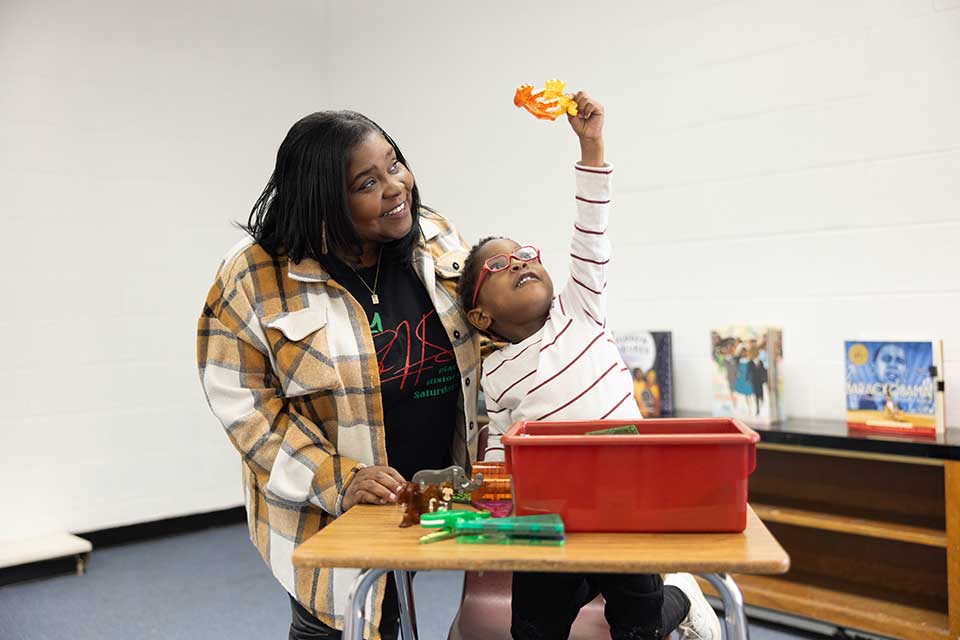
Williams: We start the day with breakfast at 8:45, and then class starts at 9:15. Right after breakfast, before we head to class, we have an African pledge and then sing “Lift Every Voice and Sing.” We break at 12:30 for lunch, which is prepared onsite by a chef, who uses these meals to teach his own history lesson. He might make a Nigerian dish like jollof rice, or curry chicken, or shrimp and grits, but whatever it is, he explains what he’s made, where it originated from, and why it’s important. So he’s expanding both palates and minds. Then we’re back in class until 2:45. At that time we all meet back in the cafeteria, where two people from each class are chosen to share what they’ve learned that day. That communal storytelling is its own kind of learning experience.
When a four-year-old and a ninety-two-year-old are learning the piano together, it’s a beautiful thing to see.
The curriculum for all the grades starts in the past and then moves to the present and on into the future. So we’ll spend three months learning about Africa, then three months learning about current history, and then the last three months, in what I call the future, involves more critical thinking and more action-based things for them to do. But of course the students of different ages are going to be learning on different levels. My original idea was, How can everyone actively learn together despite their age differences? With the way we do things, each person is going to have something different to say about what they learned on a particular day, but at the end of that day, everybody will have learned something. This year I added music as an elective subject, so we now offer the opportunity to take piano lessons. When a four-year-old and a ninety-two-year-old are learning the piano together, it’s a beautiful thing to see. Even when it comes to trying new foods, they’re having that experience together.
Hill: Black History Saturdays is focused on learning from each other about our history—not just Oklahoma history, but our collective history as a people. It’s about instilling pride not just in who we are right now but also in who we have been over the course of seven million years of Black history. How do you teach these things in a way that makes it impactful even for the younger children?
Williams: I don’t personally have a teaching certificate, but that’s why I made sure to have trained educators involved. When the little ones are learning about the African kingdoms—the culture, the clothes, the hair, the different complexions of different tribes—they’re seeing people who look like them, and that gets them so excited. They like learning about the joy, the resistance, the resilience, all those things that have shaped us as a people. And in the process they’re learning to take pride in themselves. And while these kids are learning about their history, they’re also learning about the importance of helping each other. They have roles and responsibilities in the school, things like making sure the adults have paper and pens in their classroom. By taking on that kind of accountability and interacting with people of different ages, these kids are learning a valuable lesson about community.
Hill: How do you envision the future of Black History Saturdays outside of Tulsa? Do you want to do similar work in other communities—maybe in Florida, North Carolina, Texas, or Arkansas, where there’s been a similar response on the state level to the teaching of Black history? With other states now banning books and making it hard to have conversations in the public schools about critical race theory or diversity, equity, and inclusion, do you see Black History Saturdays as the start of a national movement?
Williams: I do see it as a movement. It’s definitely not just a program anymore. I now offer my services as a consultant to people who want to create their own space for teaching Black history. I realize that it’s going to look different for everyone, and not everyone will want to do it on such a grand scale. But how do people who just want to start something small at their church or community center get started? I’ve been able to provide a blueprint of sorts for how they can get something going and how they can start their own banned-book library.
I do see it as a movement. It’s definitely not just a program anymore.
I want to do more of that, because the goal is to teach people how to do this in their own communities. And the more I go out and speak about it, the more it inspires people to act. I want to inspire people to get angry, though, too, because sometimes that’s what it takes to spark action and get people engaged. It was my anger about House Bill 1775 that set Black History Saturdays in motion.
Hill: This is a timely and necessary mission, and I can see it spreading well beyond Tulsa, well beyond Oklahoma. It’s particularly important for reaching young people, who are able to walk so much more confidently when they know who they are and where they came from. That self-confidence then spills over into how they understand one another, how they relate to one another and the world around them, and ultimately how willing they are to serve their own communities. Black History Saturdays has the potential to accomplish something so much bigger than you ever could have imagined when the idea first came to you. I am excited to see where it goes from here.
Editorial note: As part of the University of Oklahoma’s yearlong commemorations of the Tulsa Race Massacre centennial in 2020–2021, WLT’s spring 2021 “Redreaming Dreamland” issue featured work by Jewell Parker Rhodes, Patricia Smith, Tracy K. Smith, Joy Harjo, Quraysh Ali Lansana, and sixteen other writers and artists, including OU professors Rilla Askew, Kalenda Eaton, and Karlos K. Hill. Dr. Hill’s “Bearing Witness” column has been appearing in WLT since 2022.