

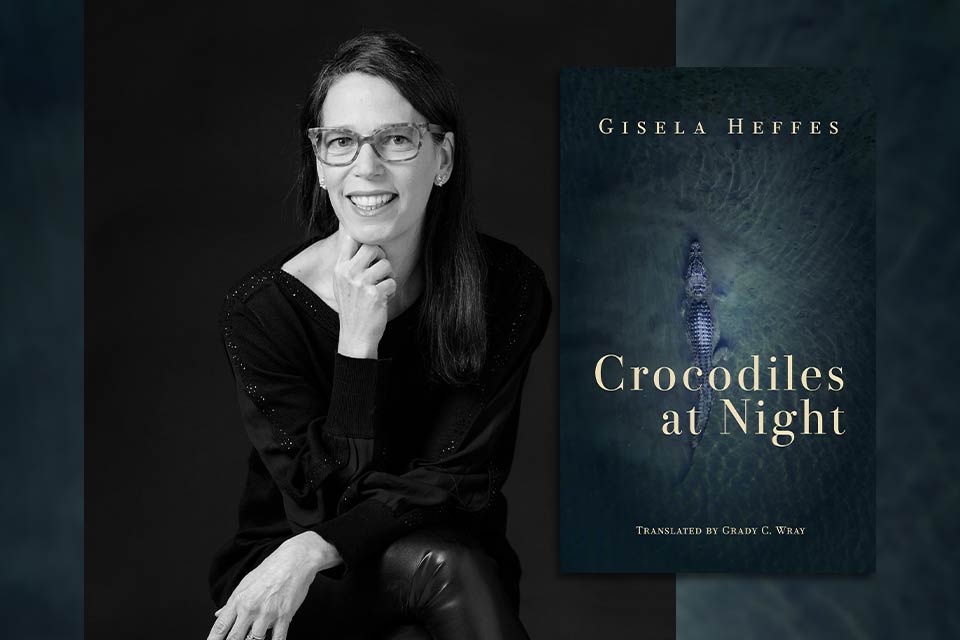
In Gisela Heffes’s books, multiple presences and absences move between the politics of destruction and preservation that intersect in our world, in the face of the emergence of ecological awareness in the fields of art or literature. Drawing on valuable translations such as those of Grady C. Wray, her writing invokes Giorgio Agamben’s categories; she explores the displacements in the interaction among the human, the nonhuman, and the inhuman, combining narrative and the visual and relating to various contemporary spaces.
Claudia Cavallin: Let us start with Crocodiles at Night (Deep Vellum, 2025; see WLT, Nov. 2025, 77) and Cocodrilos en la noche (Tusquets, 2023), under the mobility of translation. An expression of Vera’s is “La pifiaste, nena,” which literally means “You got it wrong this time, babe,” as is usually done, from the Argentine nature of the term pifiar to the shared modernity of a global vocabulary. How does the identity of your writing translate into English? Is it also a game on this side, on the other side, which does not stop as a migrant writer usually does?
Gisela Heffes: Absolutely. One of the axes that runs through the novel is precisely that shattered ethos which defines and characterizes the protagonist, and whose unmistakable image—to evoke a comparison—would be that of splinters expanding in space like flashes from a splintered mirror. In these journeys, what stands out is a condition of tearing and uprooting. For this reason, “La pifiaste, nena” refers not only to porteño slang but also to the language of the suburbs and serves as an anchor for exploring those vestiges of the local that, with exile, were gradually dissipated. As a side note, this encrypted jargon appears notoriously in my first novel, Ischia, whose English translation, also done by Grady C. Wray for Deep Vellum (2023), was a challenge and a fabulous job on his part.
However, as you rightly say, in the game between the other side and the other side, not only is that fragmentarily expressed but rather, or above all, the impossibility of translation. It is in this ambivalent tension that language is inscribed but also the bodies that circulate and slide between two spatial entities which obey, in turn, distinctive perceptions. In the articulation between the side here and the side there, I wanted to raise, through the formal structure, the question of what is here and what is there. Because, in addition to uprooting and its consequent tearing, this duality of inhabiting different territories is a bodily mark that delimits positions and perspectives. The migrant writer must assume this double duality: first, that writing is an experience of displacement and dislocation. Moreover, second, that the distance inherent in every game implies an extrinsic positioning and perspective. Sometimes contingent, sometimes not, but, without a doubt, a hybrid identity that does not accommodate either the there or the here.
Cavallin: Wray’s translation, which is both thought-provoking and unsettling, is of two chapters from Crocodiles at Night titled “There” and “Here.” Inside them, you can find phrases like “Día sin número” (day no number). Those unnumbered days are like a space in Plato’s Parmenides, where the philosophy of time hangs between being and becoming. When we are intimate with our experiences, in the face of death, in the face of the loss of the father, is there a possibility of reconstructing what we were before and who we will be when we can solidify our existence again?
I believe that the power to replace what we were and to venture who we will be resides, precisely, in language.
Heffes: Speaking of translations, this approach is particularly interesting because the tension of being is not expressed in the same way in other languages. The fact that French or English do not offer this possibility (limiting themselves to être and to be) leads me to think, once again, of translation as an unfinished project, and of its impossibility. However, I believe that the power to replace what we were and to venture who we will be resides, precisely, in language. It is language that allows us to cling to that past instance and project ourselves materially toward a beyond. I am thinking of Clarice Lispector and the work on language as visceral substance, or of Benjamin, Wittgenstein, and Derrida, for whom language abandons the notion of representation to become matter, detritus, or inscription.
In the philosophical framework you mention, that play on words gives existence texture and density. On the other hand, the loss of a parent exerts, as an experience, a violence of temporal perception that is articulated around grief and, at the same time, destabilizes. It is a circumstance that disrupts and displaces what is assumed to be permanent. It is as if finitude were imposed to undermine the illusion of immortality. Undoubtedly, nothing is fixed or invariable, and language, in a Deleuzian machinic key, corresponds to dynamic and decentralized processes. In this sense, the word, in its agency, offers an ambivalent promise, in which the creative bet can be regenerative.
Cavallin: In Visualizing Loss in Latin America: Biopolitics, Waste, and the Urban Environment (2023), your dedication includes your family, Josefina Ludmer, Sergio Chejfec, and Sylvia Molloy. You begin with your photography, which blurs the gaze, and then guide us through the fluidity of (eco)critical perspectives across different eras. Another photograph by Chris Jordan seems to highlight that we are the cause of our losses. How should we stop losing and rebuild our urban ecosystem?
Heffes: In the dedication, I evoke presences that became absences. What ecological consciousness, in a way, tries to activate is an awareness of absence. What is done with what is no longer there, with those who ceased to exist, or with what will be extinguished? There are significant nuances and divergences, but the extractive processes that cause progressive ecological devastation ingest, with insatiable voracity, human and nonhuman forms and materials. For me, ecological awareness must attend to this dynamic between presence and absence, to what is destroyed to build, and to what is eliminated for others to exist. When you say “stop losing”—instead of, for example, “stop winning”—the accent is precisely on lack. Because, and I agree with that emphatic gesture, it is the omission (what is not seen, not said, not heard) toward which we must direct our reflections.
What ecological consciousness, in a way, tries to activate is an awareness of absence.
Returning to the presences and absences of the dedication means mobilizing the memory of what is no longer there. It is to encourage an apprehension of nonexistence and to understand that in this effort, not only the memory of those who left is redeemed, but also presences are restored where apparently there was nothing, where a presumed void lived.
Cavallin: You also mention the possibility of relocating beyond the ecosystem, through eco-art and the values of use in environmental restoration. From recycling, where is the paradigm of who we are and what we constantly reproduce headed? How do we represent nature in literature, extending this notion to concepts such as borders, animals, cities, specific geographical regions, Indigenous peoples, technology, or waste?
Heffes: The concept of “recycling” seemed fundamental to me when I began working on ecocriticism and analyzing the modalities inherent in the very idea of recycling. Drawing on Agamben’s concept of nuda vita, I tried to demonstrate that the ecological crisis is a crisis of humanity and that, from the perspective of Latin American aesthetic figurations, the notion of disposability, or more precisely obsolescence, encompasses not only objects but also human and nonhuman living organisms. For this reason, Visualizing Loss in Latin America is an invitation to analyze these literary and artistic expressions through a “bioecocritical” reading, insisting that an ecocritical paradigm is not pertinent to critical intervention in our field of study.
On the other hand, recycling does not merely contemplate waste but also invites us to examine how we live with that which refuses to disappear. In this sense, nature ceases to be mere representation and externality. It becomes a materiality that, in its capacity to articulate collective projects and polyphonic alliances, traces continuities, erects community, and welcomes those absences that, it is presumed, are irreparable.
Recycling does not merely contemplate waste but also invites us to examine how we live with that which refuses to disappear.
Cavallin: In Homo Sacer, Agamben takes up the “Declaration of the Rights of Man and of the Citizen.” Do you think a spatial distribution that correlates with social, economic, and legal status creates a distinction between valuable and residual subjects?
Heffes: I daresay that the spatial distribution corresponds almost symmetrically to the social, economic, and legal status of the subjects, following an order and classification of value that organizes humanity into residual or precious subjectivities, a distinction clearly demarcated in the Latin American aesthetics I analyze. However, it is important to underline that this disposition and this principle of human organization—this Foucauldian biopolitics—are not exclusive to Latin America and manifest in spaces beyond the “third world.” It is a growing precariousness that, here in the United States, is evidenced in the brutal treatment of minorities of color and immigrants. This systemic discrimination could be stopped if there were an interest in doing so, but precisely the opposite is on the horizon.
Cavallin: In your book, you quote Gabriela Cabezón Cámara: “There are more and more marginal neighborhoods in Buenos Aires,” to emphasize the social and ecological crisis that coincides with the oppression of women. Do you think that reclaiming the historical spaces of domination in urban reality can be balanced with the fictional presence of the historical reasons that founded them?
Heffes: Historically, the domination and oppression of women were accompanied by the domination and oppression of nature. Ecofeminism is the strand within ecocriticism that questions not anthropocentric logic but androcentric logic. Taking up, as Cabezón Cámara does, different elements of the Argentine literary tradition, such as the gaucho genre or the urban marginality of the slums, is a way to reimagine those traditional spaces of subjection that were denied to writing produced by women. This maneuver of scriptural reappropriation is also in tune with the natural world, cementing affinities that alter the dominant hierarchies which dictated the axes of contact, bond, and inventiveness.
However, more than a necessary feminist writing style, I would like to suggest that there is a powerful production of women who write from different enunciative positions. Moreover, they renounce, in some cases, the very idea of individual enunciation to experiment with interventions in which a multiplicity of voices converges. It is a brave and original writing, which I celebrate more for its uniqueness than as a phenomenon (to which it is repeatedly appealed to in the present). To speak of a phenomenon risks simplifying and reducing the specific style that composes it and, ultimately, silencing it.
Cavallin: In El cero móvil de su boca • The Mobile Zero of Its Mouth (2020), translated by Grady C. Wray, the reflection of your words in Spanish stands out above the other voices. I want to emphasize the idealism of one of them: extinction. In “Extinctions,” a place opens where children inhabit different worlds; in “Other Extinctions,” memory clings to the absences in your father’s memories; in “Extinctions II,” we feel we now inhabit a world of mountain ranges and forests swallowed by human voracity. Absences, presences, water, domesticities, invasive species, repetitions, refuges, and transience are other forms of existence found there. Given these multiple natural twists, how does poetry help us in a world where we are already an endangered species?
Heffes: Poetry offers the freedom to break discursive linearity, to turn form into content, and, in this way, to situate itself along alternative trajectories. In addition to this astonishing capacity to destabilize narrative linearity, poetic language—with its ellipses, allegorical references, and strategies that interrupt the syntactic flow in normative terms—is generative, insofar as it can create chaos and confusion, stop or divert the flow of grammar, and operate from dissidence, understanding grammar as a canonical and hegemonic system. In this sense, it is possible to conceive poetry as an art of disruption. I say poetry, although all experimental writing shares that potential for detour and reconfiguration of the reading experience.
In addition, and connecting poetry with the exploitation of nature, there is currently a growing simplification, not only of the natural world or of the imagination (and the imaginary), but also of artificial intelligence, of reflection, of reading, and, above all, of creativity. There is a growing risk of reduction. If technology is predictable, lyrical and poetic language breaks with that predictability, hindering the routines of meaning-making that dominate the discursive structures and systems in which we move daily. Poetry can misplace and get lost, evading an overdetermined juncture in the sentence, the stanza, or, in broader terms, the narrative, which, in a certain way, obeys predictable forms and expectations imposed by a technology of social control.
In a broader sense, however, literary language invites us to reflect and feel what the characters experience. The sensitivity, which is the aesthetic experience, allows us to enter into others’ feelings and sensory perceptions. Moreover, this form of exhibition makes it possible to “translate” abstract data into specific sensory impressions and, ultimately, to provoke reflection on our condition as one more species within the vast arc of extinctions.
Cavallin: I close this interview with anarchist, socialist, amodern, isolated cities that have changed throughout our history. The identity utopia remains in conflict-ridden situations in migration, where it has been possible to destroy and reconstruct a memory of the city within the bodies of those who move. Beyond “The City of Nation-States,” how do you think imaginary cities are restructured in Latin American literature today?
Heffes: One of the forms of reconfiguration—and restructuring—of these cities is evident, above all, in the presence of dehumanized bodies that move between different territories or remain immobilized. Current Latin American literature underscores this condition of fragmentarity, inequity, and precariousness. It is no longer about urban or rural spaces; on the contrary, there is a continuum that intensifies this dilemma and reveals a drive in which other contrasts fluctuate. Returning to the idea of presence/absence, of consumption/waste, what we see now is an impetus to record the abandoned vestiges in those natural spaces that, in the ravages of exploitation, have become phantasmagoric.
However, these ecological devastations, deforestation, pollution, and forced migrations serve to feed the demand of urban centers and enter into dialogue with Jason W. Moore’s notion of metabolism. It is a perspective that reframes the premises of recycling and diverts attention from isolated practices to the systemic relationships between energy, work, nature, and value. What Moore proposes is a way to understand how the processes of life creation are organized, exhausted, and cheapened on a planetary scale. Moreover, one of the most interesting aspects of this translation of the gaze in current literature is the problematization of an invariable demand that makes the hecatomb of modernity possible.
Translation from the Spanish
Gisela Heffes is a writer, essayist, and professor of Latin American literature and culture at Johns Hopkins University. In addition to her pioneering contributions to ecocriticism and the environmental humanities, she has written on waste politics, imaginary cities, urban utopias, migration, motherhood, and Judeo-Argentine literature. Her most recent publications include the co-edited volumes The Latin American Ecocultural Reader (2020), Pushing Past the Human in Latin American Cinema (2021), Un gabinete para el futuro (2022), and Turbar la quietud (2023); the monograph Visualizing Loss in Latin America: Biopolitics, Waste, and the Urban Environment (2023); Grady C. Wray’s translations of Ischia (2023) and Crocodiles at Night (2025); and Aquí no hubo ni una estrella (2023).